

IV Gincana Cultura e Esportiva do Colégio Santa Luzia – 100 anos de Quantum

A IV Gincana Cultural e Esportiva se propõe a ser um projeto transformador, adaptado aos princípios da responsabilidade social, da filantropia e da interação, atendendo aos requisitos da BNCC. Este projeto visa proporcionar momentos repletos de atividades que incentivem o aprendizado, a criatividade e a integração entre os alunos, destacando a importância do papel de cada estudante na sociedade.
As atividades propostas irão: Ampliar conhecimento científico; promover a responsabilidade social: através de ações de solidariedade Fomentar a filantropia, incentivando os alunos a praticar a compaixão e a generosidade. Estimular a interação: A gincana proporcionará momentos de integração entre os alunos de diferentes séries e segmentos, fortalecendo os laços de amizade. Sendo um importante projeto para o desenvolvimento das competências gerais da BNCC – Base Nacional Comum Curricular para o Ensino Fundamental Anos Finais e Ensino Médio a saber: conhecer e explorar diferentes práticas de linguagem; utilizar diferentes linguagens, mídias e ferramentas digitais em processos de produção coletiva; compreender as linguagens como construções históricas, sociais, científicas, culturais e humanas; utilizar linguagens diferentes, como verbal, corporal, visual, sonora e digital. Portanto, a gincana será muito mais do que uma atividade recreativa, será uma experiência de aprendizado significativa, que contribua para a formação integral dos estudantes, preparando-os para serem cidadãos mais conscientes, responsáveis e engajados na construção de uma sociedade mais justa e equitativa.

A UNESCO celebra 2025 como o Ano Internacional da Ciência e das Tecnologias Quânticas. E esse será o tema da nossa gincana. A escolha do tema “A UNESCO celebra 2025 como o Ano Internacional da Ciência e das Tecnologias Quânticas” se justifica pela relevância atual dessas áreas no avanço da ciência e da tecnologia. Este tema permitirá que os alunos se familiarizem com conceitos e inovações que podem moldar o futuro, como computação quântica, criptografia quântica e novos materiais. Além disso, o estímulo ao interesse científico com a inclusão desse tema na gincana pode despertar a curiosidade e o interesse dos alunos pela ciência, incentivando a busca por conhecimento em um campo que está em expansão e que possui um grande potencial para transformar diversas indústrias. As tecnologias quânticas interagem com várias disciplinas, como física, matemática, informática e engenharia. Isso permite que os alunos integrem conhecimentos de diferentes áreas e desenvolvam uma visão mais holística sobre como a ciência pode ser aplicada em diversas situações. Trabalhar com temas complexos como a ciência quântica estimula o desenvolvimento de habilidades do pensamento crítico e criatividade.

Os alunos precisarão encontrar formas de entender e apresentar essas ideias de maneira acessível e interessante, promovendo um aprendizado ativo. Celebrar um ano internacional dedicado a um tema científico ajuda a promover valores como colaboração e um compromisso global com a ciência para o bem comum, alinhando-se com a missão da UNESCO de fomentar a paz e a segurança por meio da educação, ciência e cultura. A gincana pode ser uma excelente oportunidade para os alunos trabalharem em equipe, desenvolvendo projetos e atividades baseados nas tecnologias quânticas, o que promove habilidades de colaboração e trabalho em equipe. Discutir as ciências quânticas também permite uma reflexão sobre o futuro das carreiras científicas, inspirando os alunos a considerar seguir caminhos na pesquisa e desenvolvimento neste campo promissor. Ao adotar o tema do Ano Internacional da Ciência e das Tecnologias Quânticas, a gincana do Colégio Santa Luzia não só se torna uma plataforma de diversão e cooperação, mas também um espaço de aprendizado e reflexão sobre o papel da ciência na sociedade moderna.
CineGlobe 2025

📅 From May 14 to 18, 2025, CineGlobe returns to CERN’s Science Gateway and the Globe of Science and Innovation. Free and open to all, the festival offers an immersive experience blending cinema, science, and new technologies.

✨ 2025 Theme: INTERWOVEN
Inspired by quantum entanglement and film editing, this edition explores deep connections between storytelling and reality. In partnership with Virtual Switzerland, CineGlobe presents a unique immersive zone featuring Swiss and international VR experiences.

🎥 Workshops & Special Events

🔹 La Fabrique des Images: Hands-on animation and filmmaking workshops, from film scratches to a mini Méliès studio.
🔹 Exclusive Experience: Discover the Pin Screen, a rare animated engraving technique revisited by artist Alexandre Noyer.
🔹 Special Screening & Panel: The Thinking Game, a documentary on Demis Hassabis and DeepMind, followed by a roundtable on biotech and generative medicine.
🔹 CineGlobe x Nuit des Musées: May 17th – Live Cinema Night, where musicians will improvise soundtracks to classic tales and legends on screen.

📍 Location: CERN Science Gateway & Globe of Science and Innovation
🎟️ Free event
🔗 More details coming soon on our new website in mid-April!

Since 2007, CineGlobe has fostered dialogue between science and cinema, creating new narratives and unexpected artistic collisions. Join us for a festival where creativity, technology, and storytelling come together to inspire and reshape our collective imagination.

II International Congress of STEAM Educational Experiences

The International Conference of STEAM Educational Experiences aims to be a forum for all education professionals of all educational stages, people and institutions interested in education, and people who have started their teaching or educational research careers. It aims to be a meeting point for the exchange of experiences and reflections and the creation of synergies between professionals and institutions. There will be many presentations and workshops, both in-person and online. There will be dedicated spaces for: – Educational programming and robotics. – Climate Change. – Citizen Science. – Augmented Reality, cultural heritage, and STEAM. – Quantum Science and Technology (QST) in Education.

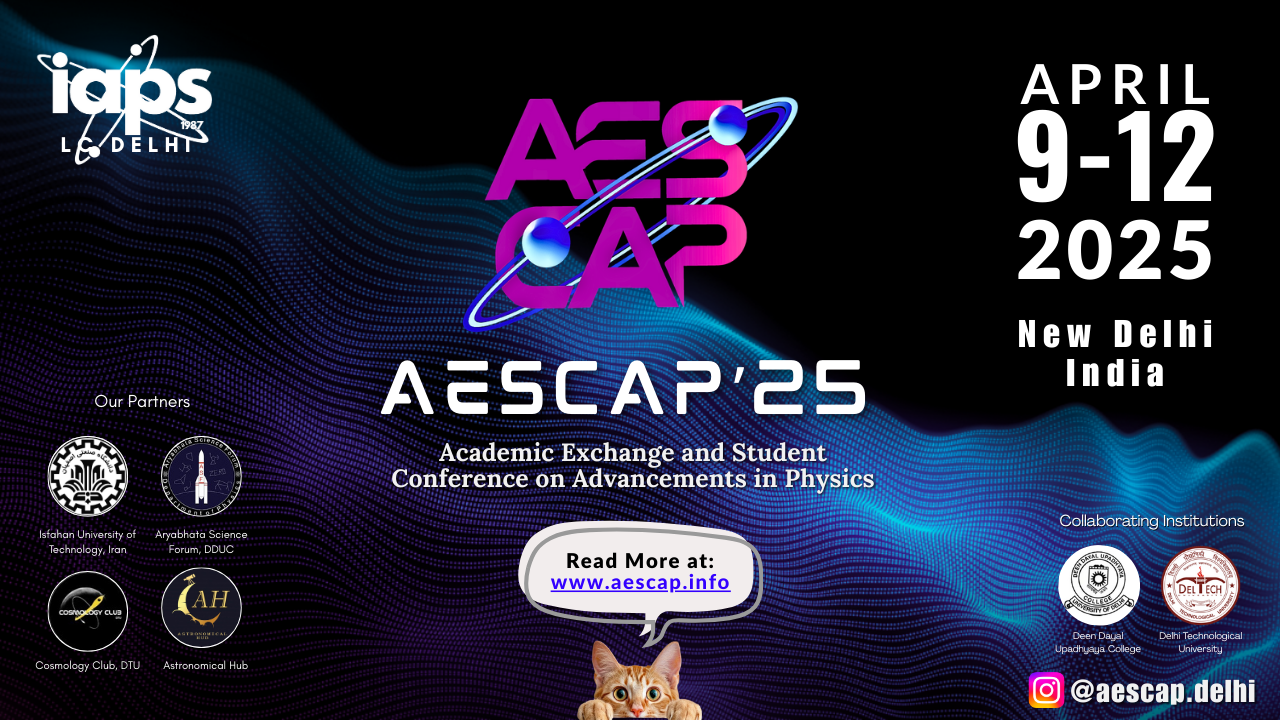
Academic Exchange and Student Conference on Advancements in Physics (AESCAP)

The student organization LC Delhi, representing the Member Committee India under the International Association of Physics Students (IAPS), is proudly presenting the Academic Exchange and Student Conference on Advancements in Physics (AESCAP). This four-day event will take place from April 9th to 12th, 2025, in Delhi. Hosted by Delhi Technological University and Deen Dayal Upadhyaya College (University of Delhi), AESCAP aims to engage undergraduate and master’s students, both national and international. The conference is expected to attract up to 200 participants, providing a platform for academic exchange and discussions on the latest advancements in quantum science and physics.

The event will focus on the rapidly evolving field of quantum computing, quantum information, and their applications. The program will cover foundational topics such as the basics of qubits, quantum computing, quantum information, introduction to quantum gates, as well as hands-on workshops for using Qiskit and quantum CCD techniques. It will also explore India’s quantum future, quantum cryptography, and the role of AI and machine learning in academia and society. We will also have famous science communicators to discuss our quantum future and discuss the importance of science communication. Beyond technical discussions, the event will address broader global challenges and initiate conversation on important topics through panel discussions on women in physics and climate change.

The event would also feature student talks and poster presentations, as well as fun interactive social events to provide networking opportunities for the attendees. It promises to be an engaging platform for learning, collaboration, and envisioning the future of quantum technology.

The Future Leaders in Quantum Hackathon

The Quantum Coalition and the International Telecommunication Union (ITU) proudly present the Future Leaders in Quantum (FLIQ) Virtual Hackathon, a global challenge designed to empower the next generation of quantum innovators.

As part of the UN International Year of Quantum (IYQ), FLIQ brings together students, mentors, and industry leaders from across the world to collaborate, compete, and create real-world quantum solutions. Whether you’re a technical problem solver, an aspiring quantum entrepreneur, or a creative storyteller, FLIQ is designed to be accessible, inclusive, and impactful helping you take your first (or next) step into the quantum world.

Ciència i Tecnologia Quàntica @ Saló de l’Ensenyament

En el marc de l’Any Internacional de la Quàntica, ICFO proposa el següent taller de criptografia quàntica amb fotons de colors.

En un món digital com el nostre, on moltíssima informació sensible (financera, sanitària, etc.) és accessible per internet, la ciberseguretat és fonamental. La criptografia quàntica, basada en les propietats dels objectes a l’escala microscòpica (ex. àtoms i fotons), promet distribuir les nostres dades de manera més segura, protegint-nos d’eventuals noves tecnologies que podrien trencar els mètodes criptogràfics actuals i revelant fins i tot la presència d’un espia. Convidarem els visitants a reproduir un sistema de comunicació òptica. Podran crear un codi criptogràfic per enviar informació de manera segura i podran fer-lo servir, enviant llum de diferents colors dins d’una fibra òptica.

Fotònica en 5 Minuts! – International Day of Women and Girls in Science

Immerse yourself in the world of photonics thanks to 4 ICFO female scientists, who will tell in 5 minutes in an attractive and inspiring way why photonics is important for their research and society in general. You can also send them your questions about science and their careers.

This event is aimed at students between 9th and 12th grade (second cycle of ESO and bachillerato) and will be in Spanish.

Photonics in 5 minutes! is organized in the framework of ICFO Women in Science Month to celebrate the International Day of Women and Girls in Science, joining the Iniciativa 11 de Febrero.

Barcelona International Youth Science Challenge. Quantum Cryptography Lab: Learn How Quantum Physics Keeps Your Data and Communications Safe

Quantum physics challenges our most basic intuitions, yet it provides astonishingly accurate predictions on the behavior of matter and energy at atomic and subatomic scales. Without it, we wouldn’t have developed useful technologies, such as Light Amplification by Stimulated Emission of Radiation (LASER), Light-emitting diodes (LEDs), transistors, Magnetic Resonance Imaging (MRI) scanners for medical diagnostics or Global Positioning System (GPS) technology, which relies on atomic clocks. We are at the second quantum technological revolution, with quantum computers being one of the most promising frontiers.

We invite you to take a journey to the core of Quantum Physics, starting from its foundations, and building day by day the basis to understand the upcoming quantum technologies. The project will combine theoretical learning with practical experiments, allowing you to enjoy a journey into secure communication starting with an introduction to mathematical language (basic algebra and matrices) followed by the theory on quantum physics and cryptography and computer simulations in a friendly environment. In the end, you will work in groups for a hands-on experiment and will witness how quantum physics is strictly connected to information processing and how it can improve current technologies, such as communications, cryptography, and computing.

ICFO will offer you the unique opportunity to visit ICFO laboratories and spin-offs, and the Cybersecurity Agency of Catalonia. This experience will showcase not only the practical and fundamental aspects of quantum cryptography but also its real-world applications. You will witness what it is like to be at the forefront of cutting-edge research in quantum cryptography and secure communications.

Even if it may seem incredible, quantum physics has an important impact on our daily lives. Richard Feynman said that it is safe to say that nobody understands quantum mechanics. But during your stay at ICFO, we challenge you to prove him wrong: understand the basics of quantum physics and discover how many new technologies can stem from it so you can be an active part of the quantum revolution!

Cleveland Discovery & Innovation Forum

The Cleveland Discovery and Innovation Forum is a global convening of leaders in engineering, computational technologies, and healthcare and life sciences aimed at landscaping the present and creating the future. This year’s forum, co-designed with the National Science Foundation, will focus on biotechnology anchored in artificial intelligence and quantum computing. The invite-only, 1-day event will dissect the journey from creative ideas to societal health benefits. The forum will bring leaders from academia, industry, and government together to participate in a dialogue grounded in science.

What is the Quantum in “Quantum Science”?

If a quantum means something that can be counted, what is the “quantum” in “quantum science” or “quantum mechanics”?  What is the thing being counted?

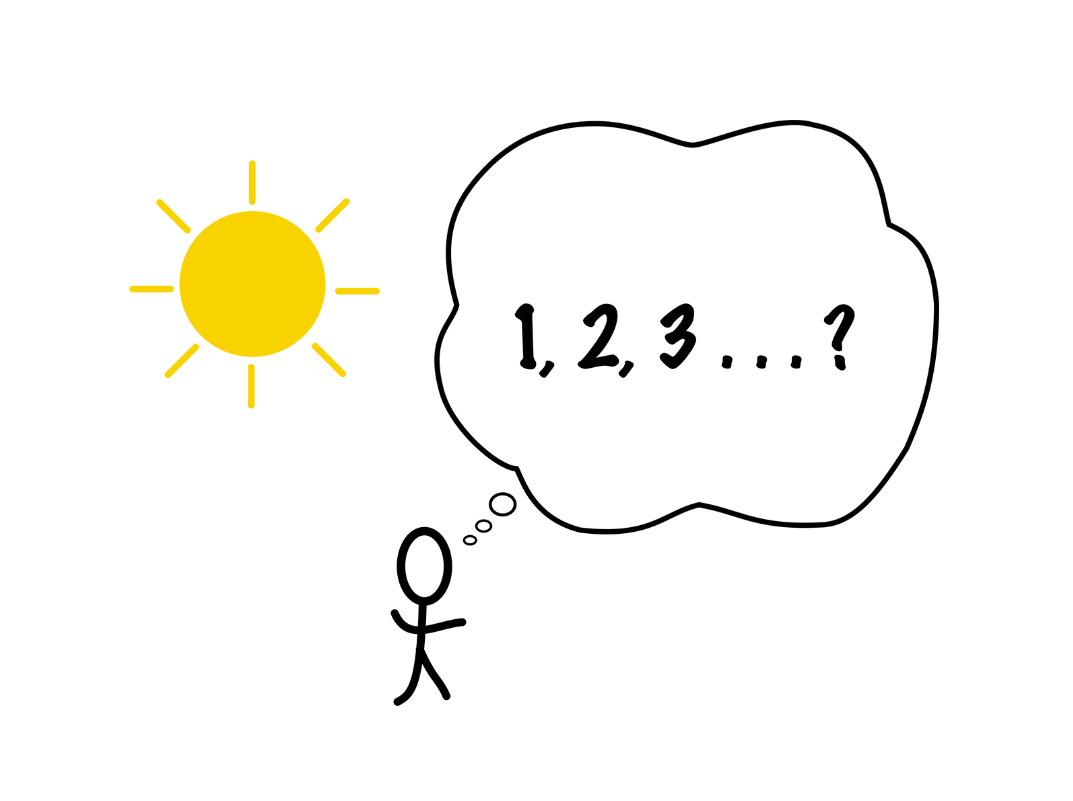
Interestingly, if you ask this question to different scientists, you will likely get different answers.  There are some connections between the different answers, but it will be easiest to start by just looking at one answer you might frequently get:  One of the first uses of the word quantum in the quantum science context is in the phrase “light quanta,” the idea that there is something countable about light.  This phrase is most easily understood in terms of the energy that light carries from one place to another.

Do you mean that if you step into the sunlight, you can feel it warming you?

Yes, exactly.  The energy in the light comes from the sun, travels millions of kilometers through space, and hits your skin, warming it up.  The longer you stand in the sunlight, the more energy your skin absorbs.  In principle, this transfer of energy from the light to your skin could be continuous.  Indeed, before quantum science, the generally accepted theory among scientists was that light energy could be continually transferred in any amount.  But it turns out, this light energy is only transferred in tiny quanta – little pieces of energy.  The common name of these light quanta you may already have heard, they’re called “photons.”

So, can you feel these photons when you’re being warmed by the sun?

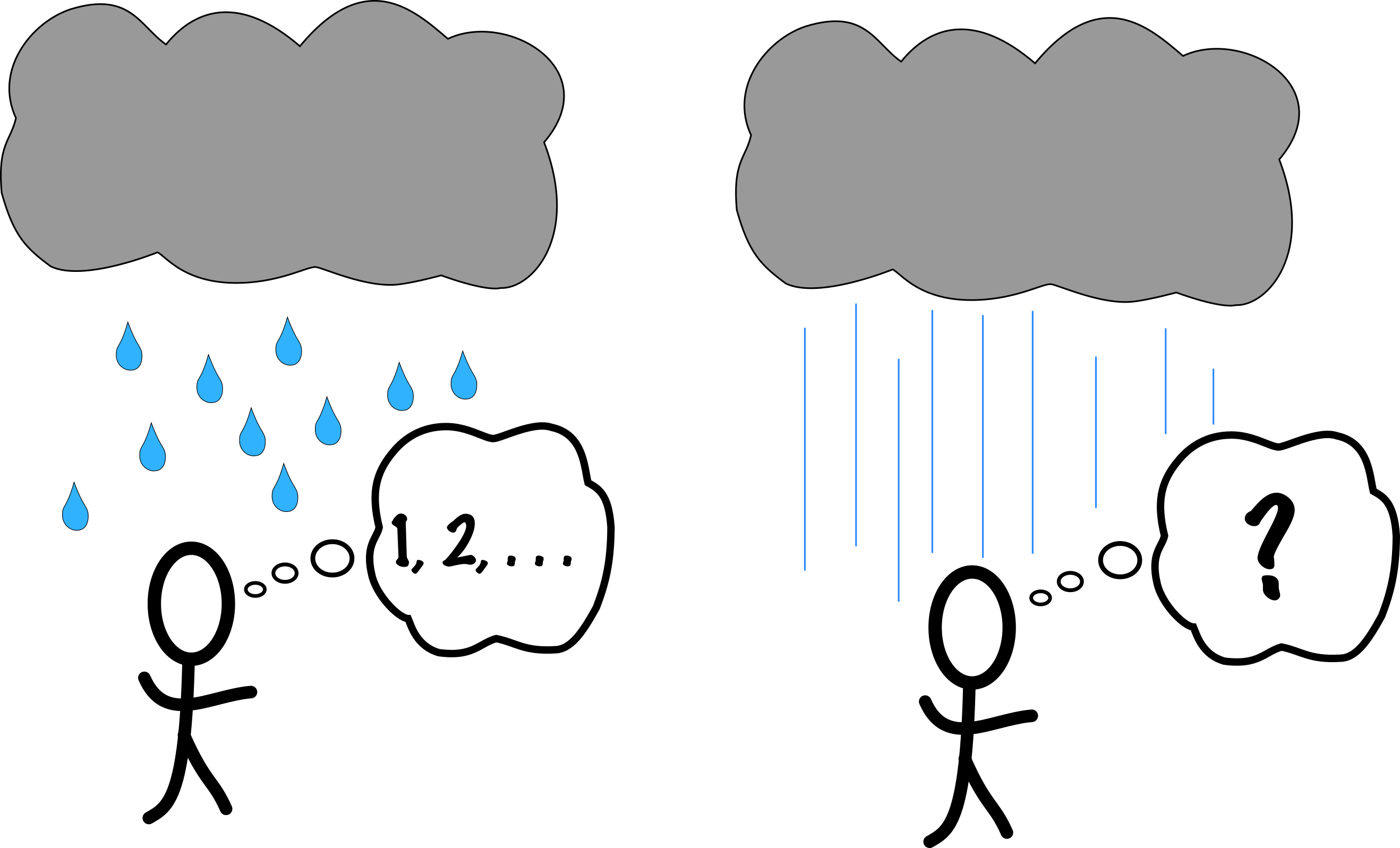
Not individually, they’re so small that they’re imperceptible to us.  However, we can now, thanks to our understanding of quantum mechanics, create instruments that do detect and count individual photons.  As an analogy to understanding why you can’t feel individual photons, instead of thinking about light hitting your skin, think about water hitting it.  If you put your hand under a running faucet or in a stream, you would feel water continually flowing, but if you go out in the rain, you would feel water hitting you in drops that are countable.

I’m not sure if I could actually count the number of raindrops hitting me when I’m standing in the rain.

It would be!  The point is not whether we can actually find the number, but whether there is something we can count at all.  In this case, a quantum of sand is a grain of sand.  But now let me ask a trickier question, if we were on the beach and looked out at the water and I said, “count the water” what do I mean?

Maybe how many liters of water?

Yes, this would be challenging!  Again, the point is not whether a person can actually calculate the correct number; it’s whether there is anything meaningful to count at all.  Now if the raindrops became smaller and smaller and came faster and faster, eventually you would no longer be able to perceive that the water hitting you came in individual drops, it would start to seem like the continuous flow of water you perceive when you put your hand under a faucet or in a stream.  The fact that there are countable drops would be hidden from your perception.

This reminds me of how a movie is just made up of a series of pictures; if the pictures are flashed before your eyes in quick succession, it doesn’t look like a series of pictures, but a continuous motion.

It’s a similar situation in that the discrete, countable nature of the pictures is hidden.  When you’re watching a movie, it doesn’t seem like there is anything to count in the motion you’re seeing.  In the same way, the rain with very small drops might seem like a continuous flow of water and the sunlight energy warming your skin doesn’t appear to have anything countable about it.  These quanta of sunlight energy are very well hidden from our usual perception of the world.  This is kind of a hallmark of quantum science – finding out that things that don’t seem to have anything countable about them do, in fact, have a countable “quantum” aspect to them.

In trying to think about these light quanta of energy in the sunlight, these photons, is each quantum of energy the same size?

No.  In the same way that raindrops or grains of sand can come in different sizes, the photon energies can have different sizes.  However, there is a very nice fact about photon size related to the fact that any light can be thought of as being made up of a combination of different colors of light.

Yes, I’ve seen how you can send light through a prism of glass that breaks it up into its different colors.

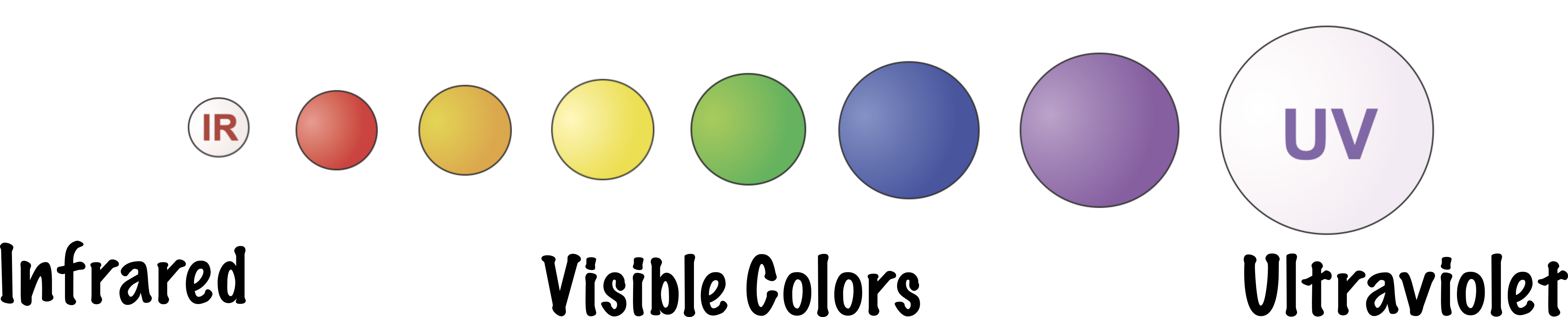
Exactly, or like a rainbow, which you can see when sunlight is broken up into its constituent colors by raindrops.  So, it turns out that each specific color of light has its own size of photons. All red light of a particular type – more technically of a particular wavelength or frequency – transmits energy in quanta of the same size.  Similarly, all blue light of a particular type has energy quanta of the same size.  Photons of blue light are larger than photons of red light, and photons of yellow light are bigger than red light but smaller than blue light.  The order of colors of a rainbow from red to violet gives the size of photons from smallest to largest.

Now I’m picturing how, when I’m standing in the sunlight, my skin is absorbing these different-sized light quanta, each corresponding to different colors.

In fact, in addition to the visible colors, sunlight also contains light that we can’t see with our eyes.  One type of this light is “ultraviolet” or UV light.  This light actually has larger energy photons than the visible light.  The size of these photons is quite relevant to us because when they hit our skin, they can do the most damage to it biologically; it’s the large photons of UV light that cause sunburns and can increase one’s chance of getting skin cancer.

So even though this quantum nature of light is quite hidden from our perception, it actually has some serious consequences for us.  One more question in thinking about all these very small, different-sized photons being absorbed by our skin when light hits us:  if there’s a countable number of them, how many are hitting us?

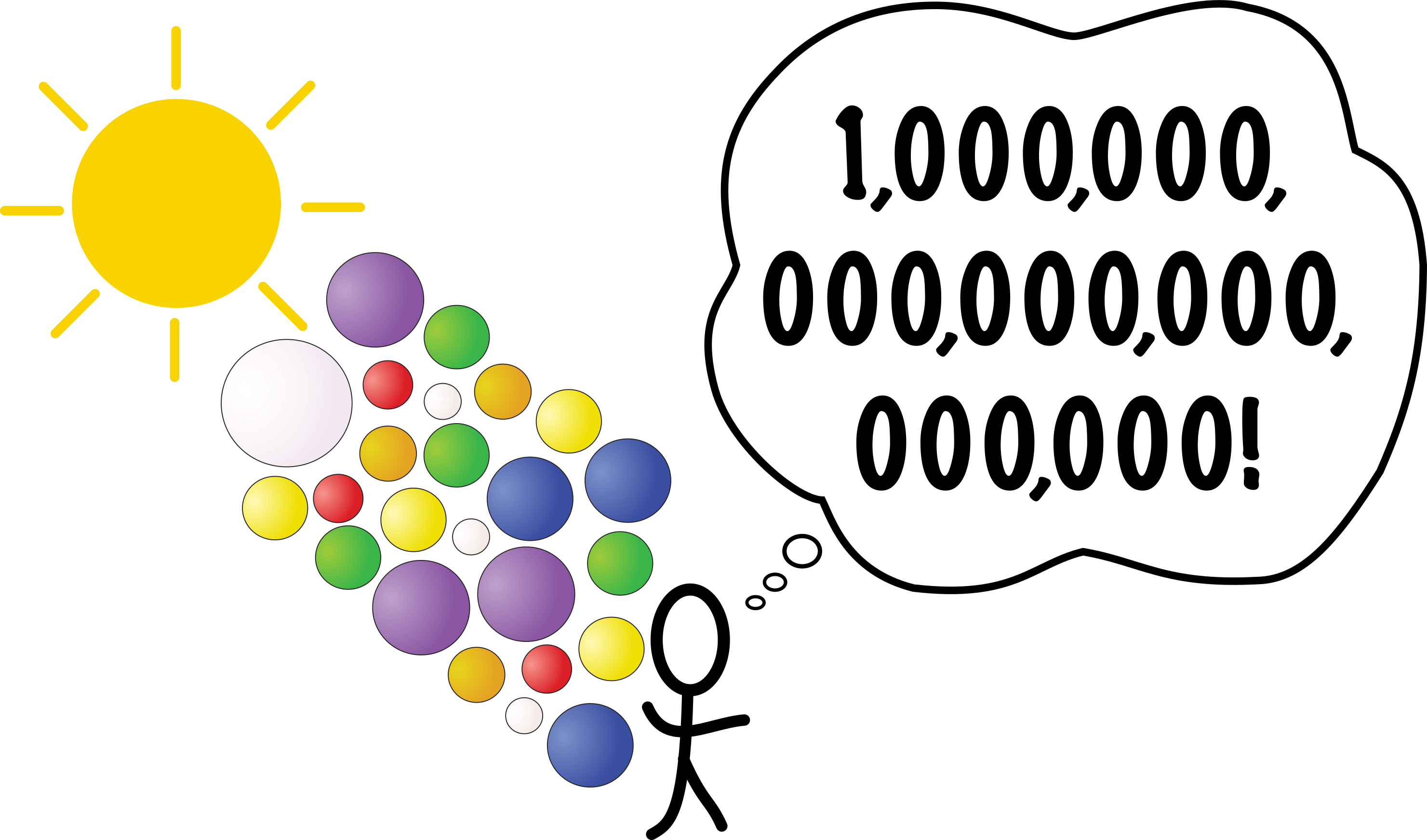
That will depend somewhat on the person and the light, but an average person standing in the sun is going to have around one billion trillion photons hit their skin each second.  That’s a one with 21 zeros:  1,000,000,000,000,000,000,000 each second.

My goodness, that’s a large number!

It’s a number you can write down, but certainly couldn’t count to!  It is a fascinating aspect to understand about the common experience of standing in sunlight that no one knew existed until the advent of quantum science.  It’s something to ponder next time you’re being warmed by the sun.


Written by Paul Cadden-Zimansky, Associate Professor of Physics at Bard College and a Global Coordinator of IYQ.

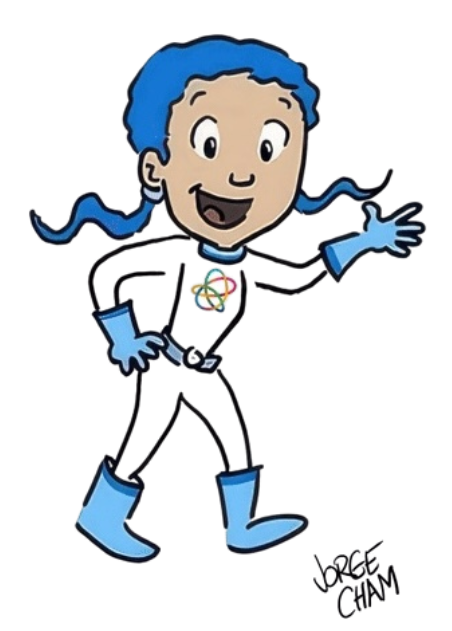
IYQ mascot, Quinnie, was created by Jorge Cham, aka PHD Comics, in collaboration with Physics Magazine
All rights reserved.