
International School of Physics “Enrico Fermi” Course 216 – Frontiers in Medical Physics

Course 216 – Frontiers in Medical Physics

Topics:
Magnetic Resonance Imaging

  • Fundaments of MRI
  • Reconstruction techniques
  • q-MRI
  • Diffusion & functional MRI, tractography
  • New frontiers in MRI technologies

X-Ray imaging

  • Fundaments of X-ray imaging
  • Dose optimization in X-ray imaging
  • Photon counting CT: image quality and new perspectives
  • Phase contrast imaging techniques
  • Dark field imaging: from the physics principles to the first clinical experience

External beam Radiotherapy (RT): status and new perspectives

  • Clinical needs in radiation oncology
  • Fundaments of radiobiology
  • Technological aspects of external beam radiotherapy
  • Advanced image guidance in photon therapy
  • Advanced image guidance in particle therapy
  • New frontiers in external beam radiotherapy: Temporal (FLASH) and Spatial (mini beams) Fractionation

Innovative instrumentation for external beam radiotherapy

  • Accelerators for ion beam therapy: status and new developments
  • New systems for FLASH & very high-energy electrons (VHEE) RT
  • Laser-driven proton sources for biomedical applications
  • New dosimeters for next-generation RT

The bleeding edge in AI, imaging, and therapeutic technologies

  • Redefining (bio)medical physics with AI and generative models
  • AI-Driven preakthroughs across physics, neuroscience, and AI
  • Quantum AI and quantum applications in precision medicine
  • Magnetic nanomaterials for next-generation neurophysics
  • Beyond boundaries: Ultra-High Field MRI (7T-17T) in human and animal research
  • Combining ultrasound and UHF MRI for brain therapies

1 – 6 July 2025
Directors
Cristina Lenardi – Università degli Studi di Milano & INFN Milano (Italy)
Katia Parodi – Ludwig-Maximilian University Munich (Germany)
Lego4Quantum

This is a global online competition. Participants submit a 3-minute TikTok-style video pitch on the Swiss youth social network Goodwall. The winner gets a trip to Geneva to participate in the University of Geneva’s SDG Summer School

In the video pitch, participants should imagine how Augmented Reality could transform LEGO bricks into virtual tools for exploring quantum mechanics and explaining quantum concepts like entanglement and superposition that underlie the quantum computing revolution.

Participants should use their imagination and talent to illustrate their ideas visually, too. You don’t need to use an AR headset or do a lot of coding to compete. Just convey your concept clearly and convincingly.

The competition opens on March 3, and closes on March 31.

Qubits Uncovered: The Gateway to Quantum Computing

This Masterclass offers an accessible exploration into the world of quantum computing, focusing on the qubit—the fundamental unit of quantum information. In this class, we demystify core quantum concepts such as superposition, interference, and measurement through hands-on demonstrations that can be performed with just one qubit. Designed for a diverse audience including computer scientists, mathematicians, and curious minds alike, the course illustrates how a single qubit can generate true randomness, secure data using quantum cryptography, and even implement simple algorithms. Join us to discover how understanding one qubit opens the door to the revolutionary possibilities of quantum technology.

Revolución Cuántica

El Instituto Tecnológico Superior de Calkiní (ITESCAM) propone organizar un ciclo de conferencias de dos días, del 3 al 4 de abril de 2025. El título del evento es “Revolución Cuántica: Ciencia, Tecnología y Futuro”. Este evento está diseñado para ser mayoritariamente divulgativo, con el objetivo de hacer accesibles los conceptos de la ciencia y la tecnología cuántica a toda la comunidad, independientemente de su formación en física.

Las actividades incluirán charlas que abordarán temas como la computación cuántica, las aplicaciones médicas de la tecnología cuántica y su impacto en la vida cotidiana, aplicaciones en energías renovables y nanomateriales. Los contenidos se presentarán de manera sencilla y comprensible, utilizando ejemplos prácticos y evitando tecnicismos, para asegurar que todos los asistentes puedan comprender y apreciar la relevancia de estos avances.

Quantum Computing 101

New to quantum computing? This foundational workshop covers the core principles, including qubits, superposition, entanglement, and quantum gates. Participants will explore the difference between classical and quantum computing, gain hands-on experience with quantum simulators, and get an introduction to quantum programming basics. Perfect for beginners looking to build a solid foundation before diving into the Future Leaders in Quantum (FLIQ) hackathon.

On the menu, get ready to

  • Understand the fundamentals: Learn the core principles of quantum computing, including qubits, superposition, entanglement, and quantum gates
  • Differentiate quantum from classical: Recognize the key differences between classical and quantum computing and why they matter
  • Explore the mathematical foundations: Get an introduction to the essential maths behind quantum computing
  • Identify key challenges: Understand real-world obstacles like quantum noise, decoherence, and the need for error correction.

From Classical to Quantum Measurement Systems – IYQ

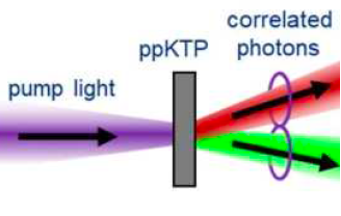
The event “From Classical to Quantum Measurement Systems” recognizes classical and quantum technology for different applications in measurement technology, including optical sensing and metrology, bioimaging and optogenetics, multimode fiber amplifier, high-speed data transmission, quantum sensing with undetected light, quantum computing, 6G-quantum communication, entangled photons for fiber communication.

2025 UBCQ Career Fair

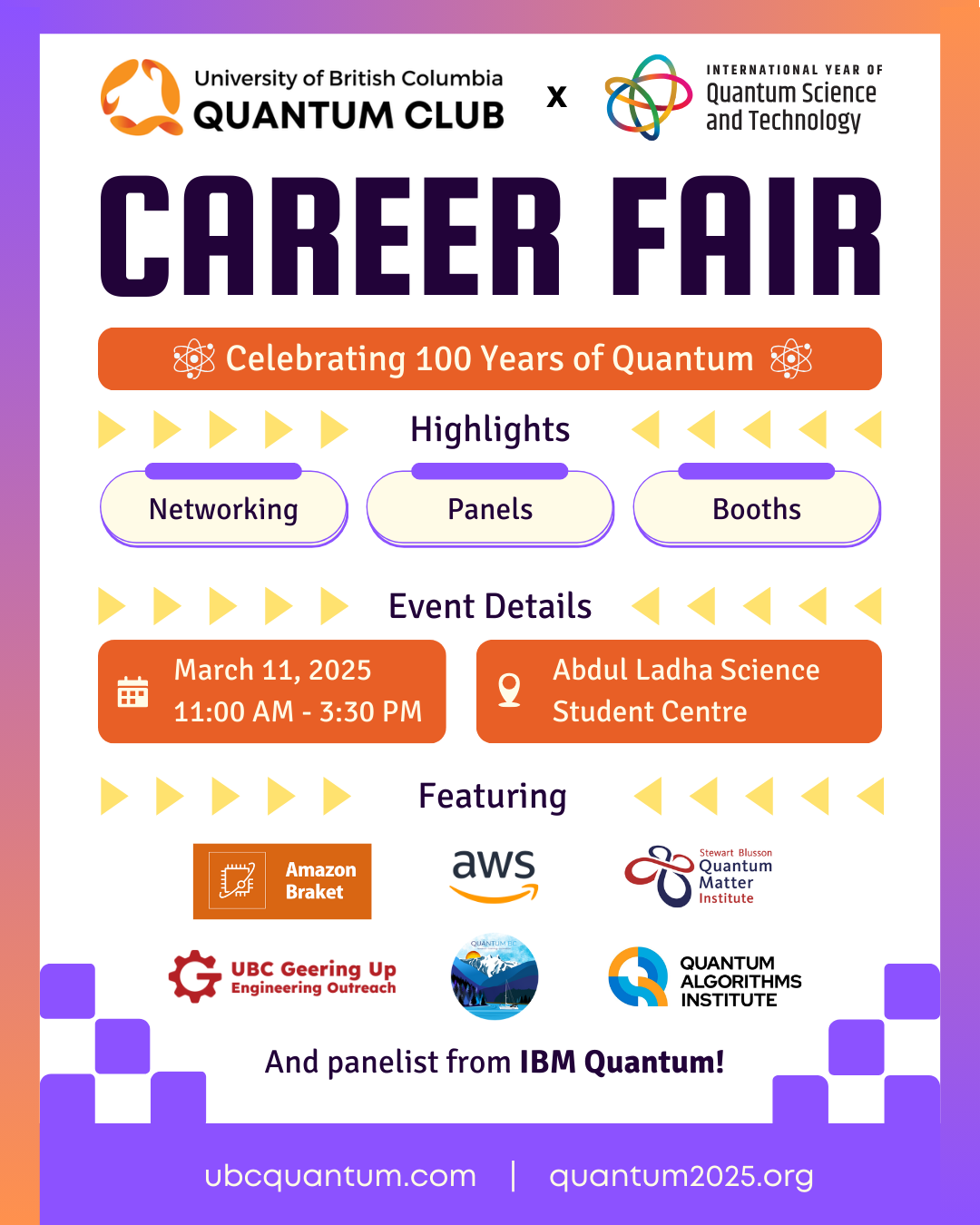
Celebrate the International Year of Quantum and 100 years of quantum mechanics at the 2025 UBC Quantum Career Fair! Open to all students, attend our event on March 11th, 11:00 am – 3:30 pm, at the Abdul Ladha Science Student Centre at the University of British Columbia for a day of networking, seminars, and panel discussions exploring quantum science and technologies in the real world. Joined by IBM, Amazon, QMI, and many more, come meet the industry leaders and academics at the forefront of quantum research!

Quantum Talks 2025

The first Quantum Talks 2025 will be a day of workshops and panels for discussions on Quantum Technologies and recent advances in the quantum computing industry. The event will have speakers from different areas, including researchers, professionals, developers, and startups in quantum technologies, including cyber, AI, optimization, hardware, and software.

The event will be realized in hybrid mode, from the auditorium of Microsoft Reactor in São Paulo, Brazil, with an audience of 80 people and online attendees.

E’ un Mondo Quantistico


Così recita la prima pagina del sito che le Nazioni Unite e l’Unesco hanno messo a disposizione di chiunque voglia accogliere l’invito a celebrare il 2025 come anno internazionale della Scienza e della tecnologia quantistica. Si tratta di una straordinaria occasione per condividere con un pubblico il più ampio possibile il come ed il perché la scienza e la tecnologia quantistica siano divenute fondamentali per l’umanità e come il loro ruolo non potrà che aumentare in futuro. Anche se la teoria viene ancora percepita come surreale, assai difficile e basata su principi la cui comprensione è preclusa ai più, ognuno può, indipendentemente dalla propria formazione, avvicinarsi alla fisica quantistica. Per questo il manifesto dell’IYQ riporta come prima missione delle iniziative quella di “contribuire ad accrescere la consapevolezza del pubblico riguardo l’importanza e l’impatto della Scienza Quantistica e delle sue applicazioni in tutti gli ambiti della vita”. Perché quando tutto intorno a noi diviene “quantum” è importante abbandonare ogni reticenza ed impegnarsi a comprendere, con rigore e coraggio, i fondamenti della fisica quantistica, giungendo ad una comprensione profonda dei fondamenti logici della teoria, così da apprezzare in modo non superficiale i nuovi scenari e le inedite prospettive che essa ci regala. In questo incontro ci proveremo insieme a Paola Verrucchi, ricercatrice dell’Istituto dei Sistemi Complessi del CNR e docente per il Dipartimento di Fisica dell’Università di Firenze.