

Laser, Offspring and Powerful Enabler of Quantum Science

Article published in Physical Review X Quantum

Among all the inventions that quantum physics has produced, the laser holds a particularly important place, both for the rich story of successive discoveries that led to its birth, and for the role it has played in fundamental and applied research. I recall here the lineage of theoretical discoveries and experiments that have marked this history, restricting myself to the contribution of lasers to blue sky science and leaving aside its well-known role in various domains of technology. This story started from advances in the old quantum theory, from Einstein’s theoretical description of stimulated emission to O. Stern’s experimental discovery of the spatial quantization of the electron spin. Nuclear magnetic resonance, atomic clocks, optical pumping, and masers followed, and the pace of discoveries accelerated with the appearance of the laser in 1960. This extraordinary light source has since enabled breakthroughs in fundamental physics and opened up fields of research that could not even have been imagined at the time of its birth. I was fortunate to begin my career in physics at this crossroad of atomic physics and optics. In this article, I give my personal view of the great adventures in fundamental research in which I participated as an actor or spectator, from the cooling and trapping of atoms by light to the physics of quantum gases of bosons and fermions, the manipulation of individual quantum particles, and quantum simulations. Many other areas of fundamental physics, which I will only mention briefly, owe their development to lasers, and further advances are still to be expected in the years to come.

Read the full article here.

Featured Image: An optical molasses: a cloud of cold sodium atoms fluoresces at the intersection of three pairs of red-detuned counter-propagating laser beams. The laser beam used for the Zeeman slowing of the atoms is visible above the horizontal molasses beam. (Courtesy of W. Phillips.)

About the author: Serge Haroche works at the Laboratoire Kastler BrosselÉcole Normale Supérieure and Collège de France, Paris, France. He received the Nobel Prize in Physics in 2012.

Celebrating the First Century of Quantum Physics and Preparing for the Next One

A century ago, pioneering scientists, including Wolfgang Pauli, Werner Heisenberg, and Erwin Schrödinger, laid the foundational principles of quantum mechanics. To mark this milestone, the Editors of the Physical Review journals have curated a collection of landmark papers that shaped the field. The whole collection is accessible at this link.

The collection begins with the following editorial by Dagmar Bruß from Heinrich Heine University Düsseldorf.

Physical Review Letters’ Editorial

In this International Year of Quantum Science and Technology, we celebrate the centenary of quantum physics. The anniversary marks the theoretical developments—including Heisenberg’s and Schrödinger’s formulations of quantum mechanics—that swiftly unfolded starting in 1925, building on earlier seminal contributions that established essential quantum concepts [1–5].

One hundred years span about three human generations. Similarly, I view the last century of quantum physics as progressing through three consecutive but intertwined generations. The first quantum generation was an era of understanding and mysteries. The groundbreaking works of this period introduced a formal quantum-mechanical description of physical reality. At the same time, this era saw researchers trying to cope with the counterintuitive phenomena—including entanglement and the related nonlocality—resulting from the quantum formalism.

The second quantum generation was one of consolidation and applications. This era brought about the “first quantum revolution”—a series of technological breakthroughs that have made quantum effects a part of our daily lives. Lasers, magnetic resonance imaging, and integrated circuits are all examples of quantum-enabled technologies. Quantum theory also started to reshape fields such as chemistry, materials science, astrophysics, and cosmology. This period came with a gradual acceptance of the peculiar effects emerging in the quantum regime.

The characteristic feature of the third quantum generation is the link with information science. Having come to terms with quantum weirdness, scientists realized that the quantum world has great, inherent power for quantum information processing. Harnessing the quantum laws of nature, they devised ways to perform computing, communication, simulation, and sensing with unmatched efficiency and security. Efforts to implement these disruptive technologies lie at the heart of contemporary research.

This collection brings together papers playing a foundational role within each of these three quantum generations. In the first generation, the development of the theory [6–17] went hand in hand with the discussion of doubts, paradoxes, and possible interpretations of quantum mechanics [18–22].

During the second quantum generation, pioneering contributions included insights into topological effects [23,24], as well as the conception of experiments for proving debated quantum-mechanical properties such as nonlocality [25–27], contextuality [28], and particle-wave duality [29]. These ideas were successfully tested in experiments when suitable technology became available [30–34].

The third quantum generation was opened up by papers that built the foundations of quantum information science. The “no-cloning theorem” [35] showed the possibility of achieving unbreakable security in quantum communication [36]. Other landmark papers pointed out the possibility of building a universal quantum computer [37] and of achieving a quantum computing advantage in practical applications [38]. In parallel to quantum information science, foundational research started to pursue new and alternative directions [39].

As we enter a new century of quantum science, we wonder how disruptive quantum information technologies will be, and on what timescales their full impact will be felt. But future quantum research will need to tackle much more than technology development. After 100 years of quantum mechanics, several fundamental issues remain partially or fully unresolved. Can we understand the boundary between the quantum and the classical world? How can the laws of classical thermodynamics emerge from quantum mechanics? Can gravity be quantized, and how can experiments look for signatures of quantum gravity? Many more questions will arise that we cannot even imagine today.

Certainly, research on foundational aspects of quantum physics will be as necessary in the future as it was in its first century. And as history has amply shown, so-called “quantum leaps” in technology are by and large the fruit of fundamental advances.

References (39)

  1. Max Planck, Ueber das Gesetz der Energieverteilung im Normalspectrum, Ann. Phys. (Berlin) 309, 553 (1901).
  2. Albert Einstein, Über einen die Erzeugung und Verwandlung des Lichtes betreffenden heuristischen Gesichtspunkt, Ann. Phys. (Berlin) 322, 132 (1905).
  3. Niels Bohr, On the constitution of atoms and molecules, Philos. Mag. Ser. 5 26, 1 (1913).
  4. Walther Gerlach and Otto Stern, Der experimentelle Nachweis der Richtungsquantelung im Magnetfeld, Z. Phys. 9, 349 (1922).
  5. Arthur Compton, A quantum theory of the scattering of x-rays by light elements, Phys. Rev. 21, 483 (1923).
  6. Wolfgang Pauli, Über den Einfluß der Geschwindigkeitsabhängigkeit der Elektronenmasse auf den Zeemaneffekt, Z. Phys. 31, 373 (1925).
  7. Werner Heisenberg, Über quantentheoretische Umdeutung kinematischer und mechanischer Beziehungen, Zeitschrift für Physik 33, 879 (1925); M. Born and P. Jordan, Zur Quantenmechanik, Z. Phys. 34, 858 (1925); M. Born, W. Heisenberg, and P. Jordan, Zur Quantenmechanik. II., 35, 557 (1925).
  8. Louis de Broglie, Recherches sur la théorie des Quanta, Ann. Phys. (Berlin) 10, 22 (1925).
  9. George E. Uhlenbeck and Samuel Goudsmit, Ersetzung der Hypothese vom unmechanischen Zwang durch eine Forderung bezüglich des inneren Verhaltens jedes einzelnen Elektrons, Zuschriften Und Vorläufige Mitteilungen 13, 953 (1925).
  10. Erwin Schrödinger, Quantisierung als Eigenwertproblem, Ann. Phys. (Berlin) 384, 361 (1926).
  11. Clinton Davisson and Lester H. Germer, Diffraction of electrons by a crystal of nickel, Phys. Rev. 30, 705 (1927).
  12. Max Born, Das Adiabatenprinzip in der Quantenmechanik, Z. Phys. 40, 167 (1927).
  13. Paul A. M. Dirac, The quantum theory of the electron, Proc. R. Soc. A 117, 610 (1928).
  14. Howard P. Robertson, The uncertainty principle, Phys. Rev. 34, 163 (1929).
  15. Felix Bloch, Über die Quantenmechanik der Elektronen in Kristallgittern, Z. Phys. 52, 555 (1929).
  16. Richard P. Feynman, Space-time approach to non-relativistic quantum mechanics, Rev. Mod. Phys. 20, 367 (1948).
  17. Julian Schwinger, On gauge invariance and vacuum polarization, Phys. Rev. 82, 664 (1951).
  18. Albert Einstein, Boris Podolsky, and Nathan Rosen, Can quantum-mechanical description of physical reality be considered complete?, Phys. Rev. 47, 777 (1935).
  19. Niels Bohr, Can quantum-mechanical description of physical reality be considered complete?, Phys. Rev. 48, 696 (1935).
  20. Erwin Schrödinger, Die gegenwärtige Situation in der Quantenmechanik, Naturwissenschaften 23, 807 (1935).
  21. David Bohm, A suggested interpretation of the quantum theory in terms of “hidden” variables. I, Phys. Rev. 85, 166 (1952).
  22. Hugh Everett, Relative state formulation of quantum mechanics, Rev. Mod. Phys. 29, 454 (1957).
  23. Yakir Aharonov and David Bohm, Significance of electromagnetic potentials in the quantum theory, Phys. Rev. 115, 485 (1959).
  24. Michael V. Berry, Quantal phase factors accompanying adiabatic changes, Proc. R. Soc. A 392, 45 (1984).
  25. John S. Bell, On the Einstein Podolky Rosen paradox, Phys. Phys. Fiz. 1, 195 (1964).
  26. Daniel M. Greenberger, Michael A. Horne, Abner Shimony, and Anton Zeilinger, Bell’s theorem without inequalities, Am. J. Phys. 58, 1131 (1990).
  27. Lucien Hardy, Nonlocality for two particles without inequalities for almost all entangled states, Phys. Rev. Lett. 71, 1665 (1993).
  28. Simon Kochen and Ernst Specker, The problem of hidden variables in quantum mechanics, J. Math. Mech. 17, 59 (1967).
  29. John A. Wheeler, The “past” and the “delayed-choice” double-slit experiment, Mathematical Foundations of Quantum Theory, edited by A. R. Marlow (Academic Press, New York, 1978), pp. 9–48, 10.1016/B978-0-12-473250-6.X5001-8.
  30. Stuart J. Freedman and John F. Clauser, Experimental test of local hidden-variable theories, Phys. Rev. Lett. 28, 938 (1972).
  31. Alain Aspect, Jean Dalibard, and Gérard Roger, Experimental test of Bell’s inequalities using time-varying analyzers, Phys. Rev. Lett. 49, 1804 (1982).
  32. X. Y. Zou, L. J. Wang, and L. Mandel, Induced coherence and indistinguishability in optical interference, Phys. Rev. Lett. 67, 318 (1991).
  33. Vincent Jacques, E Wu, Frédéric Grosshans, François Treussart, Philippe Grangier, Alain Aspect, and Jean-François Roch, Experimental realization of Wheeler’s delayed-choice gedanken experiment, Science 315, 966 (2007).
  34. B. Hensen et al., Loophole-free Bell inequality violation using electron spins separated by 1.3 kilometres, Nature (London) 526, 682 (2015); Marissa Giustina et al., Significant-loophole-free test of Bell’s theorem with entangled photons, Phys. Rev. Lett. 115, 250401 (2015); Lynden K. Shalm et al., Strong loophole-free test of local realism, 115, 250402 (2015).
  35. William K. Wootters and Wojciech H. Zurek, A single quantum cannot be cloned, Nature (London) 299, 802 (1982).
  36. Charles H. Bennett and Gilles Brassard, Quantum cryptography: Public key distribution and coin tossing, Proceedings of the International Conference on Computers, Systems & Signal Processing (1984), Vol. 1, pp. 175–179.
  37. David Deutsch, Quantum theory, the Church–Turing principle and the universal quantum computer, Proc. R. Soc. A 400, 97 (1985).
  38. Peter W. Shor, Algorithms for quantum computation: Discrete logarithms and factoring, Proceedings 35th Annual Symposium on Foundations of Computer Science, Santa Fe, NM (1994), pp. 124–134; L. K. Grover, Quantum mechanics helps in searching for a needle in a haystack, Phys. Rev. Lett. 79, 325 (1997).
  39. Sandru Popescu and Daniel Rohrlich, Quantum nonlocality as an axiom, Found. Phys. 24, 379 (1994).

Featured image: Niels Bohr and Albert Einstein. Wikipedia, public domain.

What does “Quantum Mechanics” Mean?

We’ve talked about what quantum means, but what does “quantum mechanics” mean?


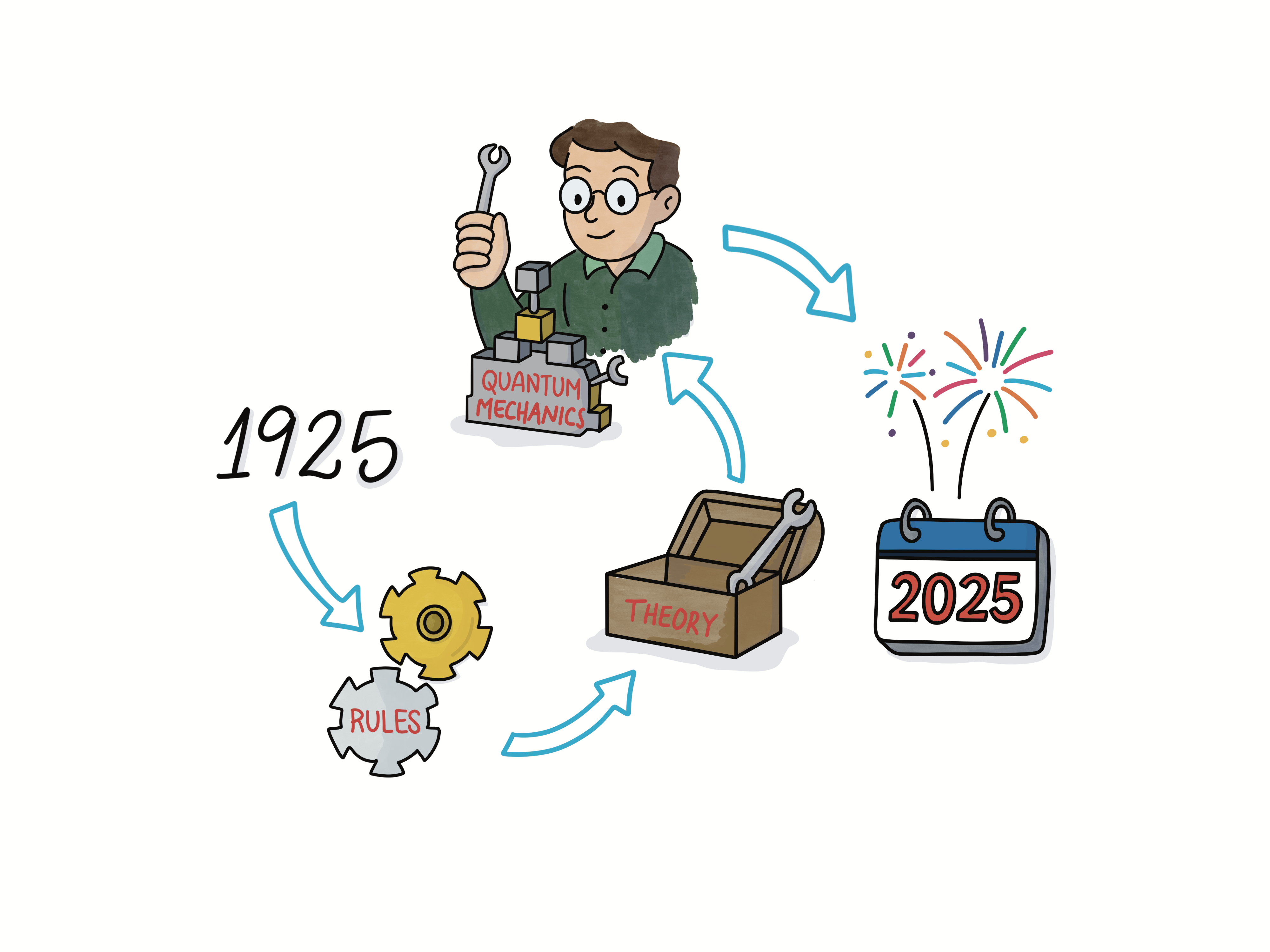
Quantum mechanics is a very general set of rules governing the physical world that was developed starting in 1925. The year 2025 was chosen as the International Year of Quantum Science and Technology because it marks 100 years of quantum mechanics.  We’ve talked elsewhere about what quantum means; the mechanics part refers to a systematic set of rules that can be widely applied to describe how things move and change.

Do “quantum mechanics” and “quantum theory” mean the same thing?

These terms are often used interchangeably, but a conceptual and historical distinction can be made between them. Historians usually trace the beginning of quantum theory to the year 1900.  This is the first time a quantum hypothesis—in this case, that energy came in countable pieces—was introduced in trying to understand a physical phenomenon. It became clear this was a useful hypothesis, but there was disagreement at the time about what its physical significance was. In the period from 1900 to 1925, other physical phenomena were explained using this and other quantum hypotheses. This was a period of quantum theory, sometimes now called the “old quantum theory,” but it was before there was quantum mechanics.

Then what changed to go from quantum theory to quantum mechanics?

In the 1900-1925 period, there was no consistency in how and when to apply these quantum hypotheses to explain experiments and make predictions. Sometimes they seemed to work spectacularly well, which gave many people confidence that there must be something to the idea.  But many other times, scientists tried to use these hypotheses to model or predict things, and the model didn’t make any sense, or the predictions were wrong. The point is that there was no systematic way of applying quantum theory ideas to different physical systems. A systematic method would be a “mechanics.”

And this systematic method was developed in 1925?

The groundwork for it, yes.  The basic framework and some general sets of principles to follow took a few years to sort out in order to be able to apply them systematically to a wide range of problems.  People are even now still working to revise and extend this framework, but many of the core pieces of quantum mechanics were put in place in 1925.  The term “quantum mechanics” started to be widely used in the 1920s to describe these systematic rules.  It was also a phrase that distinguished this new mechanics from what’s now called “classical mechanics.”

What is “classical mechanics”?

Classical mechanics, or sometimes just “mechanics,” is the framework for describing the motion of massive objects that was initially developed in the 17th century.  This framework is a set of general rules that can be used to describe how planets orbit the sun or the rate at which a dropped object falls to the ground.

These would be ideas like “to every action, there is an equal and opposite reaction” and other rules of motion?

Yes, exactly.  The rules of classical mechanics are still very useful and often easier to use than those of quantum mechanics, but quantum mechanics is an even broader theory that, in many scientists’ assessments, supersedes the rules of classical mechanics. One way to put it is that by the end of the 19th century, scientists thought they had a good, systematic theory for how matter moved around—that’s classical mechanics—and a good, systematic theory for how light worked—this is the electromagnetic wave description of light. However, there were a number of puzzles in trying to understand how light and matter interact with each other. In the period from 1900 to 1925, some of these puzzles seemed to be solved using quantum ideas, but there was no systematic understanding of how light and matter interacted in all cases.

And quantum mechanics provided a systematic way for understanding how light and matter interact?

Not only did quantum mechanics provide a full description of how light and matter interact, but in doing so, it dramatically revised our understanding of light and matter and the rules governing each of them. The earlier “classical” rules governing matter and light were revealed to be only approximations of a richer, quantum description of matter, light, and their interactions.


Written by Paul Cadden-Zimansky, Associate Professor of Physics at Bard College and a Global Coordinator of IYQ.

IYQ mascot, Quinnie, was created by Jorge Cham, aka PHD Comics, in collaboration with Physics Magazine
All rights reserved.

Illustrations: Solmar Varela

Featured image by Alchemist-hp www.pse-mendelejew.de.

A History Wall of Quantum Physics: A Journey Through More Than One Hundred Years of Quantum Physics History

The DPG is launching the online resource “A History Wall of Quantum Physics” as part of the International Year of Quantum Science and Technology

(DPG is an IYQ sponsor.)

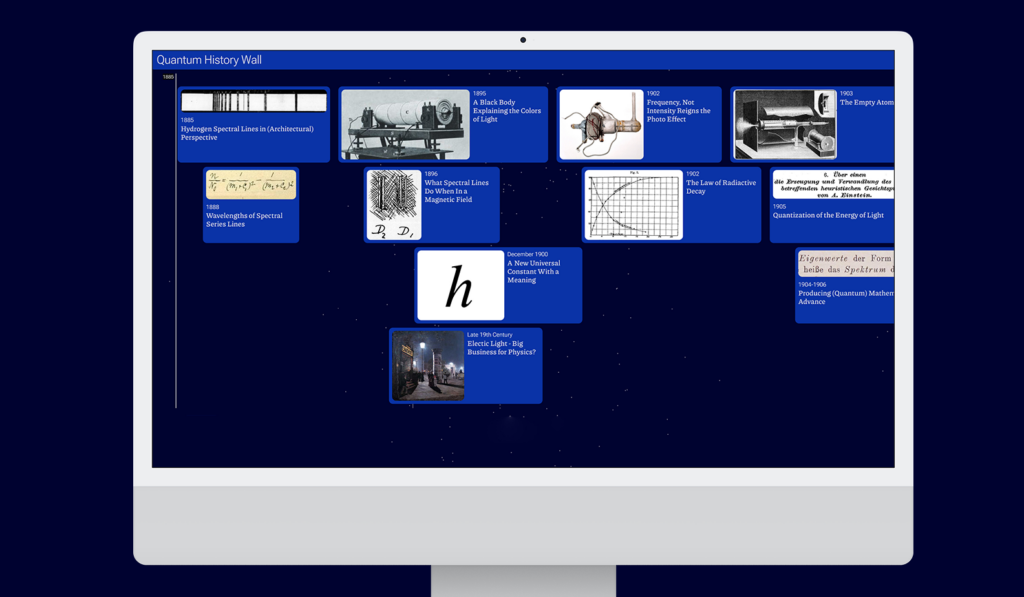
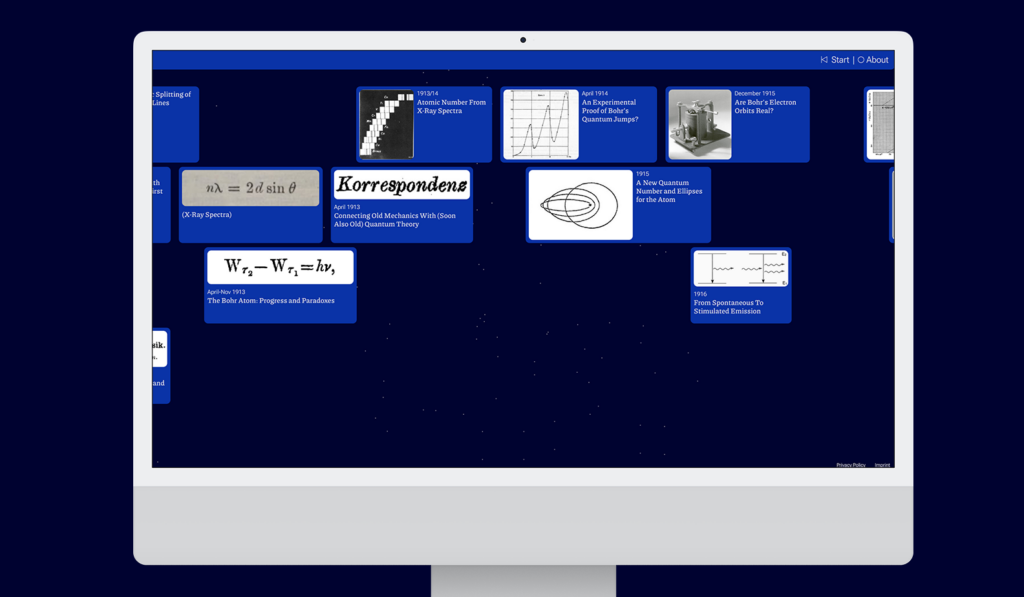
The Deutsche Physikalische Gesellschaft (German Physical Society | DPG) has launched a website that offers insights into the multi-layered history of quantum physics. The website quantum-history.org uses a visual approach to the development of quantum physics and quantum mechanics in particular, whose historical development, like the theories and experiments themselves,  is complex. The website offers both English-language and German-language versions.

Interested parties can now explore quantum physics online: from terms and concepts, theories and interpretations, to instruments, experiments, and measurements. Visual elements are combined with short texts or “history snacks” that explain the physical background and historical context as concisely and easily understandable as possible.

“Instead of people, their memories and views, the focus here is on physics itself,” explains project leader Arne Schirrmacher. “The history is presented visually: through curves, formulas, drawings, notes, and diagrams that represent the key advances, but also by photos and quotes that explain the context and conflicts in the development of quantum physics.”

Physics historians and physicists interested in the history of physics have intensively studied the history of quantum theory over the last two decades. The Quantum History Project made a significant contribution between 2006 and 2012, bringing together an international group of researchers at the Max Planck Institute for the History of Science and the Fritz Haber Institute of the Max Planck Society. This led to the establishment of a larger network of quantum historians that is still active today and has contributed to the History Wall.

“The future applications of innovations based on quantum physics are diverse, and their full range is not yet foreseeable,” says Klaus Richter, President of the German Physical Society. “In Germany, the International Quantum Year is therefore also being celebrated under the motto ‘100 years is just the beginning’.”

The “Quantum History Wall” was realized with the support of the Wilhelm and Else Heraeus Foundation and is a contribution of the DPG to the International Year of Quantum Science and Technology. Further thanks go to the participating publishers and institutions, such as the American Physical Society, the Heisenberg Society, the Deutsches Museum, Wiley-VCH, Hirzel, Springer Nature and others for generously granting free usage rights to numerous archival materials and photographs.

The History Wall is currently also part of the special exhibition “Was zum Quant?!”, which is under the umbrella of the DPG and on display in the Forum Wissen, the Museum of Knowledge of the University of Göttingen, until October 2025.

Concept and content edited by Arne Schirrmacher

Feedback: quantum-history@dpg-mail.de

UNESCO 2025 International Year of Quantum Science and Technology launches Quantum 100 initiative to recognize and champion the global quantum community

LONDON – April 28th, 2025 – UNESCO’s 2025 2025 International Year of Quantum Science and Technology (IYQ) today announces the launch of the Quantum 100: A global snapshot of careers & community, a major global initiative to celebrate the diverse people behind quantum science and technology. 

From researchers to policymakers, educators to entrepreneurs, and students to communicators, The Quantum 100 will recognize and champion 100 quantum professionals from around the world. 

To be considered for inclusion, IYQ is asking for submissions which demonstrate important contributions to quantum science and technology or the quantum community in the fields of: 

  • Academia 
  • Arts
  • Communication
  • Education
  • Government 
  • Industry 
  • Philanthropy 

Submissions are open from today until 28th May.

Each person within the Quantum 100 will have their name and photo in an online gallery on the IYQ website with details about their accomplishments. Submissions will be reviewed by members of the IYQ Steering Committee, an international consortium of scientists and policymakers, with announcements of the Quantum 100 beginning on 29 July, to coincide with 100 years since the publication of Werner Heisenberg’s “magical” paper that led to the development of the new model of quantum mechanics.

“The Quantum 100 is in the true spirit of the IYQ ,” said Sir Peter Knight, 

Professor at Imperial College London, Chair of the Quantum Metrology Institute at the National Physical Laboratory and co-chair of IYQ Steering Committee. “ Quantum sciences and the wider quantum community is driven forward by a cohort of diverse, globally-minded individuals. With this initiative, we will celebrate the roles and contributions of these individuals, and in doing so inspire the next generation of quantum talent. One of the goals of IYQ is that anyone, anywhere can participate, and the Quantum 100 is a timely reminder of how many different kinds of people are already participating and thriving in the quantum industry around the world.”

Silvina Ponce Dawson, President of IUPAP (International Union of Pure and Applied Physics) added:

“With diversity key to scientific endeavour, The Quantum 100 represents an important and timely initiative to highlight how quantum science and technology can be tackled from different perspectives. I truly hope that Quantum 100 will inspire other activities and help increase diversity within a field that is already exerting a huge impact on human society worldwide.” 

For further information, please visit https://quantum2025.org/quantum-100/ 

About the International Year of Quantum Science & Technology: 

The UN declared 2025 the International Year of Quantum Science & Technology  (IYQ) to mark the 100th anniversary of the study of quantum mechanics, and to help raise public awareness of the importance and impact of quantum science and applications on all aspects of life. It also aims to inspire the next generation of quantum scientists and improve the future quantum workforce by focusing on education and outreach. Anyone, anywhere, can participate in IYQ by helping others to learn more about quantum or simply taking the time to learn more about it themselves. 

World Quantum Day 2025: Return of the QuanTour Light Source, Hands-on Experiments, and an Enjoyable Science Slam

(DPG is an IYQ sponsor.)

Quantum technology took the stage in Berlin on April 14. The highlight was the ceremonial return of the QuanTour light source to Urania, a symbolic conclusion to a year-long journey through European research institutions. The QuanTour linked laboratories and universities across Europe as a precursor to this year’s International Year of Quantum Science and Technology.

“With the QuanTour, we wanted to set an example for networking, transparency, and enthusiasm for quantum technology,” say the initiators, Doris Reiter and Tobias Heindel, who had the idea for the project two years ago. “Due to the great interest, the QuanTour light source will make one more stop in Turkey before being passed on to the Physikalisch-Technische-Bundesanstalt.”

Measuring the same quantum light source more than a dozen times in different laboratories is a unique experiment and an important step toward establishing standards for quantum technologies. At the same time, the QuanTour made quantum research visible to the public across Europe: researchers gave insights into the physics laboratories and their everyday life in science via Instagram and in a podcast.

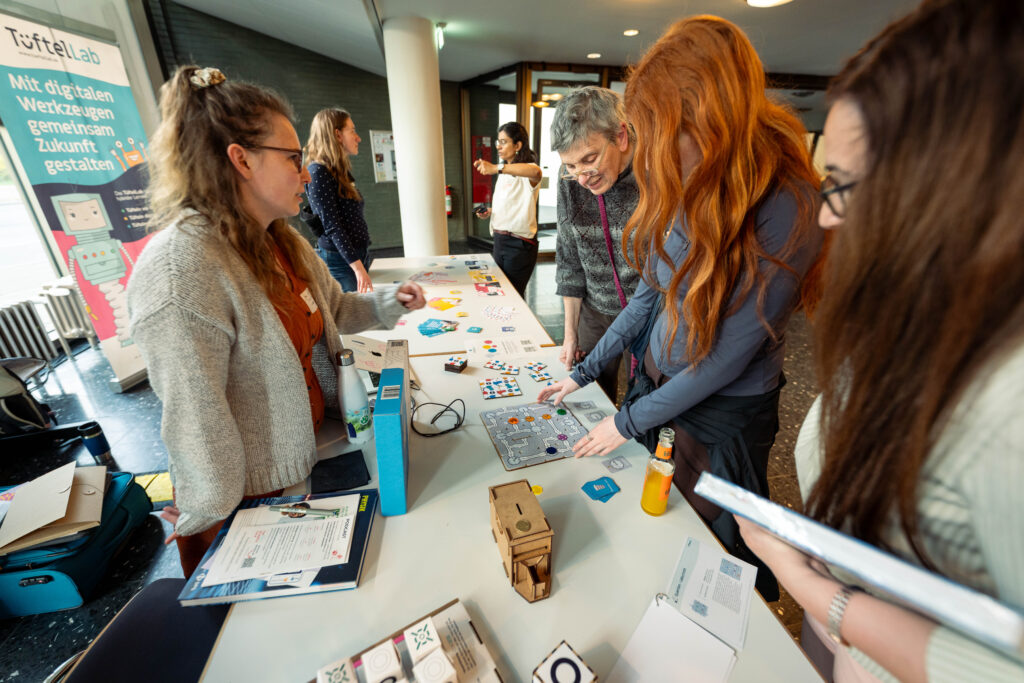
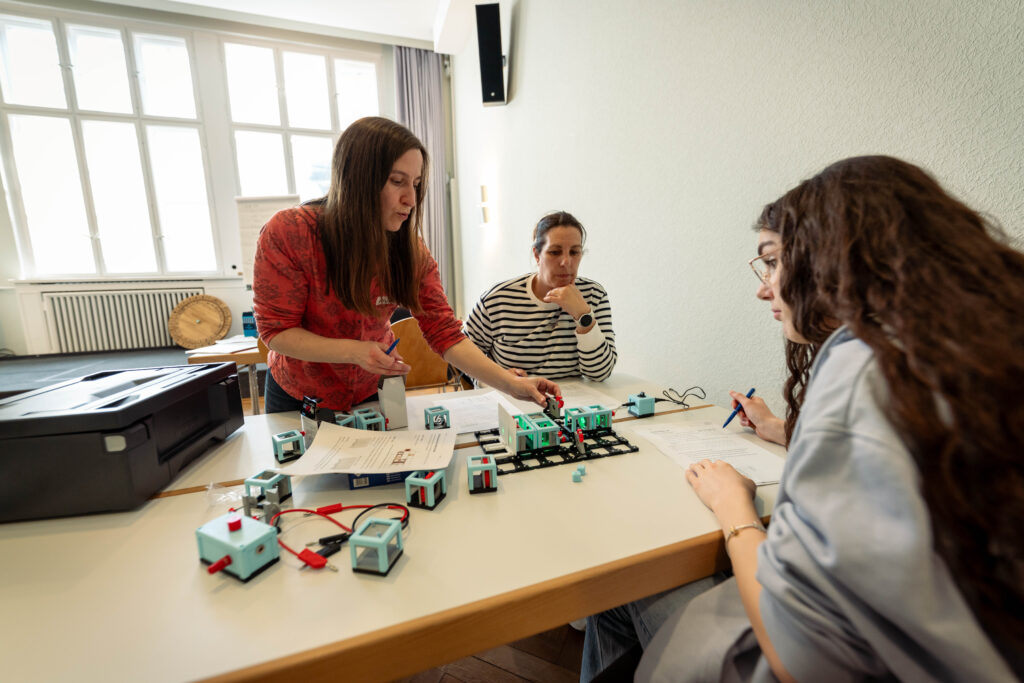
In addition to the return of the light source, the World Quantum Day event offered a varied program with numerous interactive experiments, workshops, and a hands-on exhibition. During the workshop on quantum cryptography, students could playfully try out for themselves how a secret key is transmitted in the form of a random bit sequence using individual photons, and whether this was intercepted. Another workshop illustrated quantized conductance. With experimental skill, participants were able to observe quantum jumps in the conductance of gold wire using an oscilloscope by carefully pulling two gold wires apart.

In the hands-on exhibition, quantum phenomena such as superposition and entanglement were made accessible in a playful way, for example, with the game Quantum Tic-Tac-Toe by the Junge Tüftler:innen or the artwork Quantum Jungle, which visualized the Schrödinger equation. The analogue Paul Trap by Q-Bus demanded skill in handling an ion trap experiment made of wood. The program was complemented by the touring exhibition Rethinking Physics, which highlighted the role of women in science. The booths of Leap, AQLS, Berlin Partner, BTU, and The Science Talk provided information about the multifaceted quantum landscape in Berlin.

The highlight of the evening was a Quantum Science Slam: five young researchers presented their scientific work in a creative and easy-to-understand way, from molecular films and stardust quantum computers to motion-dependent quantum emotions. Science journalist and physicist Sabrina Patsch, who humorously explained quantum entanglement using the fictional animals Quaninchen and Queerschweinchen, won the slam.

Cover picture © DPG / Mauro Franceschetti

Quantum Computing for the benefit of humanity

Interview with Catherine Lefebvre, Senior Advisor at the Geneva Science and Diplomacy Anticipator (GESDA) for the Open Quantum Institute, a GESDA initiative hosted by CERN

Imagine it’s the year 2035. Quantum computing has reached some maturity, revolutionizing industries and solving complex problems at an unprecedented scale. Large corporations rely on quantum systems to accelerate technological innovation. But has this progress been shared equitably? Has quantum technology been used to tackle humanity’s most pressing challenges, such as strengthening global food security, improving global access to affordable essential medicines, and reducing carbon emissions? Or has it remained in the hands of a few, widening the gap between those who have benefited from it and those who don’t?

In the framework of the International Year of Quantum Science and Technology, we interviewed scientist Dr. Catherine Lefebvre, who specializes in exploring quantum computing-related thought scenarios. She is a Senior Advisor for the Open Quantum Institute at the Geneva Science and Diplomacy Anticipator (GESDA).

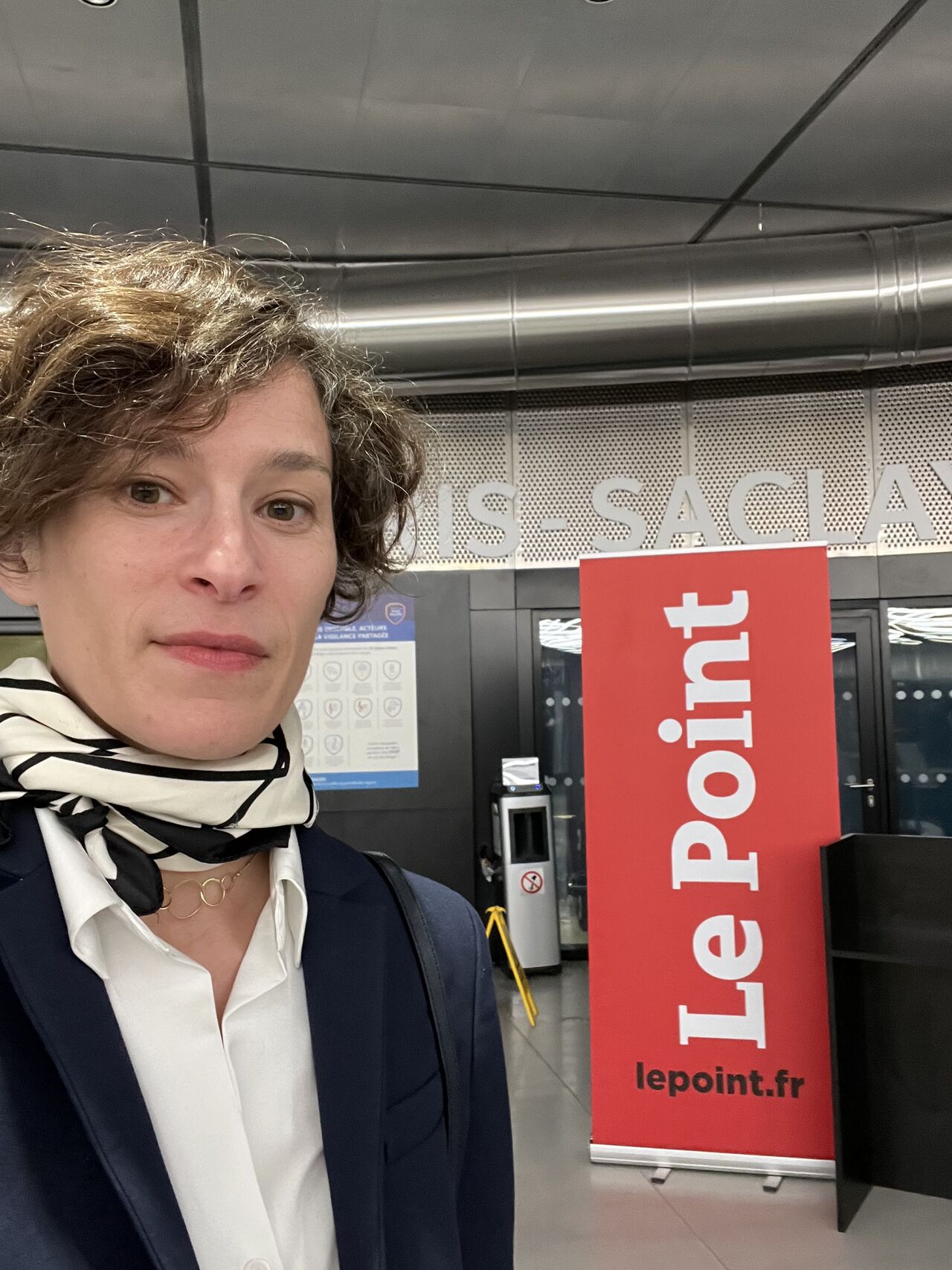
2025 Laureate in Innovation by Le Point.

At GESDA, what we do is to anticipate future scientific and technological breakthroughs in the next 5 to 25 years, as well as the potential related challenges, not only in quantum but also in many other scientific fields. From these challenges, we explore the potential opportunities to make sure that these breakthroughs could benefit all, and not only the rich countries that typically develop and use the technology. With a taskforce of experts, we work towards accelerating a solution and transforming into concrete actions that could lead to a better scenario for everyone. This is how we co-created the Open Quantum Institute,” Catherine explained. 

Concerned about the impact of emerging technologies on humanity, she and her colleagues, with the close collaboration of research, diplomacy, industry and impact experts around the globe, launched the Open Quantum Institute (OQI) in October 2022—a bold step toward making quantum computing more inclusive and beneficial for our society and planet. “The mission of the OQI is to promote global, equitable and inclusive access to quantum computing and, through that, to explore applications of quantum computing that would benefit humanity.”  

History has taught us that when transformative technologies—like social media or artificial intelligence—are concentrated in the hands of a few, the consequences can be profound and unpredictable. Today, as we stand on the brink of the quantum era, we face a similar crossroads. Looking at quantum computing through an international lens, we see stark disparities: many countries lack the infrastructure, expertise, or funding to participate, leaving vast potential untapped. If quantum technology becomes the exclusive domain of the wealthiest nations or corporations, we risk deepening the digital gap and reinforcing global inequalities. 

Catherine enthusiastically explains how she got involved at GESDA and how she and her colleagues helped bring the Open Quantum Institute to life:

I was doing a training in science diplomacy during the pandemic when I got the opportunity to learn about GESDA. Thanks to my mentor, Prof. Barry Sanders, I was able to join the task force on the quantum initiative, and soon after my involvement grew, and I became part of the GESDA team, as a volunteer. We co-designed a solution that would respond to the opportunity quantum could present, translating it into an institute, which is now the OQI. Towards the end of the OQI incubation phase in 2023, we confirmed CERN as partner to host the institute and help scale it for the three-year pilot, with the support of UBS [the Swiss bank UBS Group AG]. We officially launched the activities at CERN in March 2024, and we are now celebrating a successful first year of the pilot!” 

So, what exactly is the mission of the Open Quantum Institute, and what steps its stakeholders are taking? Catherine dives into these questions with clarity and insights.

91st Acfas Congress in Ottawa, May 2024 – Panel on Science Diplomacy.

A promising quantum future for all rests on four activity pillars 

First activity pillar: Accelerating applications for humanity

The first OQI activity pillar is on exploring applications. We’re using the framework of the UN on the Sustainable Development Goals [SDGs] and beyond to explore where quantum computing approaches could be applied to relevant problems that would help accelerate the achievement of the SDGs. For that, we put together multidisciplinary teams of quantum experts, subject-matter experts and UN organizations or large NGOs from all around the world to explore potential impactful use cases of quantum computing.

Second activity pillar: Access for all  

Once the use cases reach sufficient maturity, we collaborate with industrial partners who are donating credits for the implementation on quantum devices: first on simulators, and then on QPUs [quantum processing units]. This is the second pillar: focusing on access.

Third activity pillar: Advancing Building Capacity

The third activity pillar focuses on how to scale globally, how to onboard quantum-underserved geographies in entering their quantum journey, and eventually participating in the exploration of use cases based on their own local challenges. This is working towards increasing inclusivity and equitable access with training and upskilling activities. 

Last year, we launched an educational consortium with several academic and industrial education providers to share best practices, put together resources, and make them accessible to target geographies, which are Africa, Southeast Asia, and Latin America. 

Together with the educational consortium members, OQI is supporting local organizations to deploy educational activities, such as hackathons. For instance, there will be an OQI-supported hackathon in Ghana in July, and several others in Greece, Egypt, Thailand, etc., in 2025 and 2026. Additionally, we are looking into mentorship and internship programs helping to build knowledge capacity globally.

Fourth activity pillar: Activate multilateral governance for the SDGs

The other target audience for OQI in terms of education are diplomats, ambassadors, and policymakers. This ties to the fourth pillar, which involves governance and science diplomacy. Equipping diplomats with science-based information about what quantum means, where do we stand in terms of technological development, what are the possible challenges and the geopolitical implications; we provide a neutral multi-stakeholder platform to foster a multilateral dialogue with the goal to accelerate an effective governance approach.

We have designed a Quantum Diplomacy Game, which is a role play simulation to immerse participants in the anticipation of the geopolitical implications of quantum computing and actively explore multilateral governance. The game was played in Washington and at the Technical University of Munich earlier this year and will be “played” in the Philippines, Costa Rica, etc. during the pilot of OQI. ” 

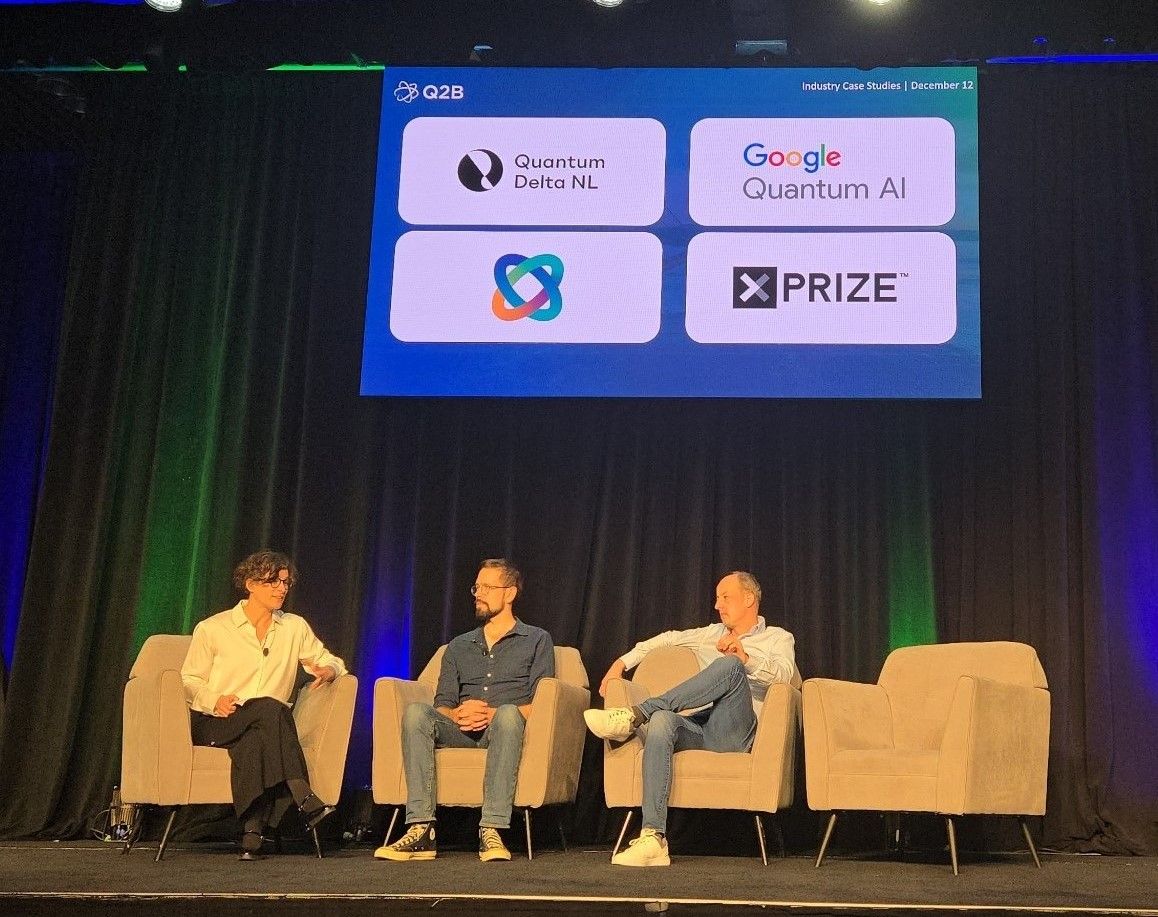
Q2B Silicon Valley December 2024. Panel on Quantum and Sustainability. 

Enduring challenges to ensure quantum for good and for all 

As Catherine reflects on the collaborative nature of the Open Quantum Institute’s work, she highlights on the key challenges they face—bridging gaps in expertise and communication across diverse stakeholders and geographies. 

One of our great challenges is in the translation. I am going to give you a concrete example of use cases development. Because these are multidisciplinary teams, we constantly need to find a way to speak a common language to be effective in the collaboration between, for instance, quantum experts and domain experts. 

Another challenge is in upskilling researchers and developers who want to participate with ideas to carry on a use case. We have developed a rigorous methodology to guide the participants from the ideation to the proof-of-concept so that strong use cases could lead to implementation on quantum computers in the future. The snapshot today is that too few participants from quantum-underserved geographies have the level to meaningfully contribute to building strong use cases, so there is a lot to be done for OQI and our collaborators. This is the reality, and it is also validating the need for our education activities.”     

While these challenges highlight the complexity of building inclusive and high-quality quantum use cases, Catherine emphasizes the importance of fostering collaboration through rigor, resilience, and practical problem-solving.

We need to be realistic; no one learns quantum overnight, and not everyone needs to know quantum computing in depth. In exploring use cases, it’s important to bring local experts who   with know about their challenges, their own realities, and so these use cases could have real impact, especially on underserved communities and geographies. For example, in certain geographies, they want to be active in preventing natural disasters, how we could predict floods more accurate with quantum computing. This is a real problem in Malaysia, for instance, it is a problem close to their heart. At OQI, we are supporting the development of use cases that will be impactful, and collaborating with local so that the impact can be directed to these affected countries.” 

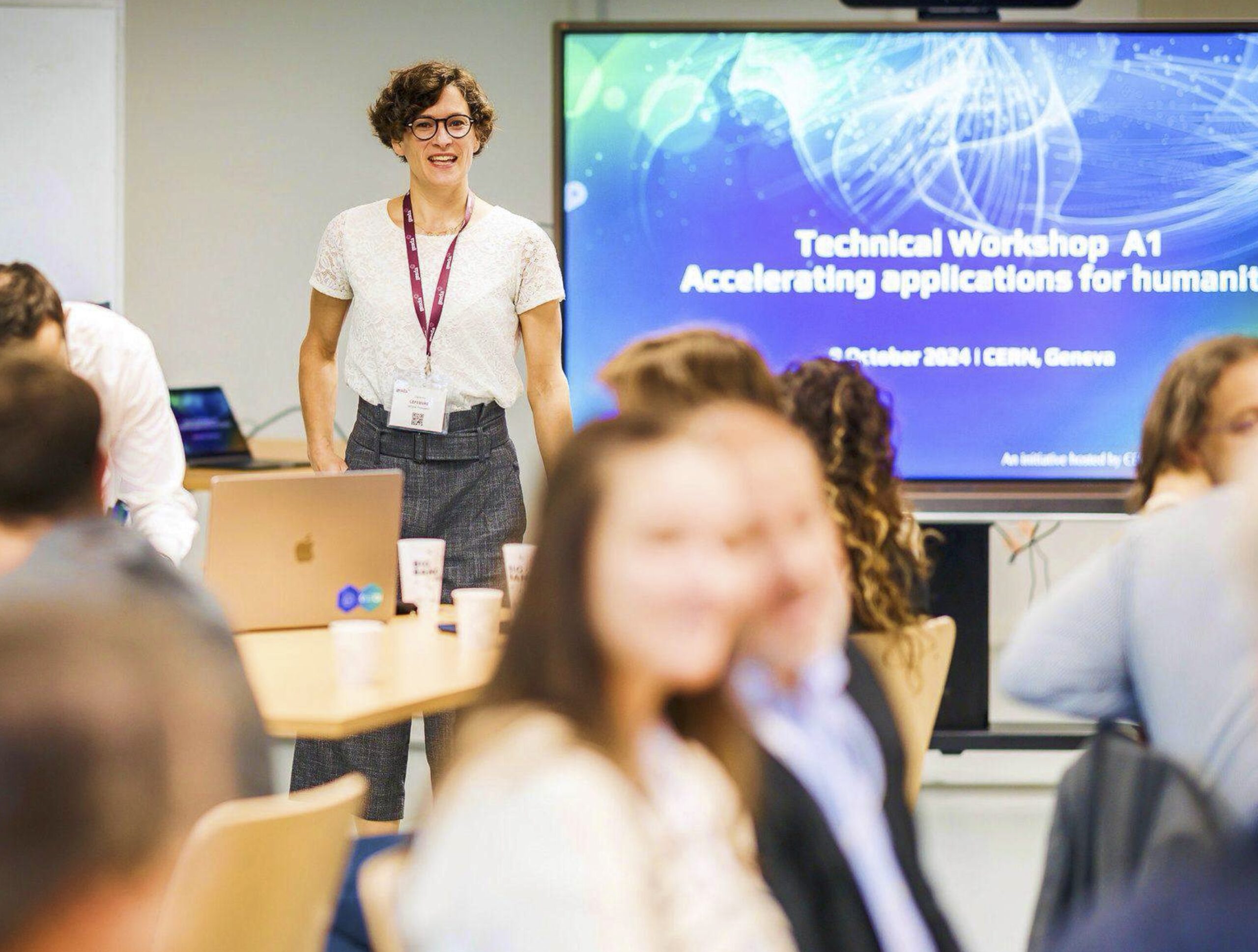
OQI technical workshop on quantum approaches at the GESDA Summit, October 2024 Credit: Marc Bader.

Passion for science and collaboration as motivation to foster global changes

The OQI approach reflects more than just strategy—it speaks about the values that have guided Catherine’s journey from the start. She’s motivated not just by the technology itself but by the global collaboration it can foster and the global challenges it has the potential to address. A deep passion for quantum science and a strong belief in the power of collaboration have shaped the professional path of this remarkable woman in quantum since she was a young girl. 

When I was six, I decided I wanted to become a chemist – although at that age I didn’t really know what that meant! As an undergraduate student, I first learned that I hated experimental chemistry laboratories, and luckily, I quickly found out a course on quantum mechanics applied to chemistry and I said, this is it, this is what I want to learn more. I ended up doing a PhD in theoretical chemistry and molecular physics. From there, I worked as a researcher for several years. Aside to quantum, my other passion that has grown since my PhD years is collaboration. My PhD thesis was in cotutelle between two universities, in Quebec and in Paris, and I learned to build bridges between the two departments in chemistry and physics in two different countries. As a theorist, I was also involved in multi-country collaboration with experimentalists. Being exposed to different scientific cultures and different approaches to science was wonderful. That early exposure fueled my passion for collaboration and crafted my role and my career as a researcher, and led me to science diplomacy.” 

Although 2035 is not really that far, quantum computing is still today in its infancy. The future is wide open, which means we have the unique opportunity to co-shape its path for the greater good. And everyone can be involved.

To be involved in science diplomacy in action, like what we do at OQI in the field of quantum computing, you don’t necessarily need to be an expert in quantum. For non-experts, it’s an opportunity to stay informed about the scientific development and engage actively in framing the future through the dialogue and exchange between the scientists and decision-makers.”

While OQI focuses primarily on quantum computing, other emerging quantum technologies may also contribute to addressing the Sustainable Development Goals (SDGs). It is essential for diplomats and organizations like GESDA to remain attentive to these developments. “My message for anyone is that what is important is to be curious, understand the importance of cooperation at the intersection of science and diplomacy. We have this great opportunity to bring quantum for the benefit of all humanity, the time is now to be active.”  

Featured Image by Marc Bader.

Europe and the Future of Quantum Science

PRESS RELEASE

(EPS is an IYQ sponsor.)

Today, 1st April 2025, the City of Göttingen is celebrated as a European Physical Society (EPS) Historic Site, recognising the contributions made by scientists working in the city to the foundation and development of Quantum Physics. On this occasion, the European Physical Society (EPS) along with its Member Societies, the Austrian Physical Society, Danish Physical Society, French Physical Society, Finnish Physical Society, German Physical Society, Institute of Physics (UK and Ireland), Italian Physical Society, Lithuanian Physical Society, Society of Physicists of Macedonia, Polish Physical Society, Spanish Royal Physical Society and the Swiss Physical Society also wish to look forward with a joint declaration on the future of Quantum Science.

Quantum Science remains a rapidly developing field, bringing with it new and unexpected results. Technologies based on these discoveries can change lives, address societal challenges, and drive scientific and economic progress.

The EPS Historic Site celebration and the EPS Declaration form part of the EPS’ activities in the International Year of Quantum Science and Technology.

About The European Physical Society

The European Physical Society (EPS) is a not-for-profit association whose members include 42 National Physical Societies in Europe, individuals from all fields of physics, and European research institutions and physics-based companies. As a learned society, the EPS engages in activities that strengthen ties between physicists in Europe. As a federation of National Physical Societies, the EPS advocates for issues of common interest to all European countries relating to physics research, science policy, and education.

– Go to www.eps.org
– EPS Contact: anne.pawsey@eps.org

What is the Quantum in “Quantum Science”?

If a quantum means something that can be counted, what is the “quantum” in “quantum science” or “quantum mechanics”?  What is the thing being counted?

Interestingly, if you ask this question to different scientists, you will likely get different answers.  There are some connections between the different answers, but it will be easiest to start by just looking at one answer you might frequently get:  One of the first uses of the word quantum in the quantum science context is in the phrase “light quanta,” the idea that there is something countable about light.  This phrase is most easily understood in terms of the energy that light carries from one place to another.

Do you mean that if you step into the sunlight, you can feel it warming you?

Yes, exactly.  The energy in the light comes from the sun, travels millions of kilometers through space, and hits your skin, warming it up.  The longer you stand in the sunlight, the more energy your skin absorbs.  In principle, this transfer of energy from the light to your skin could be continuous.  Indeed, before quantum science, the generally accepted theory among scientists was that light energy could be continually transferred in any amount.  But it turns out, this light energy is only transferred in tiny quanta – little pieces of energy.  The common name of these light quanta you may already have heard, they’re called “photons.”

So, can you feel these photons when you’re being warmed by the sun?

Not individually, they’re so small that they’re imperceptible to us.  However, we can now, thanks to our understanding of quantum mechanics, create instruments that do detect and count individual photons.  As an analogy to understanding why you can’t feel individual photons, instead of thinking about light hitting your skin, think about water hitting it.  If you put your hand under a running faucet or in a stream, you would feel water continually flowing, but if you go out in the rain, you would feel water hitting you in drops that are countable.

I’m not sure if I could actually count the number of raindrops hitting me when I’m standing in the rain.

It would be!  The point is not whether we can actually find the number, but whether there is something we can count at all.  In this case, a quantum of sand is a grain of sand.  But now let me ask a trickier question, if we were on the beach and looked out at the water and I said, “count the water” what do I mean?

Maybe how many liters of water?

Yes, this would be challenging!  Again, the point is not whether a person can actually calculate the correct number; it’s whether there is anything meaningful to count at all.  Now if the raindrops became smaller and smaller and came faster and faster, eventually you would no longer be able to perceive that the water hitting you came in individual drops, it would start to seem like the continuous flow of water you perceive when you put your hand under a faucet or in a stream.  The fact that there are countable drops would be hidden from your perception.

This reminds me of how a movie is just made up of a series of pictures; if the pictures are flashed before your eyes in quick succession, it doesn’t look like a series of pictures, but a continuous motion.

It’s a similar situation in that the discrete, countable nature of the pictures is hidden.  When you’re watching a movie, it doesn’t seem like there is anything to count in the motion you’re seeing.  In the same way, the rain with very small drops might seem like a continuous flow of water and the sunlight energy warming your skin doesn’t appear to have anything countable about it.  These quanta of sunlight energy are very well hidden from our usual perception of the world.  This is kind of a hallmark of quantum science – finding out that things that don’t seem to have anything countable about them do, in fact, have a countable “quantum” aspect to them.

In trying to think about these light quanta of energy in the sunlight, these photons, is each quantum of energy the same size?

No.  In the same way that raindrops or grains of sand can come in different sizes, the photon energies can have different sizes.  However, there is a very nice fact about photon size related to the fact that any light can be thought of as being made up of a combination of different colors of light.

Yes, I’ve seen how you can send light through a prism of glass that breaks it up into its different colors.

Exactly, or like a rainbow, which you can see when sunlight is broken up into its constituent colors by raindrops.  So, it turns out that each specific color of light has its own size of photons. All red light of a particular type – more technically of a particular wavelength or frequency – transmits energy in quanta of the same size.  Similarly, all blue light of a particular type has energy quanta of the same size.  Photons of blue light are larger than photons of red light, and photons of yellow light are bigger than red light but smaller than blue light.  The order of colors of a rainbow from red to violet gives the size of photons from smallest to largest.

Now I’m picturing how, when I’m standing in the sunlight, my skin is absorbing these different-sized light quanta, each corresponding to different colors.

In fact, in addition to the visible colors, sunlight also contains light that we can’t see with our eyes.  One type of this light is “ultraviolet” or UV light.  This light actually has larger energy photons than the visible light.  The size of these photons is quite relevant to us because when they hit our skin, they can do the most damage to it biologically; it’s the large photons of UV light that cause sunburns and can increase one’s chance of getting skin cancer.

So even though this quantum nature of light is quite hidden from our perception, it actually has some serious consequences for us.  One more question in thinking about all these very small, different-sized photons being absorbed by our skin when light hits us:  if there’s a countable number of them, how many are hitting us?

That will depend somewhat on the person and the light, but an average person standing in the sun is going to have around one billion trillion photons hit their skin each second.  That’s a one with 21 zeros:  1,000,000,000,000,000,000,000 each second.

My goodness, that’s a large number!

It’s a number you can write down, but certainly couldn’t count to!  It is a fascinating aspect to understand about the common experience of standing in sunlight that no one knew existed until the advent of quantum science.  It’s something to ponder next time you’re being warmed by the sun.


Written by Paul Cadden-Zimansky, Associate Professor of Physics at Bard College and a Global Coordinator of IYQ.

IYQ mascot, Quinnie, was created by Jorge Cham, aka PHD Comics, in collaboration with Physics Magazine
All rights reserved.