Course 217 – future needs for Metrology: climate science, quantum technologies, and the digital transformation
Modules and Topics
Module I (core module): Fundamentals of Metrology and the Digital Transformation of Measurement Quantum standards and open metrology, artificial intelligence, application of digital technologies to metrology, time scales, new methods for uncertainty evaluation, materials for neural network applications, the SI ‐ how it works and how it was developed, the contributions of Galileo to measurement.
Module II (optional): Metrology for the Quality of Life and Climate Science Measuring temperature and the atmosphere for climate, metrology of food, standards for laboratory measurements, metrology for inorganic chemistry, measurement challenges in the “omics,” and metrology for biology and medicine.
Module III (optional): Physical and Quantum Metrology Fundamental metrology with cold atoms, quantum (optics) technologies, time series analysis, electrical metrology of power grids, ion/optical and nuclear clocks, materials for neural network applications, photometry & spectrometry, and advances in thermometry.
Date: July 9 – 18, 2025 Directors: Dolores Del Campo – CEM, Madrid (Spain) Cornelia Denz – PTB, Berlin (Germany) Martin J.T. Milton – BIPM, Paris (France) Diederik S. Wiersma – LENS, Sesto Fiorentino FI and INRiM, Torino (Italy)
Curso 217 – Necesidades futuras de la Metrología: ciencia del clima, tecnologías cuánticas y transformación digital
Módulos y temas
Módulo I (módulo básico): Fundamentos de Metrología y Transformación Digital de la Medición Normas cuánticas y metrología abierta, inteligencia artificial, aplicación de las tecnologías digitales a la metrología, escalas de tiempo, nuevos métodos de evaluación de la incertidumbre, materiales para aplicaciones de redes neuronales, el SI: cómo funciona y cómo se desarrolló, las aportaciones de Galileo a la medición.
Módulo II (opcional): Metrología para la Calidad de Vida y las Ciencias del Clima Medición de la temperatura y la atmósfera para el clima, metrología de los alimentos, normas para mediciones de laboratorio, metrología para la química inorgánica, retos de medición en las “ómicas”, y metrología para la biología y la medicina.
Módulo III (optativo): Metrología Física y Cuántica Metrología fundamental con átomos fríos, tecnologías cuánticas (óptica), análisis de series temporales, metrología eléctrica de redes eléctricas, relojes iónicos/ópticos y nucleares, materiales para aplicaciones de redes neuronales, fotometría y espectrometría, y avances en termometría.
Fecha: 9 – 18 de julio de 2025 Directores: Dolores Del Campo – CEM, Madrid (España) Cornelia Denz – PTB, Berlín (Alemania) Martin J.T. Milton – BIPM, París (Francia) Diederik S. Wiersma – LENS, Sesto Fiorentino FI e INRiM, Turín (Italia)
Cours 217 – Besoins futurs de la métrologie : science du climat, technologies quantiques et transformation numérique
Modules et sujets
Module I (module de base) : Principes fondamentaux de la métrologie et transformation numérique de la mesure Normes quantiques et métrologie ouverte, intelligence artificielle, application des technologies numériques à la métrologie, échelles de temps, nouvelles méthodes d’évaluation de l’incertitude, matériaux pour les applications des réseaux neuronaux, le SI – comment il fonctionne et comment il a été développé, les contributions de Galilée à la mesure.
Module II (facultatif) : Métrologie pour la qualité de la vie et la science du climat Mesure de la température et de l’atmosphère pour le climat, métrologie des aliments, étalons pour les mesures en laboratoire, métrologie pour la chimie inorganique, défis de la mesure dans les ” omiques “, et métrologie pour la biologie et la médecine.
Module III (optionnel) : Métrologie physique et quantique Métrologie fondamentale avec des atomes froids, technologies quantiques (optique), analyse des séries temporelles, métrologie électrique des réseaux électriques, horloges ioniques/optiques et nucléaires, matériaux pour les applications de réseaux neuronaux, photométrie et spectrométrie, et avancées en thermométrie.
Date : 9 – 18 juillet 2025 Directeurs : Dolores Del Campo – CEM, Madrid (Espagne) Cornelia Denz – PTB, Berlin (Allemagne) Martin J.T. Milton – BIPM, Paris (France) Diederik S. Wiersma – LENS, Sesto Fiorentino FI et INRiM, Turin (Italie)
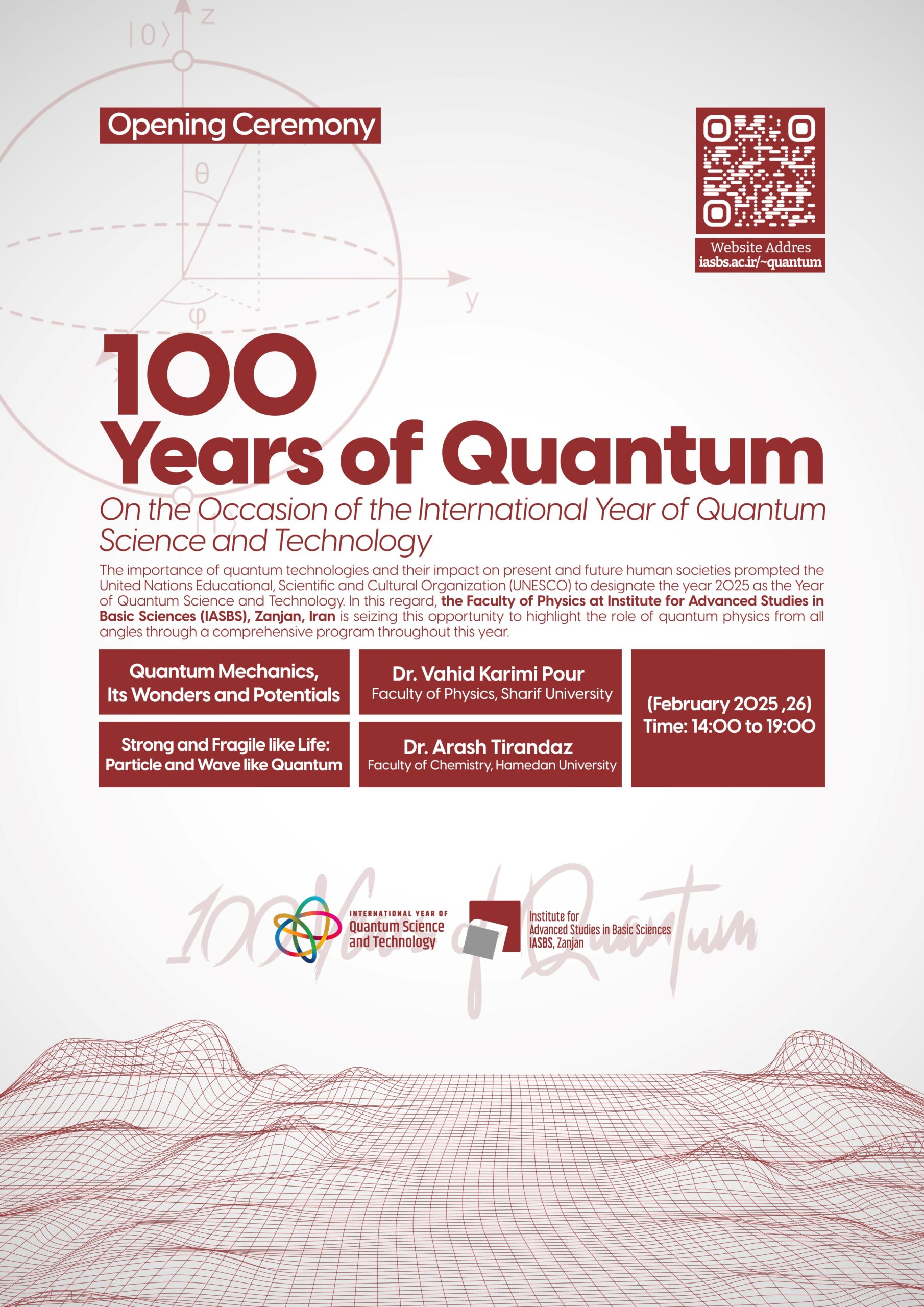
Quantum science and technologies harness the principles of quantum mechanics to transform computing, communication, and sensing to new areas. These advancements drive innovation across industries, shaping the future of science and technology. In order to introduce and highlight the importance of them in technologies and today’s world, IASBS is organizing a variety of events throughout the year during the International Year of Quantum. At the opening ceremony, in addition to commemorating this worldwide occasion, we will be discussing the background, significance, effect, and future of two key areas: quantum foundation and quantum biology.
La ciencia y las tecnologías cuánticas aprovechan los principios de la mecánica cuántica para transformar la informática, la comunicación y la detección hacia nuevas áreas. Estos avances impulsan la innovación en todos los sectores, configurando el futuro de la ciencia y la tecnología. Para presentar y destacar su importancia en las tecnologías y en el mundo actual, la IASBS organiza diversos actos a lo largo del año durante el Año Internacional de la Cuántica. En la ceremonia de inauguración, además de conmemorar esta ocasión mundial, debatiremos los antecedentes, la importancia, el efecto y el futuro de dos áreas clave: la fundación cuántica y la biología cuántica.
La science et les technologies quantiques exploitent les principes de la mécanique quantique pour transformer l’informatique, la communication et la détection en de nouveaux domaines. Ces avancées stimulent l’innovation dans tous les secteurs et façonnent l’avenir de la science et de la technologie. Afin de présenter et de souligner l’importance de ces technologies dans le monde d’aujourd’hui, l’IASBS organise une série d’événements tout au long de l’année pendant l’Année internationale des quanta. Lors de la cérémonie d’ouverture, outre la commémoration de cette occasion mondiale, nous discuterons du contexte, de l’importance, des effets et de l’avenir de deux domaines clés : les fondations quantiques et la biologie quantique.
Annie McEwen went to a mountain in Pennsylvania to help catch some migratory owls. Then Scott Weidensaul peeled back the owl’s feathery face disc, so that she could look at the back of its eyeball. No owls were harmed in the process, but this brief glimpse into the inner workings of a bird sent her off on a journey to a place where fleshy animal business bumps into the mathematics of subatomic particles. With help from Henrik Mouristen, we hear how one of the biggest mysteries in biology might finally find an answer in the weird world of quantum mechanics, where the classical rules of space and time are upended, and electrons dance to the beat of an enormous invisible force field that surrounds our planet.
If you’ve heard or read about quantum mechanics, you may have seen it described as “weird.” Even the great Albert Einstein — one of the founders of quantum mechanics — called certain aspects of the theory “spooky.”
With its wave-like particles and particle-like waves, quantum mechanics certainly challenges our intuitions of how the world works. Accepting what is counterintuitive to us — while striving to learn more — is a very important part of science!
Quantum can seem intimidating because it deals with the granular and fuzzy nature of the universe and the physical behavior of its tiniest particles that we cannot see with our eyes. Just because we haven’t experienced the world of quantum the way we can see the effects of gravity doesn’t mean quantum has to be “weird” or “spooky.”
The founders of quantum mechanics may have thought it was “weird” because it was different from the physics they were used to. But that was more than 100 years ago. Quantum just is the way it is!
I’m passionate about flipping the script on quantum and making it accessible to all.
In this blog post, I will attempt to normalize quantum mechanics by drawing analogies to concepts you may already know and understand.
I will also try to explain the five things that I have noticed confuse people about quantum mechanics. (Don’t worry; no math will be required!) You probably don’t need to understand quantum mechanics in-depth, but I hope this will help you think about it and how it applies to your life.
Quantum in action
Before the early 2000s, computers did not exhibit quantum behavior. But as technology advanced and transistors in computers got smaller (now as small as 5 nanometers, which is 5 billionths of a meter!), they started to show quantum behavior. Quantum behavior limits how small transistors can be and how fast computers can compute because it makes transistors “pesky” in that they don’t exhibit the predictable behavior that engineers want. For this reason, computers now operate on multiple “cores” to help increase computing speed and power.
The Wonderful World of Quantum
When you zoom in on matter at the quantum scale, nature gets granular. At this scale, we find tiny particles such as:
Photons: particles of light that have no mass or charge.
Electrons: subatomic particles that make up the atom, carry electricity and have charge and mass.
Quarks: the building blocks of protons and neutrons.
Alternatively, you can think of matter like a digital image: If you zoom in enough on an image, you start to see it’s made of individual pixels.
Classical physics governs the movement of things we can see, such as baseballs and planets. Quantum physics is a world we can’t easily see. If any part of quantum is substantially different from classical physics, it is that physics at the quantum scale is not only granular but also “fuzzy.”
When we zoom in on an image, a pixel seems to have a well-defined boundary, or does it? If you were able to zoom in on the atoms and subatomic particles that make up the pixel, you would see that the subatomic particles aren’t well defined. Their boundaries and behavior are somewhat unclear. This is similar to drawing a “perfect” line with a pencil and ruler. If you looked at that line with a microscope, the edges would look more wobbly than straight.
The lack of clarity in quantum mechanics creates unique behaviors. The consequences of these behaviors perplexed the physicists who were the first to try to understand quantum mechanics. These behaviors are:
Wave-particle duality: Tiny particles look like they are behaving like waves or particles, depending on how you observe them.
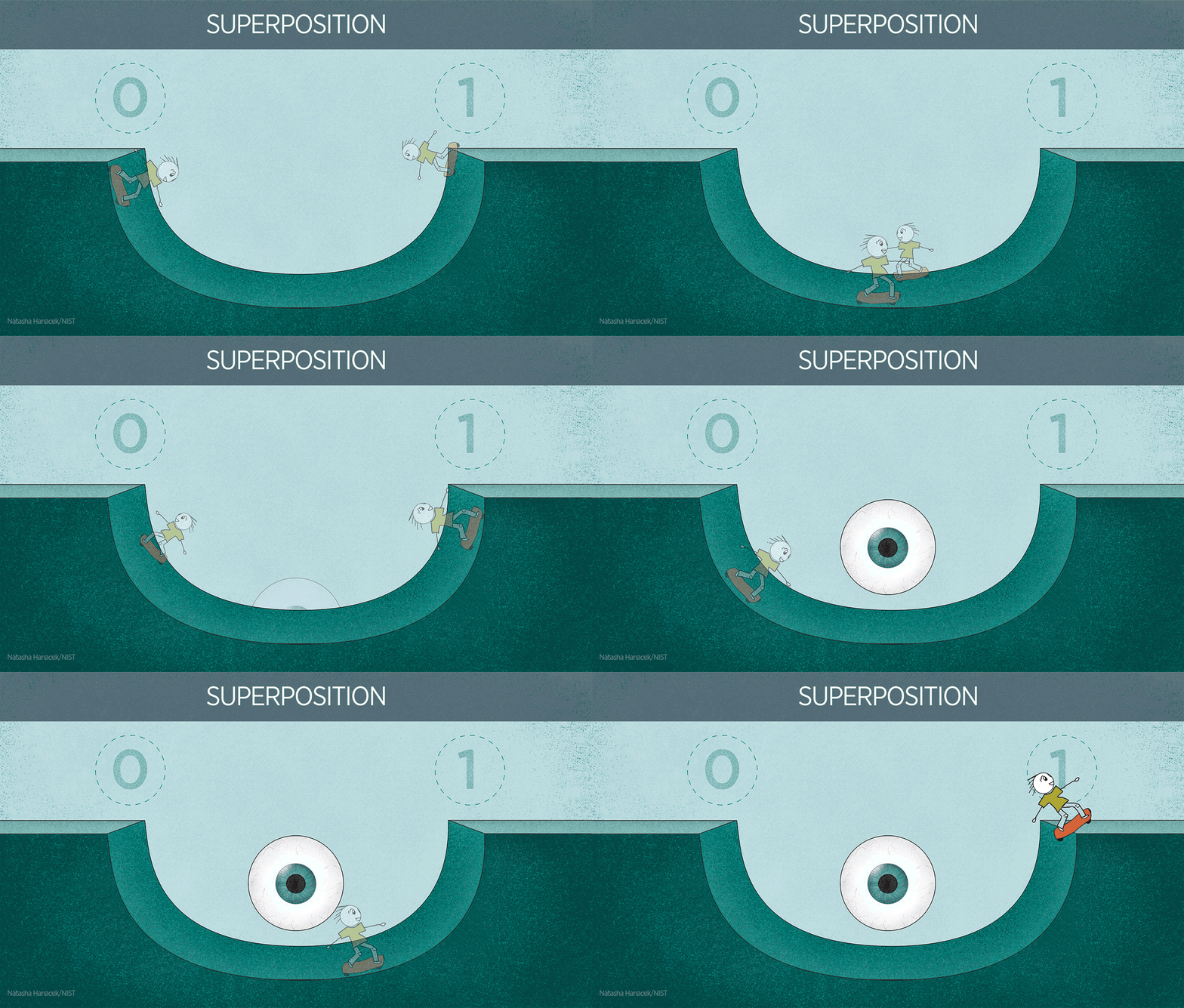
Superposition: In the quantum world, particles can exist in multiple states at once.
The Heisenberg uncertainty principle: Nature imposes a fundamental limit on how precisely you can measure something. (You can’t measure certain pairs of properties at the same time with unlimited precision.)
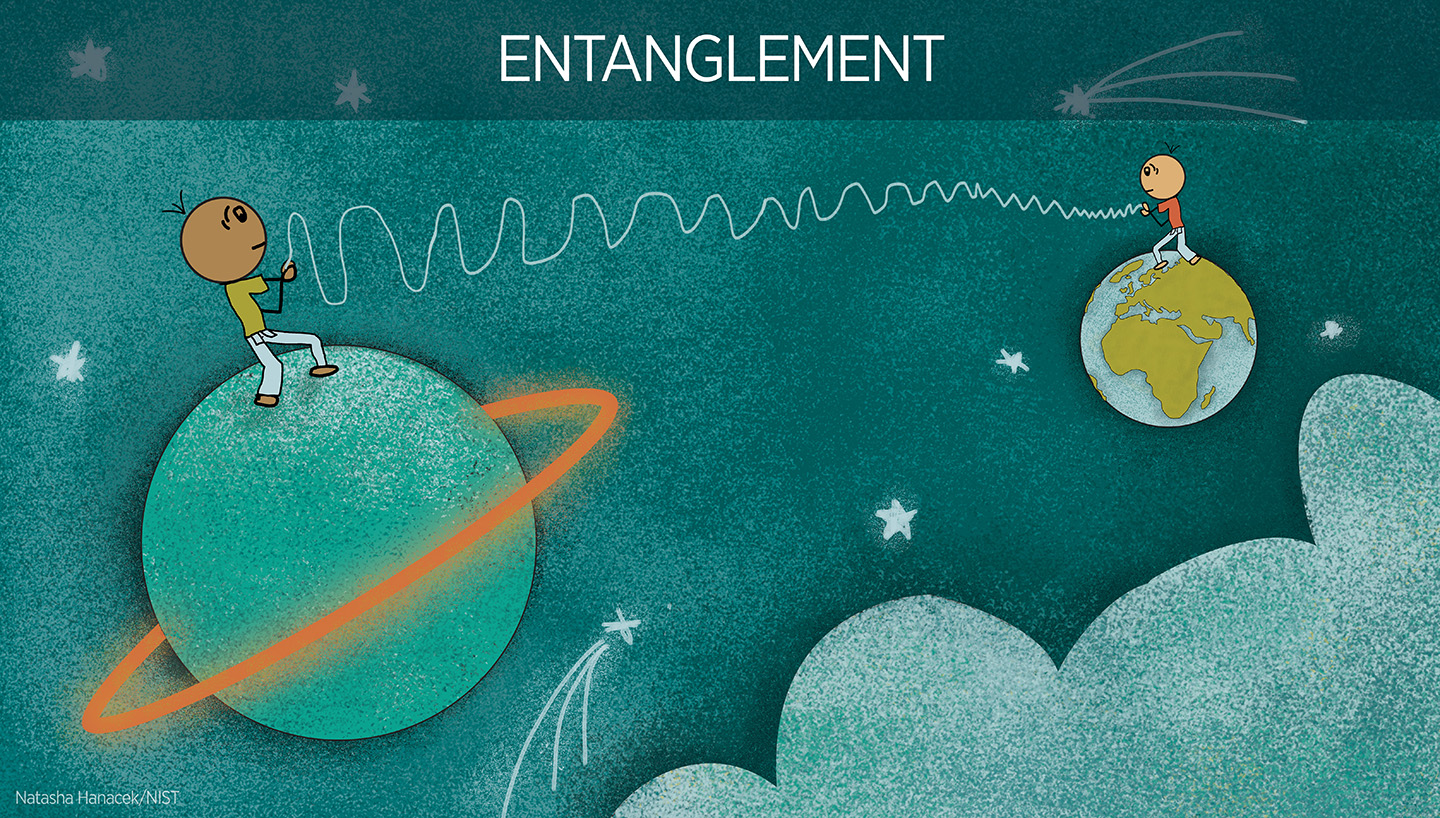
Entanglement: Two things can be so interconnected that they influence each other, regardless of distance apart.
Spin: Spin is a fundamental characteristic of elementary particles. Like mass or charge, spin determines a particle’s behavior and interaction with other particles.
I will discuss how these behaviors are central to emerging quantum technologies like quantum computing and quantum cryptography and how they manifest in fantastic ways in the natural world.
Wave-Particle Duality
The fuzziness at the granular level occurs because these tiny particles act a bit like waves (similar to water waves and radio waves). Remember the definition of wave-particle duality: Tiny particles like electrons and photons can appear to behave like waves or particles, depending on how you observe them. The wave-like properties of particles at the quantum level are like water waves; they can interfere with one another, resulting in “ripples.” The ripples allow us to predict the particles’ behavior (where they are most likely to be found, what energy they are likely to have and how they will interact with other particles).
Take light as an example.
When light passes through water droplets, the light can act like waves that form the beautiful patterns of a rainbow.
On the other hand, when light hits a solar panel, it acts like a particle. Because we observe the photons’ energy being deposited in chunks (like a solid ball hitting a screen), we perceive them as behaving like particles.
Superposition
To better understand the energetic states of particles, I can draw an analogy to musical instruments. Instruments have many notes (tones, vibrations or frequencies) that they can sound on. When you add energy to an atom, for example, you can excite the cloud of electrons that surround the atom, like striking a drum. Just as a musical instrument can sound on multiple tones because of the mechanical structure of the drum, superposition allows particles to exist in multiple “states” at the same time. This is because of the force or “tension” the nucleus creates on the electron cloud.
In the quantum world, particles can exist in multiple states at once. Credit: N. Hanacek/NIST.
Superposition in action
Superposition is extremely useful in quantum technologies. For instance, superposition is used to make atoms oscillate in atomic clocks. It’s also important to note that physicists have quite a bit of control over superposition in well-controlled systems like atomic clocks. Physicists can control the atom to be in one electronic state or another. Or they can create a superposition of both states.
You can imagine superposition as being similar to a pendulum swinging between positions (one at the far left and one at the far right). When oscillating, the pendulum is at neither position but oscillating from one position to the other. The “swinging” back and forth between the platforms is the oscillation that forms the clock signal, just like the oscillation of a pendulum, just way faster!
Heisenberg Uncertainty Principle in Measurement
The notion of uncertainty exists for measurements of all physical systems but becomes really apparent at the quantum scale.
When you try to measure the state of any system, you inevitably disturb it at some level. Why? Because to observe it, you typically need to interact with it using some type of probe.
For instance, we use photons bouncing off objects to see them with our eyes, a form of measurement that allows us to judge an object’s position, movement and size. The light bouncing off a skyscraper doesn’t have large enough energy to significantly disturb the skyscraper. But if the skyscraper were as small as an electron, the energy could become comparable enough to the skyscraper’s to significantly disturb its state.
This is part of the essence of the Heisenberg uncertainty principle, which says that the act of measurement disturbs the quantum state of the object. As a result, there are limits to how precisely certain pairs of properties, like position and momentum and time and energy, can be known simultaneously.
Entanglement
Quantum entanglement occurs when the quantum states of two or more particles become strongly correlated. This means the state of one particle can instantaneously influence the state of the other, regardless of distance. A common analogy to understand correlation is to think of two entangled photons as two coins that always land the same way when you flip them.
In the quantum phenomenon known as entanglement, the properties of two particles are intertwined even if they are separated by great distances from each other.Credit: N. Hanacek/NIST.
In quantum key distribution (QKD), entangled photons are used to securely exchange cryptographic keys (like in financial transactions for banks or top-secret military messages). If an eavesdropper tries to intercept the photons, the act of measuring them disturbs their quantum state, causing a detectable change in the correlation between the photons. This disturbance alerts the communicating parties to the presence of an eavesdropper, ensuring the security of the key exchange.
Entanglement in action: quantum communication and computation
Entanglement and superposition are used in many of the newer quantum technologies being developed today, such as quantum networking, quantum communication and quantum computing. Quantum bits, or qubits, that are entangled with each other have a potential “quantum advantage” that can allow them to solve some calculations much faster than classical computers and that allows exponential improvement of computing power with the number of qubits.
Spin
While wave-particle duality, superposition, the Heisenberg uncertainty principle and entanglement are all manifestations of the fact that quantum systems have wave-like behavior, spin is off on its own.
Although deeply associated with quantum mechanics, spin is just a characteristic a particle has when it’s created, similar to mass and charge. Despite its name, the term “spin” doesn’t mean the particle is actually spinning.
The spin of electrons, neutrons and protons that make up an atom make it possible for them to form stable structures, such as the elements, planets and our bodies. Your own body and anything you interact with in the physical world exists in its current form because spin gives the particles volume! Electrons can’t occupy the same space because of their given spin. This is what gives matter volume.
Photons have a different spin than electrons, protons, and neutrons, allowing them to occupy the same space. This gives photons remarkable qualities. If you have noticed, you can feel the warmth of light, and you can see it, but you can’t hold it or touch it like you can hold things made of matter like pencils, table,s and pets.
Spin in action: lasers
The fact that photons can occupy the same space is responsible for the amazing utility of the laser. In lasers, all the photons can perfectly overlap with one another so that all the peaks and troughs of the light waves are perfectly aligned and added together. This allows lasers to create something like a superwave, so all the photons work together in the same space and at the same time. This allows lasers to cut metal, even if they operate with powers similar to a light bulb.
Making Quantum Accessible for All
I am deeply passionate about making quantum mechanics and quantum technology accessible to the public because I envision a future where the applications of these technologies reflect the diverse voices of all demographics.
The impact of quantum technology and computing will be profound. Quantum may bring us more secure communication systems, solve problems like how to design better medicines, and much more. It’s crucial that everyone has a role in shaping how these innovations evolve to benefit humanity and the planet.
This piece was published first on the NIST website
Tara Fortier is a physicist and project leader in NIST’s Time and Frequency Division.
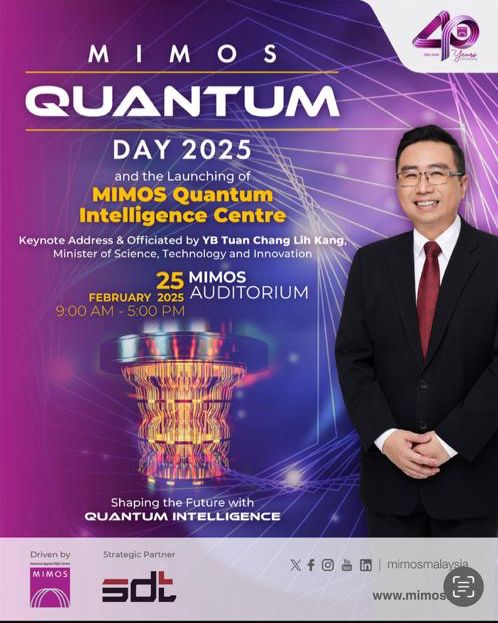
MIMOS Quantum Day 2025 marks a pivotal moment in Malaysia’s technological evolution, celebrating the launch of the MIMOS Quantum Intelligence Center. This event will bring together global experts, policymakers, and industry leaders to discuss the role of quantum computing, quantum AI, and quantum cryptography in shaping Malaysia’s innovation landscape.
El Día Cuántico 2025 de MIMOS marca un momento crucial en la evolución tecnológica de Malasia, celebrando el lanzamiento del Centro de Inteligencia Cuántica de MIMOS. Este evento reunirá a expertos mundiales, responsables políticos y líderes del sector para debatir el papel de la informática cuántica, la IA cuántica y la criptografía cuántica en la configuración del panorama de la innovación de Malasia.