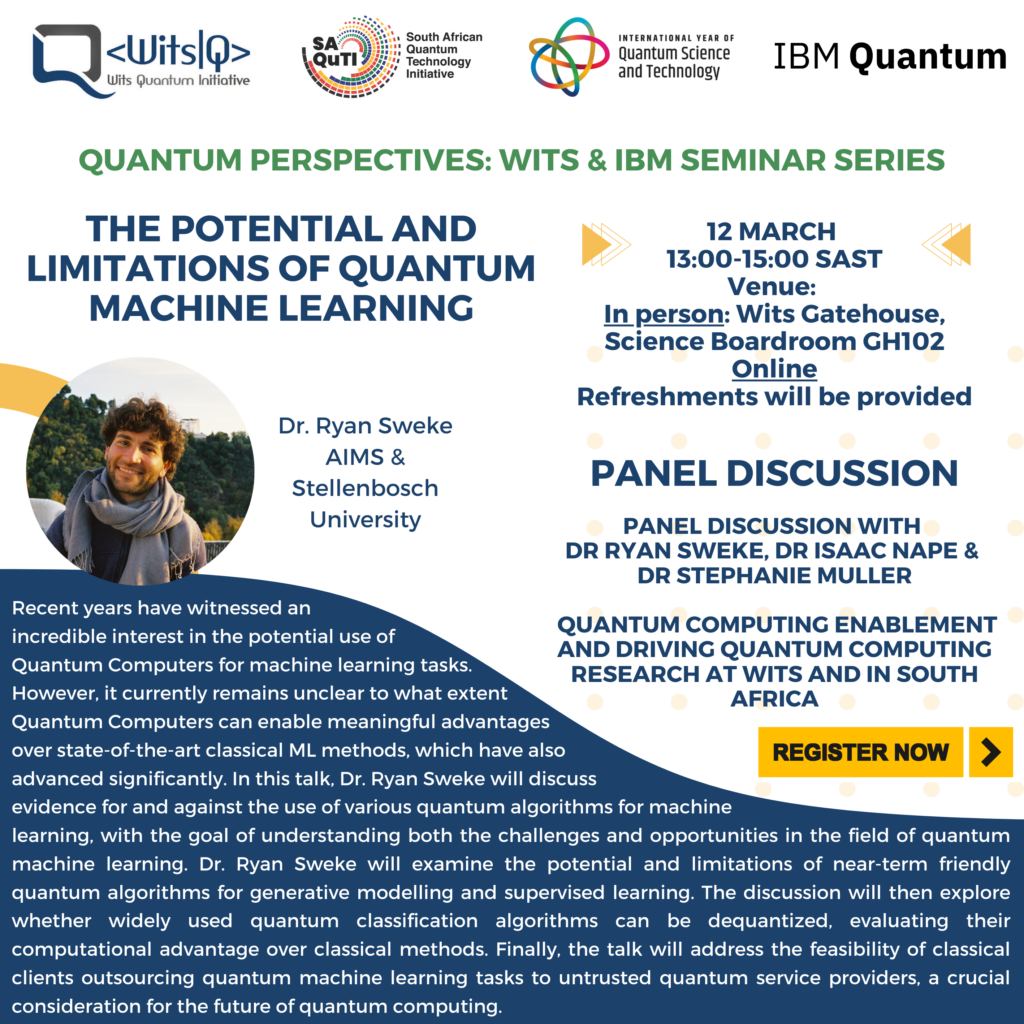
Quantum Perspectives: WITS & IBM Seminar Series
Seminar on the potential and limitations of quantum machine learning followed by a panel discussion on Quantum computing enablement and driving quantum computing research at Wits and in South Africa.

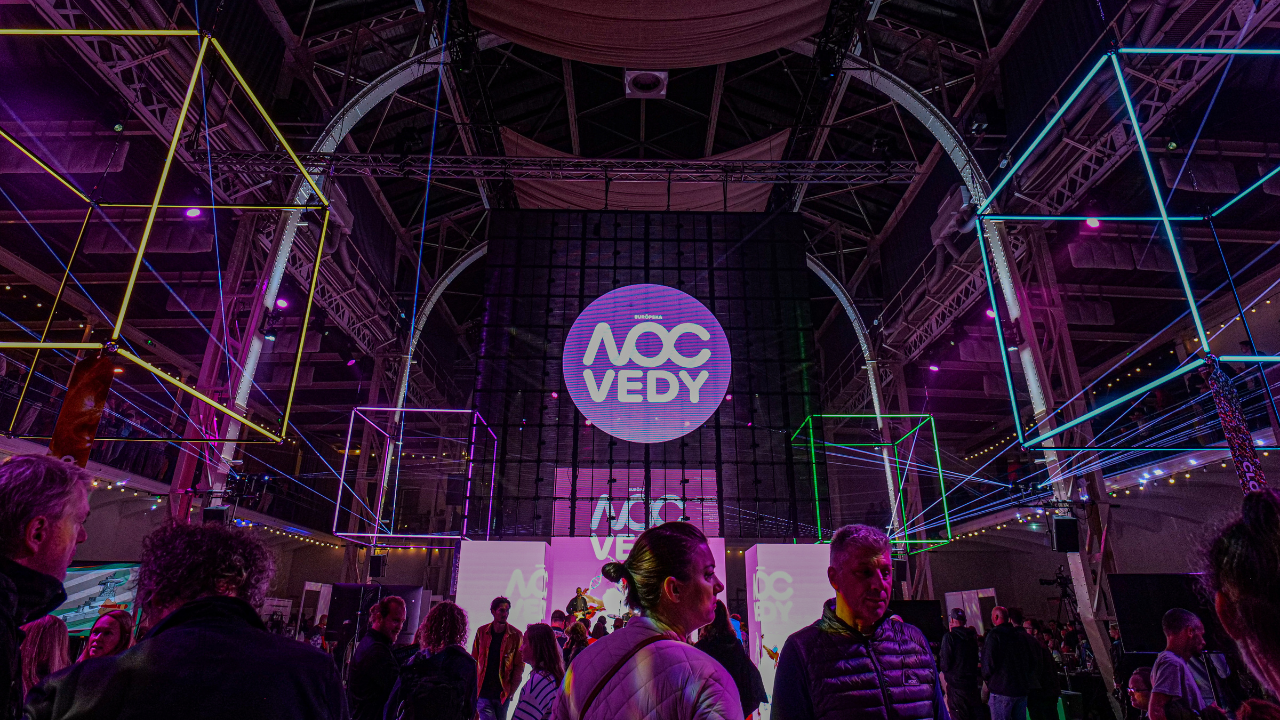
European Researcher’s Night Slovakia
European Researcher’s Night is the biggest science festival in Slovakia, and it brings news from the world of research and innovation in an inspiring and unique way.
The festival is traditionally held on the last Friday of September in Bratislava, Košice, Banská Bystrica, Žilina, Poprad, and other accompanying locations. The day-long program (9 am to 11 pm) offers a series of scientific presentations, discussions, experiments, workshops, technological attractions and so much more!
What 2025 holds
The scientific community is increasingly confronting the limitations of traditional predictive models and linear approaches in analyzing complex systems. Chaos, once understood as a synonym for disorder, is now seen as an inherent property of dynamic processes, where sensitivity to initial conditions and nonlinearity determine their evolution. Instead of perceiving uncertainty as an obstacle, we can interpret it as a catalyst for scientific discoveries and technological innovations.
Last year’s theme of complexity highlighted the interdisciplinary connections in research. This year, as part of the Night of Science, we will explore chaos as a fundamental mechanism of adaptation, evolution, and transformation in various systems. The event will open discussions on how scientific disciplines approach uncertainty and nonlinearity and what paradigmatic shifts these phenomena imply.
Quantum Physics and Chaos: Uncertainty as an Epistemological and Technological Imperative
At the quantum level, uncertainty is a fundamental property of systems. Quantum fluctuations, state superposition, and wave function collapse challenge classical notions of predictability and deterministic understanding of reality. Quantum physics thus provides a natural link between chaotic phenomena and the emergence of new orders, where uncertainty becomes a source of technological innovations.
The International Year of Quantum Science and Technology 2025 offers a unique opportunity to explore the relationship between chaotic processes and quantum mechanics. Quantum algorithms utilize chaotic behavior to solve nonlinear problems, while quantum communication protocols introduce new standards of security and efficiency in information transmission.
Chaos in Nature and Society: Mechanisms of Stability and Transformation
In natural systems, chaos does not merely represent entropy but also stabilization and emergent organization. From climate processes and ecosystem interactions to neural networks and evolutionary mechanisms – nonlinear dynamics lead to the formation of self-organizing structures and adaptive strategies.
Similar principles apply to social and technological systems. Financial markets, digital networks, and information ecosystems exhibit chaotic behavioral patterns, where even minimal perturbations significantly influence global outcomes. This presents challenges for modeling, regulating, and managing complex systems.
Night of Science 2025 will offer an interdisciplinary perspective on the connection between chaos, quantum technologies, natural phenomena, and social dynamics. We will explore how uncertainty shapes innovation processes and what epistemological and technological implications we can extrapolate for a better future. Chaos is not just a challenge – it represents a potential key to new scientific paradigm shifts.

Quantum Computing Industry Training
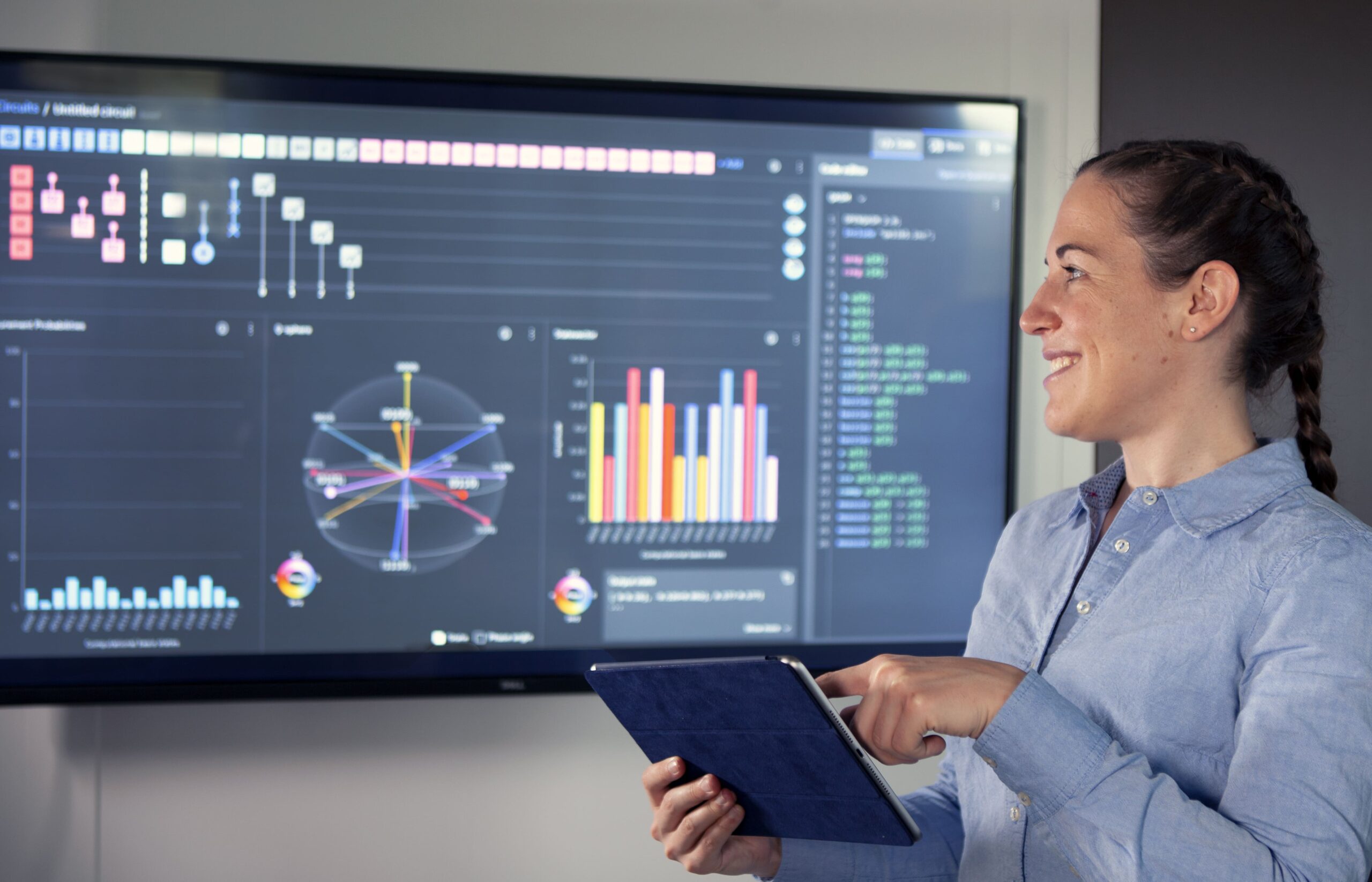
Quantum computing promises great potential for companies in almost all sectors thanks to its speed and precision advantages. The combination with machine learning methods also opens up new possibilities. How do quantum computers work, what principles are their programming based on, and why does the so-called “quantum advantage” promise a disruptive change in the IT industry? In a 3-day course, the quantum team of the Fraunhofer IAO trains the experts of tomorrow.
The free training program provides comprehensive knowledge in the field of quantum computing, from basics to application. The course aims at a general understanding of quantum technology and builds up the necessary key skills for industrial application. Four modules will teach you how to assess the key technology of quantum computing, how to deal with it and how to apply it in a targeted manner: Basics, Hardware, Algorithms, and Application.
We invite participants to join us in learning about the phenomena of the quantum world, the differences between today’s system architectures, and the basics of programming them. From the principles of quantum mechanics, we take the exciting path to their industrial application and work on a wide variety of use cases, for example, in the fields of quantum chemistry, finance, optimization, or quantum machine learning.
International Conference on Quantum Computing
The International Conference on Quantum Computing 2025 (ICoQC2025) will present the state of the art in quantum computing research from different perspectives: significant progress and novelties on the hardware, strategies and architectures for protecting quantum information, quantum algorithms themselves, and related enabling technologies. It is a follow-up on ICoQC 2018 with a similar program, composed of invited talks, contributed talks and poster sessions.
The conference will be held from May 12 to 16, 2025 in Paris.
2025 APS Global Physics Summit, Global Satellite Session – Serbia: Novel Topics in Quantum Science and Technology
The event will present quantum science and technology research by invited speakers during the virtual session and by early-career scientists during the poster session. It will aim at increasing public awareness about quantum science and its applications, and also the importance of international and interdisciplinary cooperation among researchers and institutions in quantum science and technology.
Quantum Machine Learning Conference 2025
🚀 Join Us for the 5th Quantum Machine Learning Conference! 🚀
QPoland and Fundacja Quantum AI invite you to the 5th edition of the Quantum Machine Learning Conference, an online-only event bringing together leading experts in quantum computing and AI.
📅 Date: March 15, 2025
⏰ Time: 11:00 AM UTC+1
🌍 Where: Online (Zoom)
📢 Agenda:
🎤 11:00 – Introduction to Quantum Machine Learning – Paweł Gora
🎤 11:30 – Measuring and Interpreting the States of Temporal Quantum Models – Jacob Cybulski
🎤 12:00 – Data Preparation for Quantum Autoencoders – Sebastian Zając
🎤 12:30 – KANQAS: The Implications of Kolmogorov-Arnold Networks in the Quantum Domain – Akash Kundu
🎤 13:00 – The Cost of Quantum Kernel Methods: Insights into Resource Estimation – Artur Miroszewski
🎤 13:30 – Exploring Quantum Machine Learning & Quantum Federated Learning for Financial Fraud Detection – Nouhaila Innan
🎤 14:00 – Automated Quantum Machine Learning as a Hyperparameter Optimization Problem – Tomasz Rybotycki
🔗 Register now.
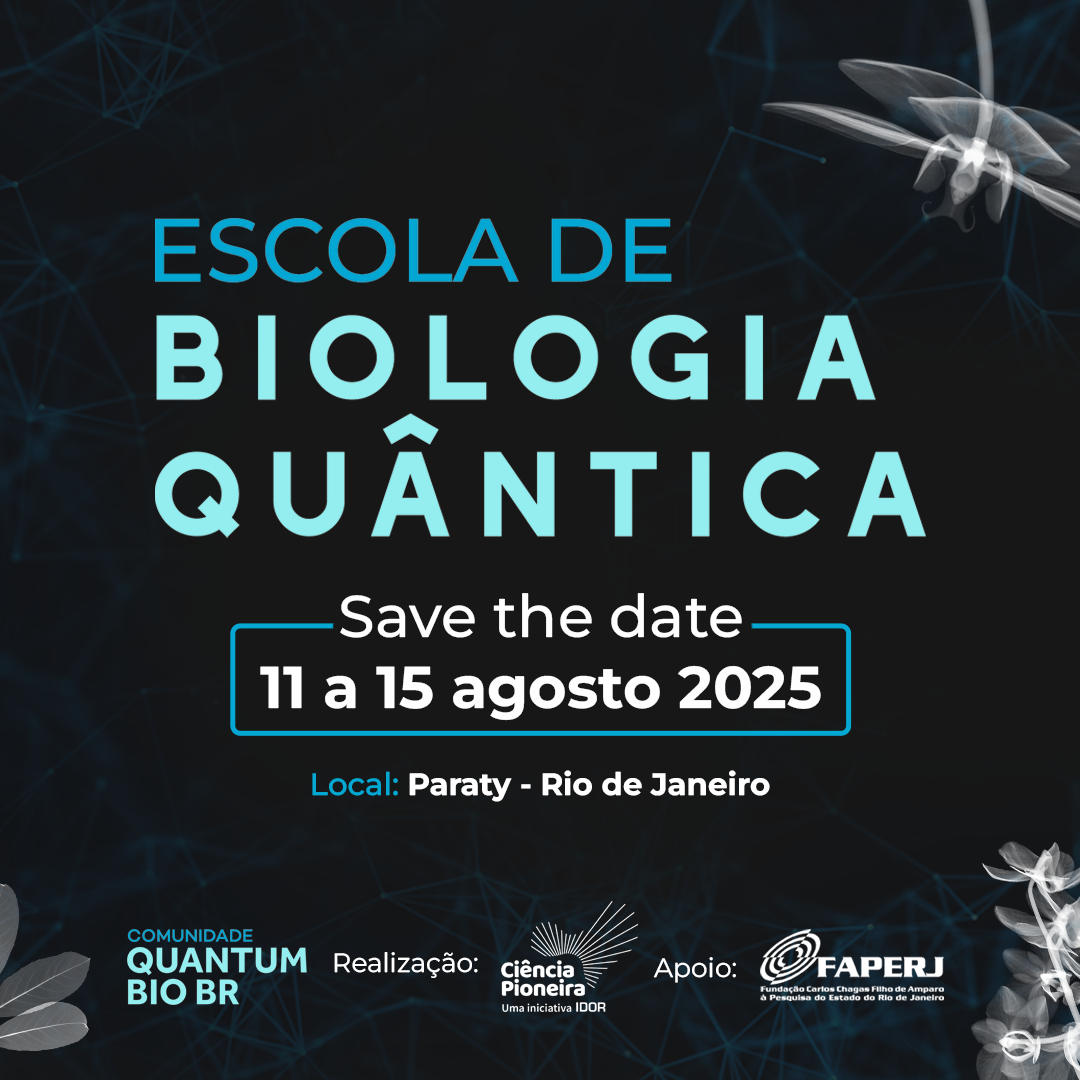
Quantum Biology School
The Quantum Biology School is organized by Pioneer Science, an independent, non-profit initiative created by the D’Or Institute for Research and Education (IDOR) to intensify disruptive scientific discovery in Brazil.
The school will inspire a new generation of researchers to explore how quantum processes influence biological phenomena, from enzyme function to photosynthesis. The program fosters research, trains specialists, and promotes collaborations in this emerging field.
Taught in Portuguese, the school features renowned professors Clarice Aiello, Marcelo Terra Cunha, Marucia Chacur, Luiz Davidovich, and Pedro Pascutti.
Participants will also engage in poster sessions and attend international seminars with experts like Paul Davies (Arizona State University), Peter Hore (University of Oxford), and Fabrisia Ambrosio (Harvard Medical School).
With a strong focus on theory, experimentation, and computational simulations, the school is a key step in positioning Brazil at the forefront of this revolutionary field.
📢 This event went through a widely publicized and open pre-selection process but is now closed to new entries.
Warsaw Quantum Computing Group, Episode LXV
We invite you to attend (online-only) Episode LXV of Warsaw Quantum Computing Group meetups!
On 6.03.2025, at 18:00 UTC+1, Alex Linden will give a talk “Google’s Willow quantum chip: Pioneering Advancements in Quantum Error Correction and Scalable Computing”.
If you are interested, please sign up here by 5.03.2025 (EOD UTC+1).
Quantum Conferences
Del 24 al 28 de febrero de 2025, la Facultad de Ciencias Físico-Matemáticas de la UMSNH será sede de las Quantum Conferences, una serie de conferencias presenciales con transmisión en vivo, diseñadas para explorar los aspectos más novedosos y fundamentales de la física cuántica.
Este ciclo académico reunirá a destacados especialistas nacionales e internacionales que compartirán sus conocimientos y experiencias en áreas como física de partículas, física teórica, química cuántica, computación cuántica y el estudio de nanomateriales.
Conferencistas y charlas:
- Oracio Navarro Chávez – “Superconductividad y materiales de moiré” | Lunes 24, 12:00 (GMT-6)
- Alejandro Corichi Gil – “Una charla sobre lo cuántico y lo gravitacional” | Lunes 24, 13:00 (GMT-6)
- Alfredo Raya Montaño – “NICA, JINR y la física de aplastar hadrones” | Lunes 24, 14:00 (GMT-6)
- José Antonio Zapata – “Física Cuántica y espaciotiempo” | Martes 25, 11:00 (GMT-6)
- Francisco Shidartha Guzmán – “Una mirada a la computación cuántica” | Martes 25, 12:00 (GMT-6)
- Rodolfo Octavio Olea – “Química Cuántica” | Martes 25, 13:00 (GMT-6)
- Guohua Sun – “Computación Cuántica” | Miércoles 26, 11:00 (GMT-6) (Virtual)
- Carlos Villarreal Luján – “Un Fenómeno Extraordinario: el Vacío Cuántico” | Miércoles 26, 12:00 (GMT-6)
- Jennifer López Chacón – “¿Por qué es importante hacer divulgación sobre la física cuántica?” | Miércoles 26, 13:00 (GMT-6)