

European Researcher’s Night Slovakia

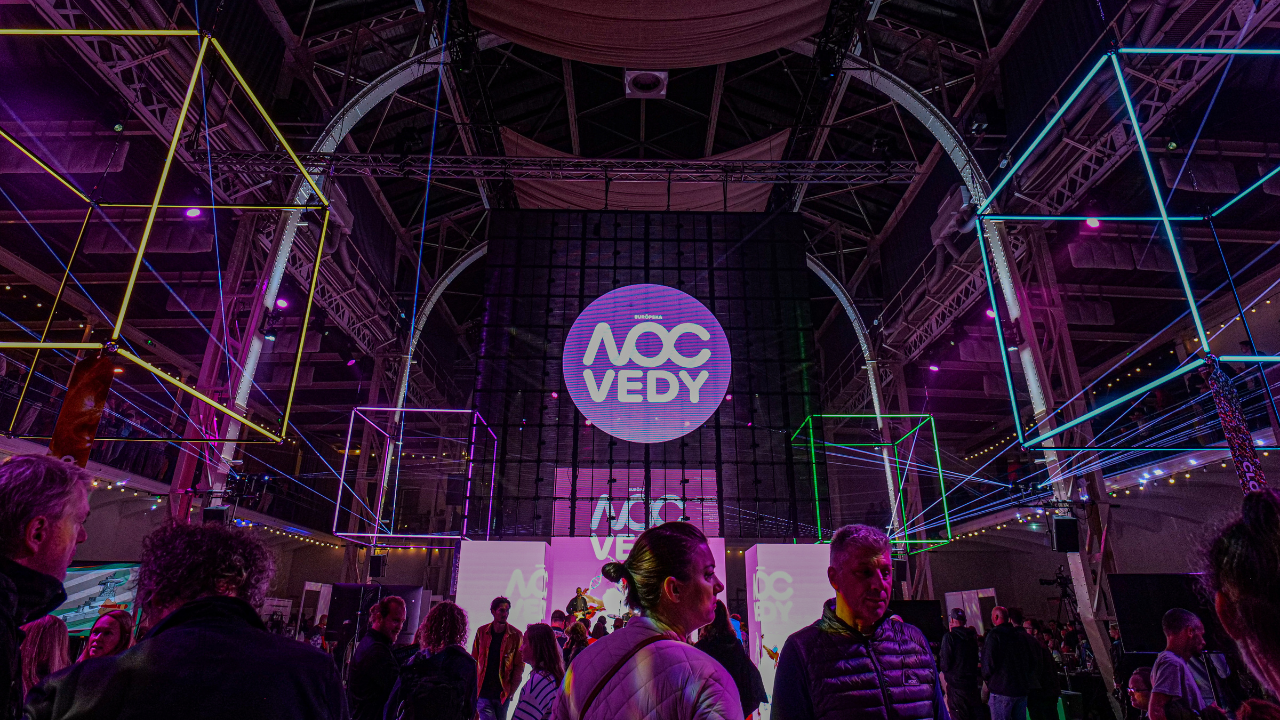
European Researcher’s Night is the biggest science festival in Slovakia, and it brings news from the world of research and innovation in an inspiring and unique way.

The festival is traditionally held on the last Friday of September in Bratislava, Košice, Banská Bystrica, Žilina, Poprad, and other accompanying locations. The day-long program (9 am to 11 pm) offers a series of scientific presentations, discussions, experiments, workshops, technological attractions and so much more!

What 2025 holds

The scientific community is increasingly confronting the limitations of traditional predictive models and linear approaches in analyzing complex systems. Chaos, once understood as a synonym for disorder, is now seen as an inherent property of dynamic processes, where sensitivity to initial conditions and nonlinearity determine their evolution. Instead of perceiving uncertainty as an obstacle, we can interpret it as a catalyst for scientific discoveries and technological innovations.

Last year’s theme of complexity highlighted the interdisciplinary connections in research. This year, as part of the Night of Science, we will explore chaos as a fundamental mechanism of adaptation, evolution, and transformation in various systems. The event will open discussions on how scientific disciplines approach uncertainty and nonlinearity and what paradigmatic shifts these phenomena imply.

Quantum Physics and Chaos: Uncertainty as an Epistemological and Technological Imperative

At the quantum level, uncertainty is a fundamental property of systems. Quantum fluctuations, state superposition, and wave function collapse challenge classical notions of predictability and deterministic understanding of reality. Quantum physics thus provides a natural link between chaotic phenomena and the emergence of new orders, where uncertainty becomes a source of technological innovations.

The International Year of Quantum Science and Technology 2025 offers a unique opportunity to explore the relationship between chaotic processes and quantum mechanics. Quantum algorithms utilize chaotic behavior to solve nonlinear problems, while quantum communication protocols introduce new standards of security and efficiency in information transmission.

Chaos in Nature and Society: Mechanisms of Stability and Transformation

In natural systems, chaos does not merely represent entropy but also stabilization and emergent organization. From climate processes and ecosystem interactions to neural networks and evolutionary mechanisms – nonlinear dynamics lead to the formation of self-organizing structures and adaptive strategies.

Similar principles apply to social and technological systems. Financial markets, digital networks, and information ecosystems exhibit chaotic behavioral patterns, where even minimal perturbations significantly influence global outcomes. This presents challenges for modeling, regulating, and managing complex systems.

Night of Science 2025 will offer an interdisciplinary perspective on the connection between chaos, quantum technologies, natural phenomena, and social dynamics. We will explore how uncertainty shapes innovation processes and what epistemological and technological implications we can extrapolate for a better future. Chaos is not just a challenge – it represents a potential key to new scientific paradigm shifts.
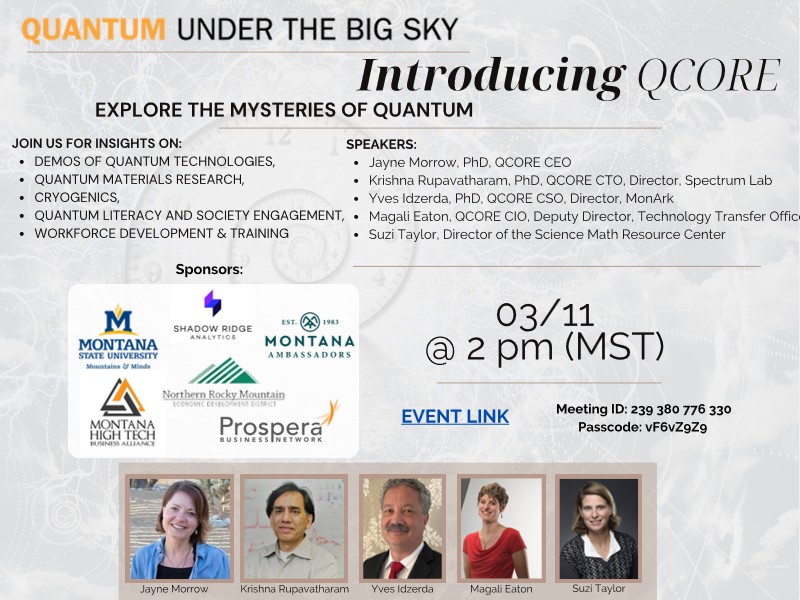
Quantum under the Big Sky: Introducing QCORE

The Montana Photonics & Quantum Alliance presents Quantum under the Big Sky: Introducing QCORE, a webinar featuring Montana State University’s QCORE. QCORE is a new research and technology development center designed to create the foundations for innovation and advocate for growing the quantum economy in Montana and the surrounding region. Currently, funded efforts are creating an applied quantum testbed that will underpin quantum networking, sensing, and computing capabilities and form the foundation for standards development.

Testbed capabilities build on existing programmatic strength in photonics research at Spectrum Lab and the quantum materials’ foundry MonArk to create synergistic capabilities and demonstrate successful pilot-scale quantum technology innovations and networked systems integration.

Join the Webinar to learn more about QCORE Programmatic Thrust Areas, Including:

  • Demonstrations of novel quantum technologies including quantum computing, sensors, and quantum networking;
  • quantum materials research;
  • cryogenics;
  • quantum literacy and society engagement;
  • workforce development, training;
  • promoting the growth of the quantum innovation ecosystem and global supply chain.

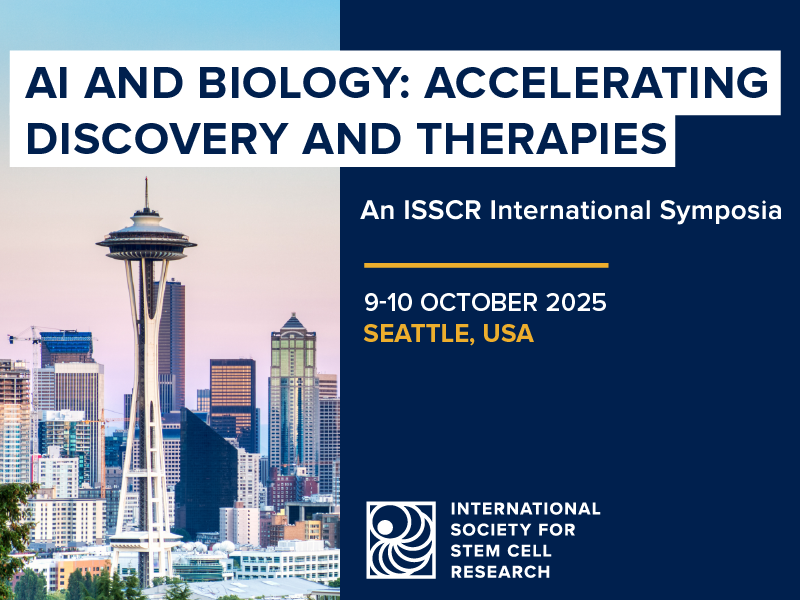
AI and Biology: Accelerating Discovery and Therapies

Recent advances in Artificial Intelligence (AI) technologies have transformed the way we approach biomedical research—from analyzing complex data, understanding development and disease, to developing new drugs and enhancing clinical outcomes. The ISSCR invites you to a unique program that aims to align data scientists and biologists to collaboratively address the challenges in AI-enabled biology and its translation to clinical applications. Join us in Seattle as we delve into the latest advancements in de novo protein and cell design, foundational models, single-cell multi-omics and multimodal imaging, manufacturing and clinical advances, diversity of data, perturbation predictions, and the emerging role of quantum computing in accelerating complex biological simulations. Connect with leading AI experts to be inspired by what the future has to offer.

International Conference on Quantum Computing

The International Conference on Quantum Computing 2025 (ICoQC2025) will present the state of the art in quantum computing research from different perspectives: significant progress and novelties on the hardware, strategies and architectures for protecting quantum information, quantum algorithms themselves, and related enabling technologies. It is a follow-up on ICoQC 2018 with a similar program, composed of invited talks, contributed talks and poster sessions.

The conference will be held from May 12 to 16, 2025 in Paris.

2025 APS Global Physics Summit, Global Satellite Session – Serbia: Novel Topics in Quantum Science and Technology

The event will present quantum science and technology research by invited speakers during the virtual session and by early-career scientists during the poster session. It will aim at increasing public awareness about quantum science and its applications, and also the importance of international and interdisciplinary cooperation among researchers and institutions in quantum science and technology.

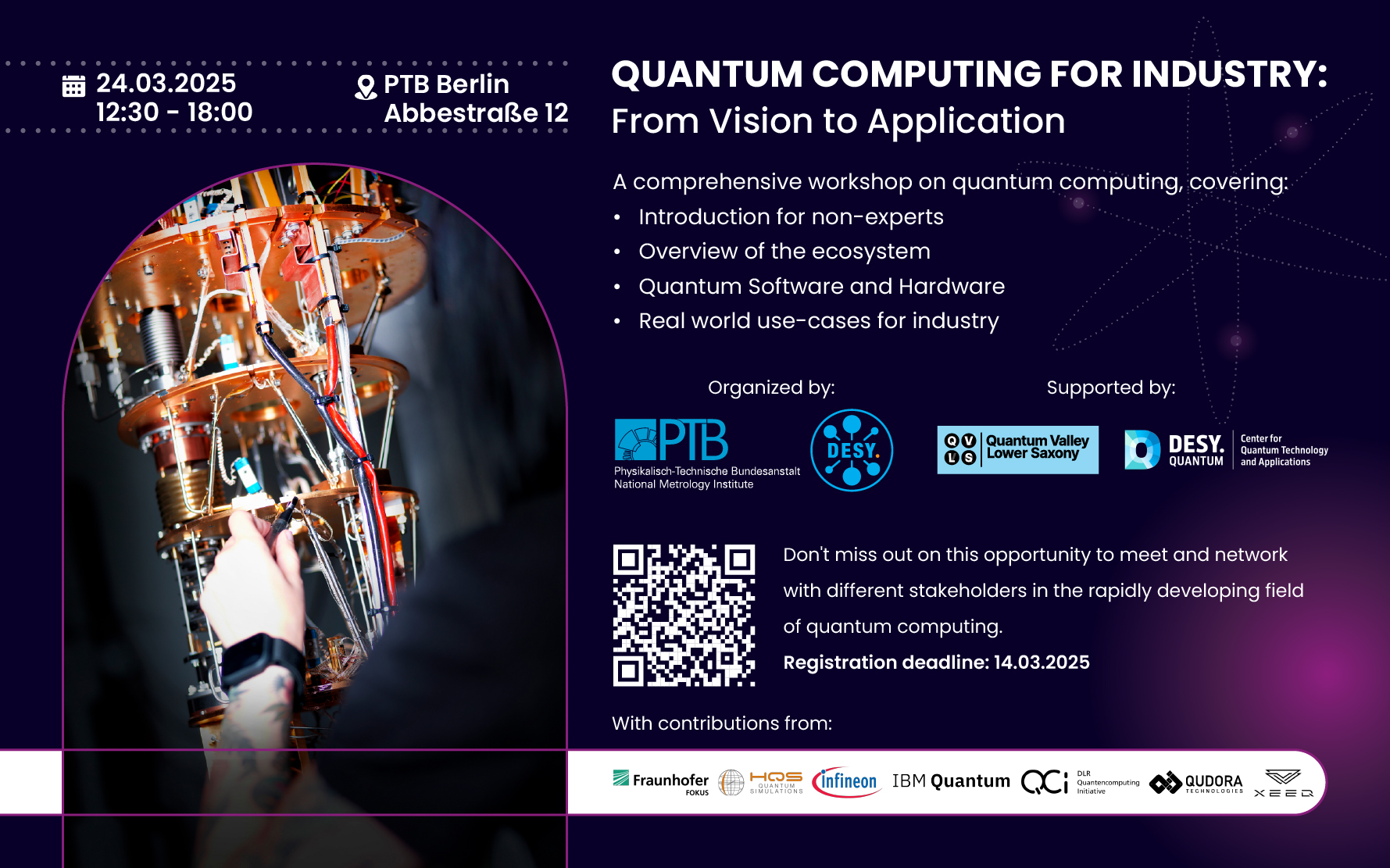
Quantum Computing for Industry: From Vision to Application

This one-day event provides a comprehensive introduction to quantum computing and its potential for industry and society. Designed for professionals across various sectors, the program offers an overview of the current quantum computing ecosystem, along with insights into emerging hardware and software technologies.

The agenda includes

A foundational introduction to quantum computing, insights into current and future quantum computing technologies, and insights into the development of quantum software.

Gain a clear understanding of the potential of quantum computing and explore how it can drive innovation. Meet quantum enthusiasts from inside and outside the field at this event.

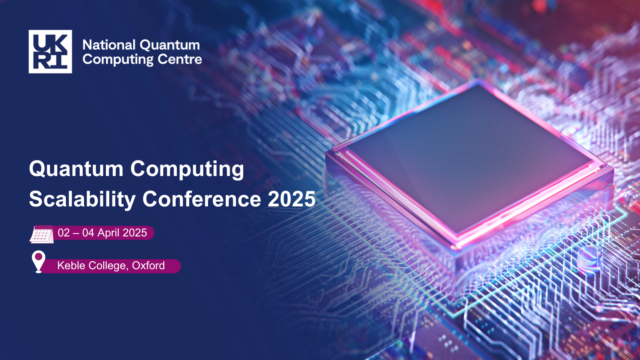
Quantum Computing Scalability Conference 2025

Scaling quantum computers is central to the NQCC’s mission. Identifying bottlenecks and addressing the most pressing challenges are critical steps toward building efficient roadmaps and supporting the growth of the UK quantum computing ecosystem. The NQCC’s Quantum Computing Scalability Conference is dedicated to tackling the key scalability issues across quantum platforms, from engineering challenges to advances in quantum physics. This conference brings together experts from diverse quantum computing fields, fostering cross-disciplinary insights and enabling honest assessments of scalability.

As the premier research-focused event hosted by the NQCC, the conference features in-depth technical talks, panel discussions, and, for the first time this year, a poster session!

Quantum Machine Learning Conference 2025

🚀 Join Us for the 5th Quantum Machine Learning Conference! 🚀

QPoland and Fundacja Quantum AI invite you to the 5th edition of the Quantum Machine Learning Conference, an online-only event bringing together leading experts in quantum computing and AI.

📅 Date: March 15, 2025
⏰ Time: 11:00 AM UTC+1
🌍 Where: Online (Zoom)

📢 Agenda:
🎤 11:00 – Introduction to Quantum Machine Learning – Paweł Gora
🎤 11:30 – Measuring and Interpreting the States of Temporal Quantum Models – Jacob Cybulski
🎤 12:00 – Data Preparation for Quantum Autoencoders – Sebastian Zając
🎤 12:30 – KANQAS: The Implications of Kolmogorov-Arnold Networks in the Quantum Domain – Akash Kundu
🎤 13:00 – The Cost of Quantum Kernel Methods: Insights into Resource Estimation – Artur Miroszewski
🎤 13:30 – Exploring Quantum Machine Learning & Quantum Federated Learning for Financial Fraud Detection – Nouhaila Innan
🎤 14:00 – Automated Quantum Machine Learning as a Hyperparameter Optimization Problem – Tomasz Rybotycki

🔗 Register now.

IYQ 2025 Opening Ceremony Vlog: 100 Years is Just the Beginning 

The International Year of Quantum (IYQ2025) Opening Ceremony at UNESCO in Paris was a landmark event, bringing together some of the world’s leading scientists, policymakers, and industry pioneers. The event marked the beginning of a year-long celebration of quantum science, highlighting its role in shaping the future of technology, education, and global collaboration.

Diya Nair, Global Lead for Outreach and United Kingdom’s Ambassador of Girls in Quantum, attended the ceremony to capture key moments from the event. She created a vlog that takes you behind the scenes, showcasing thought-provoking panel discussions, inspiring keynote insights from Nobel Laureates who have shaped the field and much more! A key focus of the discussions was speakers emphasising the importance of investing in quantum education to equip future generations with the knowledge and skills to shape this rapidly evolving field.

Another central theme was quantum’s potential to address some of the world’s most pressing challenges. Experts discussed applications in quantum sensing, which could revolutionise medical diagnostics and environmental monitoring; cybersecurity, where quantum encryption promises unprecedented levels of data protection; and financial services, where quantum algorithms could transform risk analysis and optimisation. The event truly served as a call to action, encouraging interdisciplinary collaboration between academia, industry, and governments to accelerate progress.

Watch the full vlog by Diya here:

As we celebrate 100 years of quantum science, its full potential is still yet to be realised. The discoveries made today will shape the technologies of tomorrow, and this event was a powerful reminder of how far the field has come—and how much further it can go.

Watch the full opening ceremony on the UNESCO YouTube Channel.

If you found this interesting, subscribe to Quriosity by Diya for more quantum content and share your thoughts in the comments – what excites you most about the future of quantum?

Diya Nair is the Global Lead for Outreach and UK Ambassador of Girls in Quantum.

Warsaw Quantum Computing Group, Episode LXV

We invite you to attend (online-only) Episode LXV of Warsaw Quantum Computing Group meetups!

On 6.03.2025, at 18:00 UTC+1, Alex Linden will give a talk “Google’s Willow quantum chip: Pioneering Advancements in Quantum Error Correction and Scalable Computing”.

If you are interested, please sign up here by 5.03.2025 (EOD UTC+1).