

Quantum Computing Experts from IBM, Microsoft, NVIDIA, and More Chart Course for the Field

Keynotes from the IEEE International Conference on Quantum Computing and Engineering—IEEE Quantum Week—will shed light on today’s milestones and what’s coming next

(IEEE is an IYQ sponsor.)

As quantum computing continues its transformation from a foundational research endeavor to a viable commercial tool, institutions, companies, and agencies that have embraced the technology from its origins now have industrial developments to report. Quantum leaders from industry, academia, and government are convening at the IEEE International Conference on Quantum Computing and Engineering—IEEE Quantum Week—from 31 August to 5 September in Albuquerque, N.M., U.S., to discuss the state of quantum engineering today and how its evolution is driving the next generation of computing. Nine keynotes from renowned quantum organizations will address the current quantum computing dynamic, emerging opportunities, and near-term potential. 

“IEEE Quantum Week keynotes address the most important developments in the field, and with the acceleration of initiatives we have seen over the past year, they have much to discuss,” said Candace Culhane, IEEE Quantum Week 2025 Chair and Quantum Science Coordinator at Los Alamos National Laboratory in Los Alamos, N.M. “From reflections on quantum engineering’s origins to its very real potential now, these renowned speakers will both challenge and inspire us to expedite our timelines and apply newfound quantum knowledge to address the world’s computing problems.”

Setting today’s foundation 

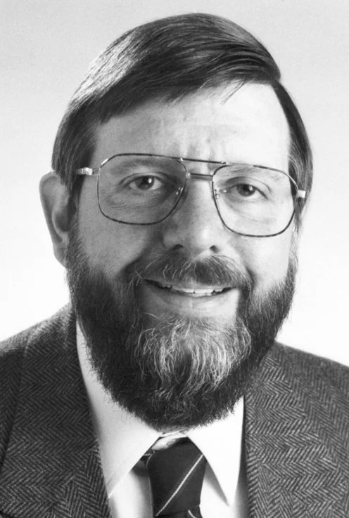
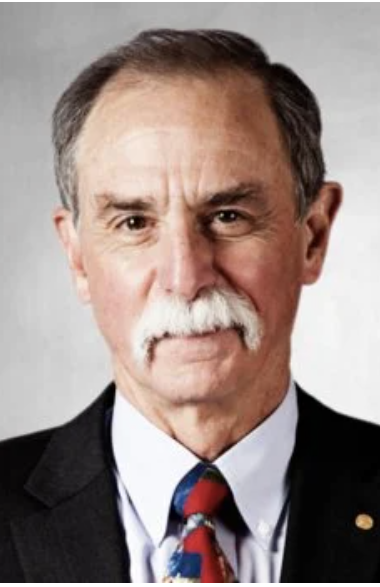
And perhaps no one would be better at providing insights into how to stay the course amidst uncertain outcomes than Nobel Laureates David Wineland and William Phillips. The recipient of the 1997 Nobel Prize in Physics “for development of methods to cool and trap atoms with laser light,” Phillips now focuses some of his research on quantum information with single-atom qubits, and Wineland, recipient of the 2012 Nobel Prize in Physics “for ground-breaking experimental methods that enable measuring and manipulation of individual quantum systems” continues to find passion in research on quantum information, quantum computing, and quantum limits to measurements. The two luminaries will be speaking together in an IEEE Quantum Week keynote on the morning of Tuesday, 2 September. 

William D. Phillips
Nobel Prize in Physics 1997.

Another two of this year’s keynotes hail from the University of California, highlighting a key focus on quantum in that region. Prineha Narang, professor and the Howard Reiss Chair in Physical Sciences at the University of California, Los Angeles, will speak on the evening of Wednesday, 3 September, followed by a presentation on Thursday, 4 September, from Chetan Nayak, professor, University of California, Santa Barbara, and technical fellow at Microsoft. Certainly, Microsoft’s February announcement about the world’s first quantum processor powered by topological qubits will be front and center at IEEE Quantum Week, and attendees can expect to hear debate about its impacts and what’s next. 

Applying today’s technology

To that point, much has happened with quantum engineering to enable more widespread commercialization of the technology since last year’s IEEE Quantum Week event. 

Take, for instance, the idea of distributed quantum computing in silicon. Stephanie Simmons, chief quantum officer at Photonic, will be speaking on Thursday, 4 September, in the evening. Earlier this year, Photonic announced that it had developed “a new, low-overhead family of Quantum Low-Density Parity Check (QLDPC) codes that can efficiently perform both quantum computation and error correction, using materially fewer quantum bits (qubits) than traditional surface code approaches…. [to enable] cost-effective quantum computing at scale.” 

Or consider the planned Wednesday, 3 September, morning address from Peter Shadbolt, co-founder and chief scientific officer at PsiQuantum, which was awarded a contract with Air Force Research Laboratory to deliver quantum chip capabilities to the U.S. Air Force. 

David Wineland
Nobel Prize in Physics 2012

Or look no further than a Friday, 5 September, morning keynote, Sam Stanwyck, head of quantum computing product at NVIDIA, which announced earlier this year that they are building an accelerated quantum computing research center in Boston. 

“With so much momentum behind quantum commercialization, we can expect continued announcements about R&D milestones at IEEE Quantum Week and beyond,” remarked Culhane. “Quantum engineering has hit an unprecedented level of applicability, and I expect we’ll only see this focus continue to grow.” 

Preparing for the future

Because as new potential emerges, the focus on fundamental research is met with an intentionality around products and solutions. 

For instance, on Monday, 1 September, evening keynote speaker Rodney Van Meter, professor of environment and information studies at Keio University in Japan, notes that his research group is focused on “bridging the gap between theoretical algorithms and real-world experiments to accelerate the deployment of useful quantum information technology.” 

Jay Gambetta, Tuesday, 2 September, evening keynote speaker and vice president of quantum at IBM, leads the IBM Quantum initiative, which recently has been prophesying the dawn of quantum advantage, the point at which quantum computers are shown to be more efficient, more accurate, or cheaper than classical computers for a particular task. 

And as quantum evolves, a highly trained workforce will be key to supporting its future applicability. Organizations like Elevate Quantum, the Mountain West’s innovation engine for quantum technology, are driving those developments on a regional scale. In fact, Elevate Quantum just announced that IBM joined its consortium with plans to “help train over 3,500 learners by 2030 in quantum software and algorithms, thereby supporting nearly 30% of the anticipated quantum workforce needed for the Mountain West.” IEEE Quantum Week attendees can expect to hear more about the future of the workforce when Zachary Yerushalmi, Elevate Quantum’s CEO and regional innovation officer, gives his morning keynote address on Monday, 1 September.

From technology breakthroughs to broader accessibility and job creation, the future is quantum. IEEE Quantum Week keynotes will expound on why, and the full program will allow attendees not only to witness the dawn of a new era but also to participate in its formation. Now’s the time to get involved in shaping what’s next for quantum engineering. 

For more information on the IEEE Quantum Week keynotes and program or to register, visit https://qce.quantum.ieee.org/2025/

A Life Dedicated to Quantum Science, Peace, Equity, and Universal Access to Knowledge

Interview with Dr. Ana María Cetto, Mexican physics professor and researcher, promoter of the International Year of Quantum Science and Technology, leader of two Nobel Peace Prize-winning organizations, and IYA’s Tate 2025 Medal.

Many scientists dedicate their entire lives to research and achieve great accomplishments. But to gather the merits that Ana María Cetto, professor and researcher at the National Autonomous University of Mexico, has accumulated would take several lifetimes. Her trajectory is so broad and deep that a few minutes of conversation with her are enough to leave us both impressed and inspired.

In addition to an outstanding scientific career researching the fundamentals of quantum mechanics, Ana María has worked tirelessly for peace, gender equity, and universal access to knowledge. Her understanding of science as an integral commitment to society, combined with her international leadership, has made her a voice admired and listened to around the world. It was precisely this spirit that led her to be one of the main driving forces behind the declaration of the International Year of Quantum Science and Technology (IYQ).

We had the successful precedent of the International Year of Light, in 2015, in which a very, very small group of scientists got down to work and devoted a lot of time and effort, also diplomatic, and it was a fantastic experience,” Dr. Cetto explains enthusiastically. “The idea [of IYQ] arose within some scientific societies who took it to the International Union of Pure and Applied Physics, whose General Assembly in 2021 agreed to approve it; that is where we came in precisely because we had already collaborated with UNESCO, we had already traveled that road, we knew the process, the complexities, and the obstacles.

So we began to work as a team, the embassy and the Mexican delegation to UNESCO to do their part, and when the initiative was submitted to the UNESCO General Conference, there was no discussion; it was approved by acclamation, by consensus. It was a joint effort and a good example of science diplomacy.

In addition to the social, ethical, political, and technical impact, the initiative also responds to a deeply personal motivation: to promote a clearer and more accessible understanding of quantum phenomena, to combat the idea that it is an unintelligible or magical science, and to insist that, with the right approach, quantum mechanics can be taught, learned, and applied in a transformative way for societies.

My motivation was twofold: to help get the initiative accepted for the common good, because there are countries where quantum science and technology are not being developed, there are many disparities, and this leads to technological dependence with all the consequences that this entails for our economies. I also want to promote people’s education and culture so that everyone has an idea of what quantum mechanics means. I am interested in showing that quantum mechanics can be understood, that it is not strange or impossible to explain. It can be explained and I would like to contribute to that, to a good understanding of physics and quantum mechanics.”  

The complexities of driving a year that celebrates a fundamental science 

Part of the interest in promoting the International Year of Quantum Science and Technology is to prepare governments, educational institutions, and industry for the challenges, bringing to the table the necessary ethical discussion about new technologies.

Despite limited resources and resistance from some industrialized countries reluctant to accept the cost and complexity of launching a new global scientific initiative, the commitment, coordination, and conviction of those involved allowed the proposal to be approved without the need for debate. In an outstanding effort of effective science diplomacy, a record 72 countries officially supported the IYQ proclamation.

There was some confusion and even resistance. The richer countries, those with more resources and those with more technology, are usually the most resistant to another scientific year, arguing that it is too expensive. Finally, we managed to get everyone interested, because the business that quantum science produces today is appreciable in communications, microelectronics, devices for disease diagnosis, drug design… quantum science is everywhere, and the countries that invest the most in it are the ones that benefit the most [the IYQ]”.

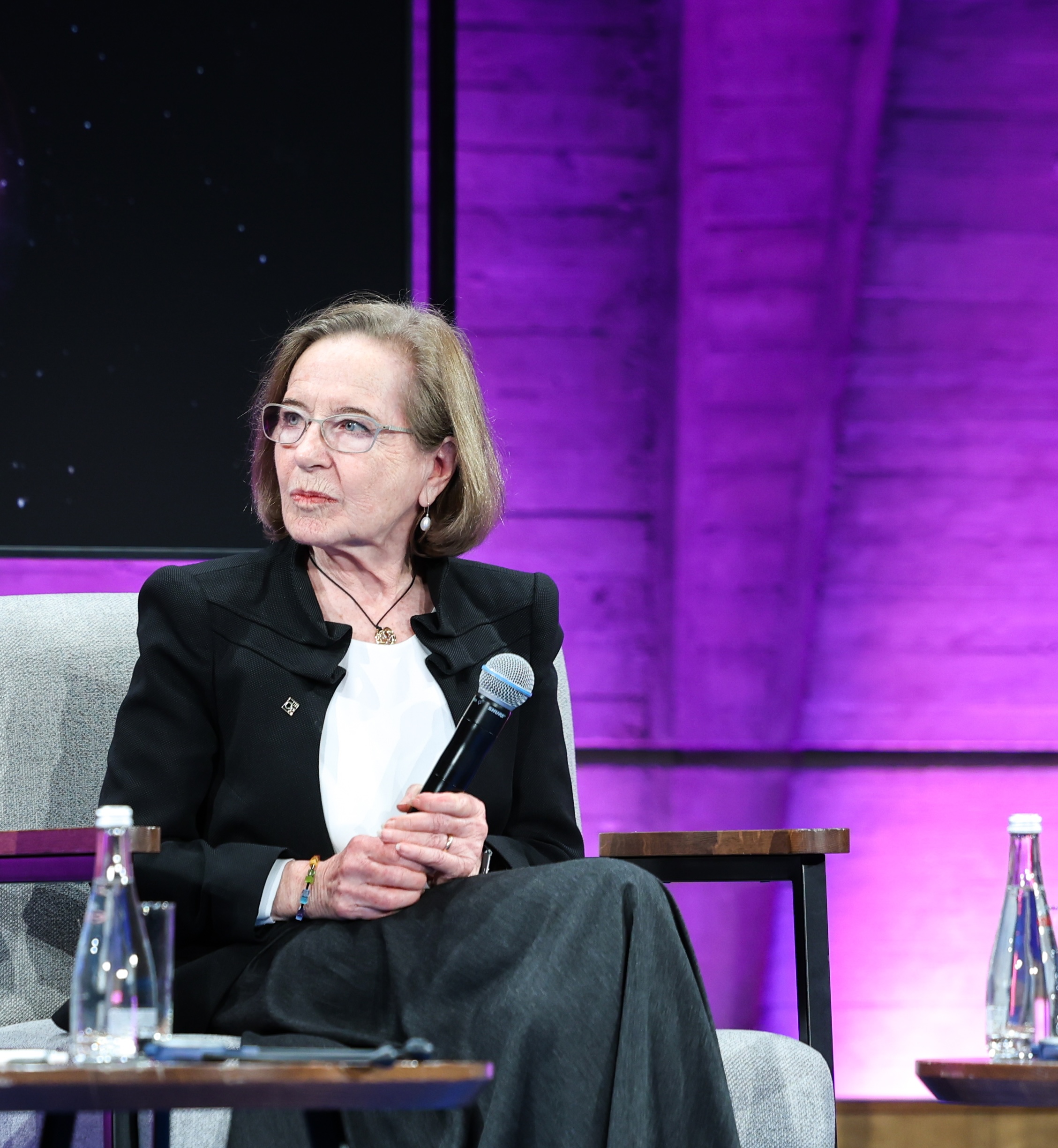
Ana María Cetto at the IYQ opening ceremony 2025. © UNESCO/Marie Etchegoyen.

A Mexican woman deserving of two Nobel Peace Prizes

Beyond her academic work, Cetto has been a strong advocate for peace and science diplomacy. Since her student years, she has been active in peace movements, and later joined the Pugwash Conferences on Science and World Affairs. This international non-governmental organization, which works to reduce armed conflict and promote global security, received the Nobel Peace Prize in 1995, while Cetto was on the Executive Committee. In 1997, she was elected president of the organization.

The work at Pugwash was interesting and enriching, and I particularly got to bring a different voice: coming from a country that has been traditionally pacifist and was a pioneer in establishing nuclear-weapon-free zones. I have a fresh, distinct vision of approaching the search for peaceful ways to solutions.

During that experience, there were some very satisfying moments, but others were not so satisfying because there were conflicts that not only persisted but also escalated. The characteristic of Pugwash is that it has outstanding scientists, including Nobel Prize winners, former military and diplomats, and professionals who are very committed to disarmament and peaceful conflict resolution.

Now I have been invited to head a newly established advisory board, which for me means recognition of my 30-year involvement, but also a lot of commitment because of the critical situation we are going through. The important thing is to continue in the struggle.”

In 2003, Dr. Ana María Cetto took on a new challenge as Deputy Director General of the International Atomic Energy Agency (IAEA), a key institution for global security that, just two years later, was awarded the Nobel Peace Prize. By joining the agency, Dr. Cetto not only broke barriers by becoming the first woman – and the first Latin American – to hold that position, but also left a profound mark on crucial issues for the future of humanity.

In one of her most influential works within the IAEA, she addressed the different nuclear technologies and the diversity of their peaceful applications that bring enormous benefits, such as in medicine, agriculture, or energy production, but also pose increasingly serious risks due to their wider availability. Given this delicate balance, Dr. Cetto emphasized the urgent need to strengthen nuclear safety infrastructures, especially in a context of accelerating technological advances, geopolitical tensions, and renewed interest in nuclear energy.

When, in 2002, IAEA Director General Mohamed ElBaradei invited me to join as Deputy Director General, I had to withdraw from Pugwash because of a potential conflict of interest. Thus began an eight-year stint in Vienna. There I headed the technical cooperation program in charge of peaceful applications of nuclear technologies. It was a very enriching experience, at a particularly good time for the Agency.

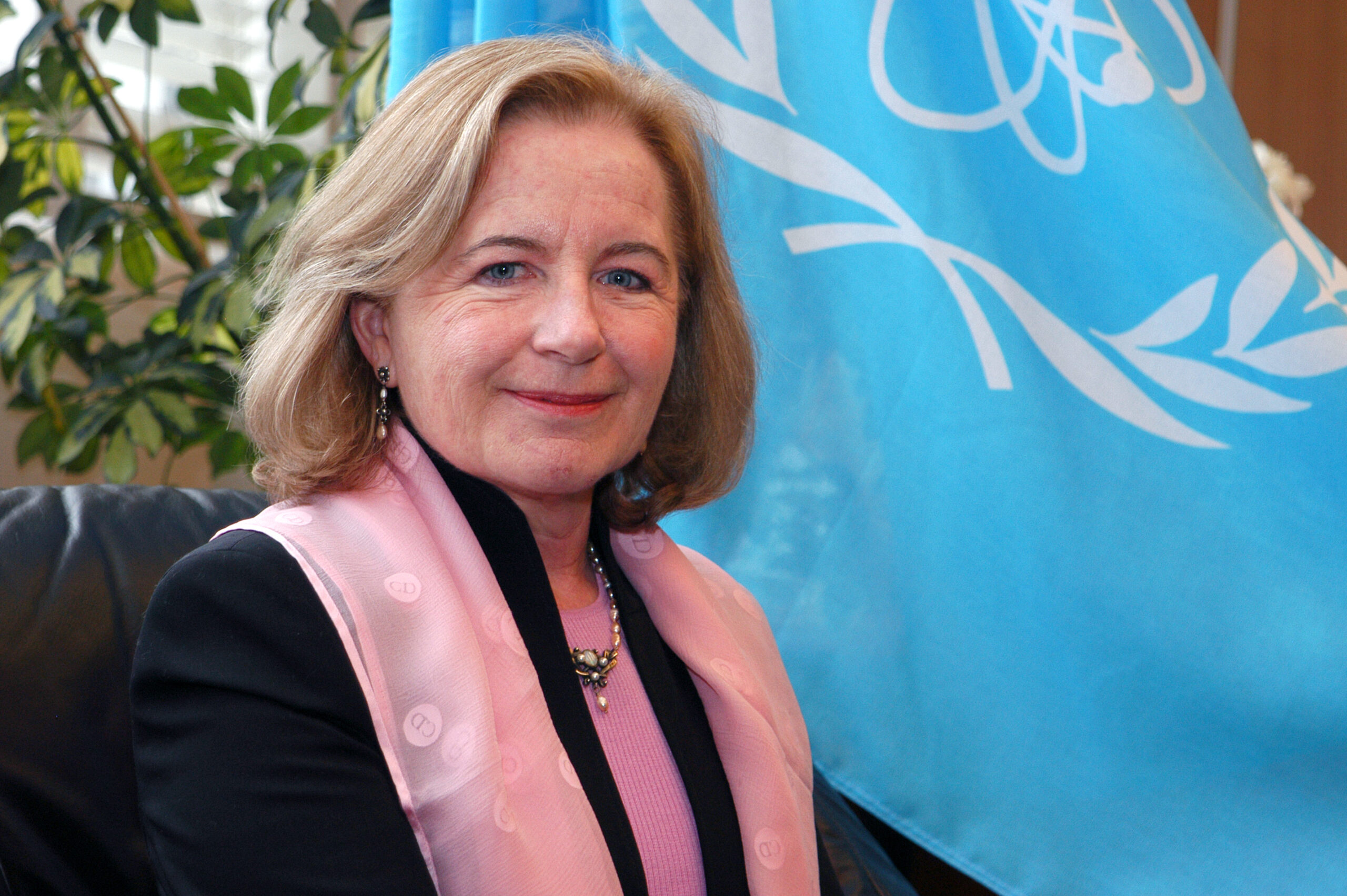
Ana Maria Cetto, IAEA Deputy Director General and Head of the Department of Technical Cooperation. IAEA, Vienna, Austria. January 6, 2003. Photo Credit: Dean Calma / IAEA.

The will to understand the fundamentals of quantum mechanics 

Research into the fundamentals of quantum mechanics is an area that many scientists look at out of the corner of their eye; some dismiss it as mere philosophy. For many, all has already been said, and they consider that investigating the cause of quantum phenomena is a waste of time: after all, some argue, quantum mechanics works so well that it has already led to impressive technologies and promising ones, such as quantum computers.

But Ana María Cetto is not willing to abandon her intellectual curiosity for practicality. From a very young age she has always insisted on getting to the heart of the matter: understanding quantum phenomena from the physics itself, not just from the interpretations. As she says, it is not just a matter of making it work but of understanding why it works.

When I was a student, quantum professors said things that I disagreed with, and that motivated me to look for another explanation. Quantum mechanics, as presented in textbooks, is a catalog of principles, akin to decrees, but all this can be explained rigorously by developing the necessary physics.  

Since the first formalism of quantum mechanics was published, 100 years ago with Heisenberg’s work and a little later with Schrödinger’s, it has been very successful: it is a formalism that allows you to make very precise calculations and even to make predictions, but the founders at that time did not care about understanding the origin of quantum phenomena. At that time, they were very busy developing their algebra, and so that question was left on the back burner.”

Together with her small research group, Ana María Cetto takes up this forgotten question with a provocative proposal: to go beyond traditional interpretations and search for the underlying physics. Inspired by an early observation by Max Planck, who in 1911 explained that his work was incomplete, she and her team have developed an approach that explains quantum phenomena associated with dual wave-particle behavior, not as mysteries, but as the result of a concrete interaction between subatomic particles and the vacuum.  

In 1911, Max Planck explained that his formula was incomplete because one must also include a term that always exists, even when there is no external radiation. When there are no light bulbs on, a field known as “vacuum” remains, and it must exert some effect on the particles. Inspired by this, we set about doing physics, not interpretation, and we have been able to explain how the vacuum field imprints on the particles a certain wave-like behavior that is expressed in interference phenomena. Atoms are still particles hit by this playful field. Imagine a stone falling into a pond and forming a wave, and the stone is interacting with the waves, so that vacuum is interacting with the particles, and with that we explain quantum phenomena.”

Tate Medal: an award for rigorous research with a social and humanistic vision

Among a long list of well-deserved awards, Dr. Cetto received this year no less than the John Torrence Tate Medal, one of the highest awards given by the American Institute of Physics. An award reserved for those who have left their mark not only in scientific research, but also in the visibility and democratization of knowledge.

The distinction recognizes his exceptional career in quantum physics, but also celebrates his international leadership, his tireless struggle for equity and for a more inclusive science, more ethical and more connected to social realities, highlighting the creation of the Regional Online Information System for Scientific Journals in Latin America, the Caribbean, Spain and PortugalLatindex, which today is a continental reference in editorial quality supported by a non-commercial network of partners in all countries of the region and has been key to transforming the landscape of access to knowledge in Spanish and Portuguese.

A deep-rooted bias still persists in the international physics community. We, because we work in a country that is not considered “central” on the map of science, continue to be victims of that bias. And in some way, we have also been complicit, because instead of citing our own work or that of colleagues in the region, we end up prioritizing the work of other authors published in foreign journals.

In many spaces, it is still considered – not openly, but subliminally, tacitly – that those of us who do science from the South produce second-rate knowledge. And that is not only false, it is deeply unfair.

That is why in recent years I have devoted time and energy to the issue of access to scientific publications, to the recognition of journals that are produced outside the so-called mainstream, controlled by large commercial publishers that have turned this into a business. It has not been easy, I had to live it closely with the Mexican Journal of Physics. The evaluation systems did not recognize it, they did not take us into account. But that is beginning to change: in Mexico and in other countries, evaluation criteria are already being adjusted to value the editorial work done in our own communities.

Publishing in today’s leading journals can cost thousands of dollars per article. You not only have to pay to read, but also to publish. And that imposes yet another barrier. That’s why we fight for a fairer system that is accessible to all.

I was very pleased to learn the reasons why I am receiving the AIP Tate Medal: for my work for equity, for international leadership in physics, and for the creation of Latindex. I am also pleased to have had the opportunity to collaborate with all the colleagues with whom I have had the good fortune to work. The fact that the results of this teamwork are recognized as a valuable contribution really makes me happy.

Training as a scientist: a privilege that entails responsibilities 

The road to leadership is sometimes traveled without maps, guided by curiosity, commitment, and a persistent question: what can I contribute from what I know? In the world of science, this question takes on a special dimension. Because doing research is not only a career of knowledge, but also an opportunity to transform realities.

Ana María Cetto’s transit as a leader in quantum physics, working not only for its understanding, but defining its role in society, definitely invites us to reflect, to look at science not only as an end, but as a means to generate social impact.

There are no recipes for participating in activities that have a social impact. As one advances and grows in one’s scientific training, learning more and more, one also begins to understand that this possibility of learning and becoming a scientist is, in many ways, a privilege. That privilege comes with responsibilities. The tools provided by science should not only be used for personal or professional development, but also to contribute to the common good. Science is, after all, a human product that is built on the work of millions of people.”


Featured picture copyright: UNESCO/Marie ETCHEGOYEN.

One Year into QuanTour: Reflections on a Traveling Quantum Light Source

(DPG is an IYQ sponsor.)

How do you measure the success of an outreach project? When we launched QuanTour just over a year ago, we didn’t really know what to expect.

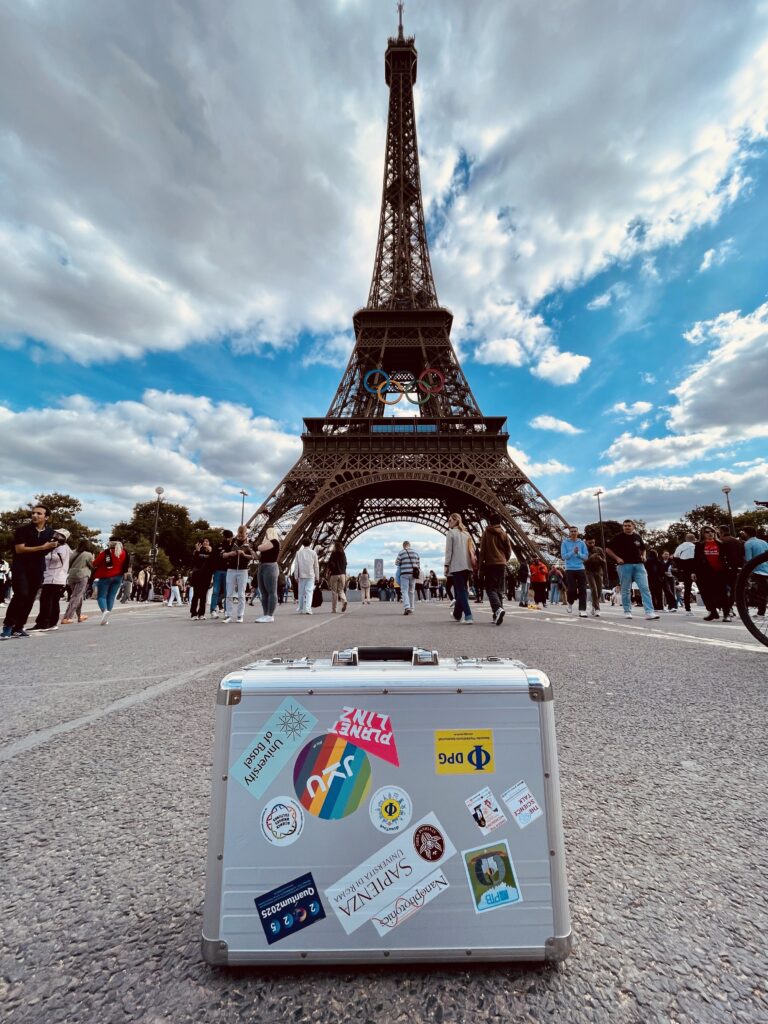
Our idea of QuanTour started with a simple, playful concept: what if a quantum emitter (an artificial atom made out of semiconductor material capable of emitting one photon at a time) could travel across Europe, visiting research labs in a kind of relay race, announcing the International Year of Quantum Science and Technology like an Olympic torch? We packed a real quantum light source — a single-photon emitter — into a custom-built suitcase and sent it on tour. The goal wasn’t just to showcase quantum technology and offer a look behind the scenes, but to connect people and to highlight the diversity of scientists, from students to professors. From the very beginning, we had one audience especially in mind: young people between the ages of fifteen and twenty-five. Not with hard educational content or dense physics explanations, but through a light, fun concept that sparks curiosity. By showcasing scientists in an authentic way, we aimed to make science tangible and approachable.

How our quantum light source fascinated people around the world

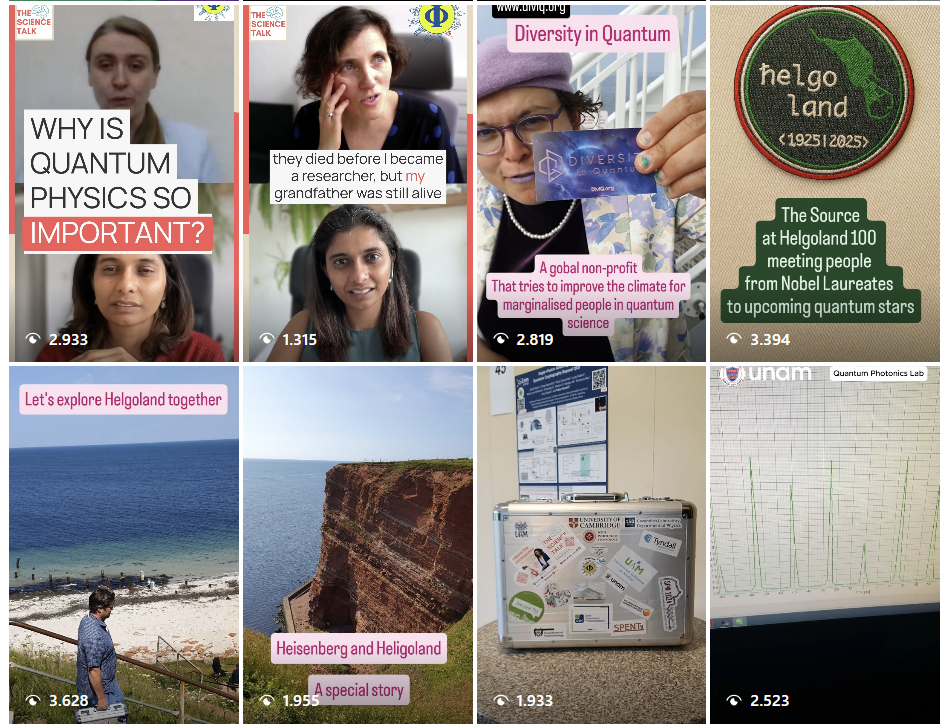
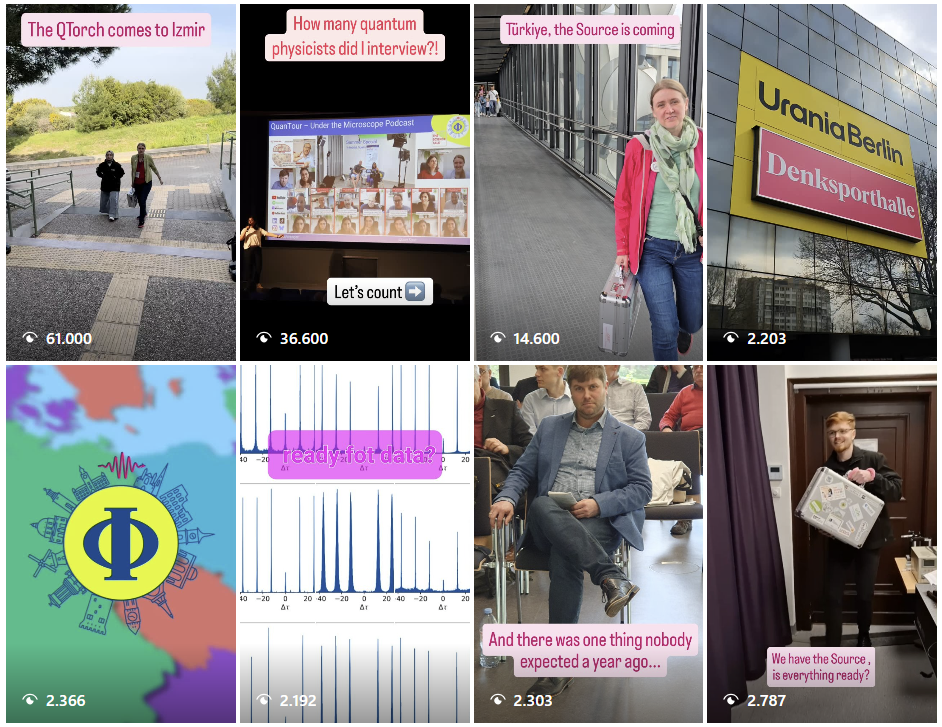
Credit: The Science Talk.

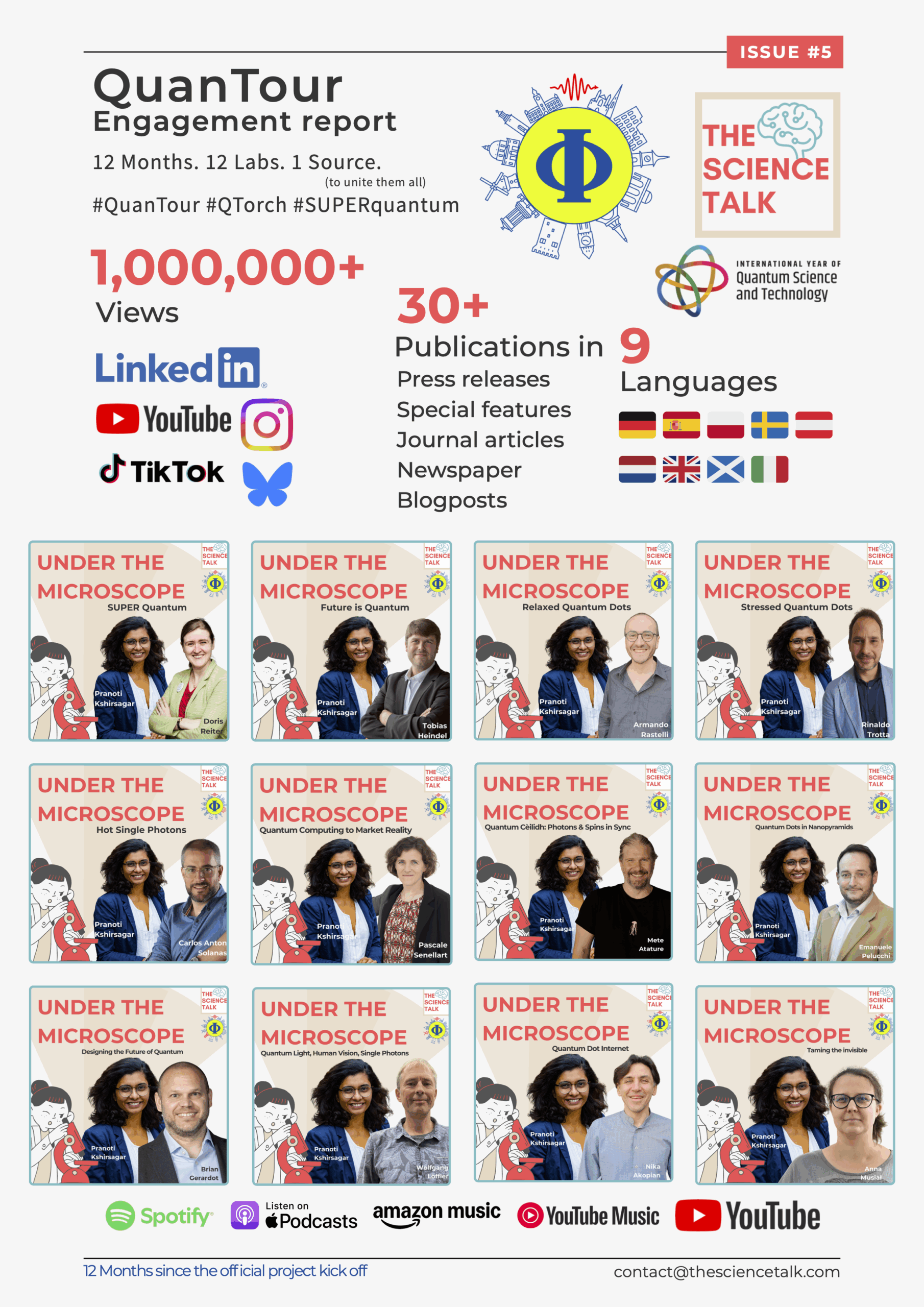
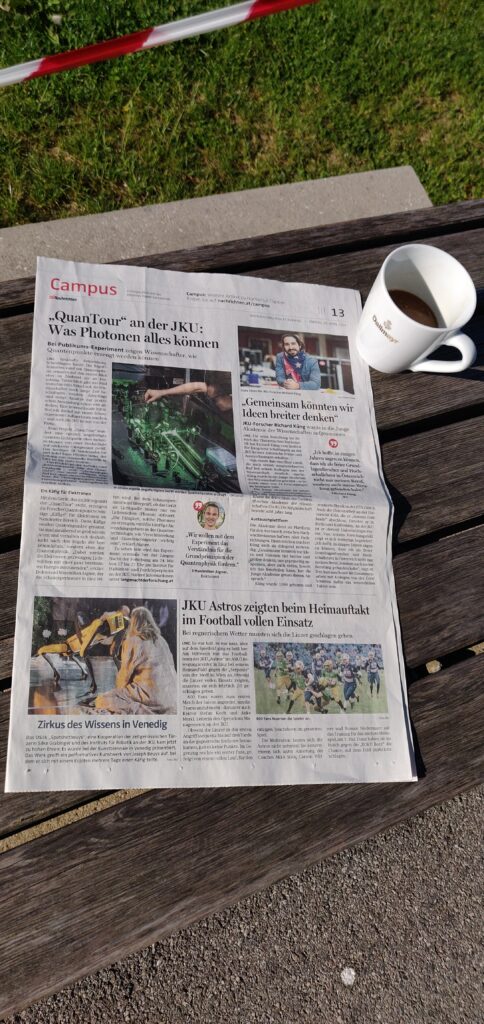
A year later, we find ourselves overwhelmed by the project’s rapid development. Across digital platforms, QuanTour content has reached over one million views, far more than we had imagined. To put that into perspective, a research paper might receive 30 citations per year, while a conference talk might reach 200 people. QuanTour, by contrast, reached homes, labs, newspapers, podcasts, and people, finding a presence in places that traditional academic outputs rarely reach.

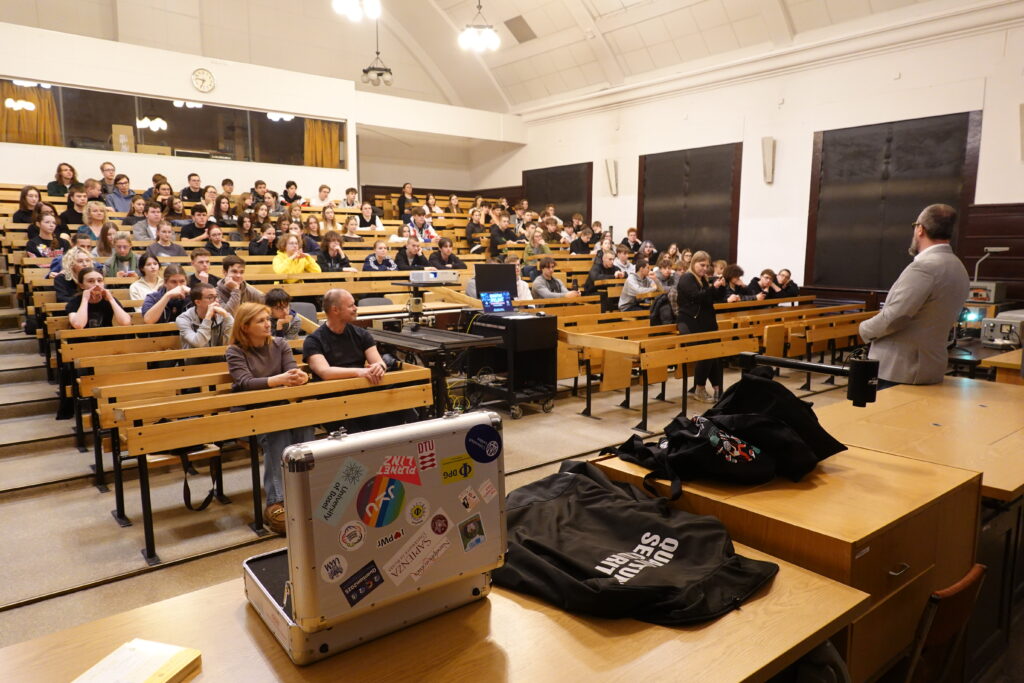
While these are just numbers, it’s the stories surrounding the quantum emitter that are truly memorable. The open lab days organized by researchers at QuanTour stops welcomed both young and old. The newspaper clippings proudly passed around among families who saw their children and grandchildren featured in the media. The regional news outlets that celebrated their role in a European-wide initiative, not only in English but in the many languages spoken across Europe. The unexpected scientific exchanges between labs that hadn’t worked together before. These encounters, often spontaneous and personal, remind us that quantum science is not just about abstract theory or precision measurement. It is about human connection, about curiosity, and about the shared joy of discovery.

Key ingredients and lessons learned

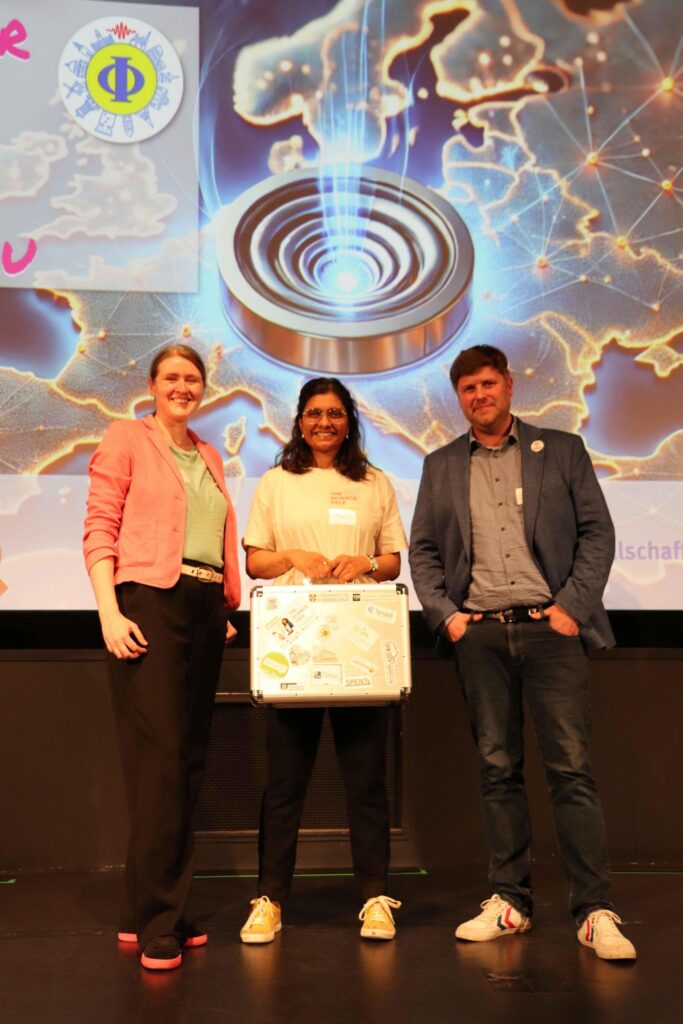
Looking back, we also learned a lot about what makes outreach successful. One key ingredient was choosing the right partners. Since the task force of the German Physical Society (DPG) was founded three years before the start of the Quantum Year, we became part of the team and refined our idea. The German Physical Society played a vital role, not only by supporting us financially—with generous funding from the Wilhelm and Else Heraeus Foundation – and administratively, but also by helping to spread the word. Another important aspect is that we teamed up with science communication expert Dr. Pranoti Kshirsagar from The Science Talk. She taught us how to build sustainable communication strategies, how to identify a target audience, how to make our content visible, and how to overcome our initial hesitation with digital platforms. She also hosted a twelve-episode podcast series featuring interviews with the scientists behind QuanTour. These episodes became much more than outreach content. They evolved into a kind of lecture series on quantum science, accessible to everyone.

Another lesson we took to heart is that outreach, just like research, thrives through collaboration. Partnering with established institutions and strong communicators can amplify ideas and make them visible to entirely new audiences. Involving the community directly is just as essential. When we announced a challenge to bring QuanTour to Türkiye, the response was immediate and enthusiastic. When it finally arrived, the celebration at the Izmir Quantum Days was unforgettable. Students asked thought-provoking questions, researchers welcomed them with enthusiasm, and the atmosphere was electric from start to finish.

Now, while the International Year of Quantum Science and Technology is in full swing, the journey of the quantum light source continues. We are already planning the next chapters of QuanTour, with new stops, new stories, and new encounters that bring quantum science into conversation with the wider world. Outreach does not end when the suitcase closes. It evolves, just like science itself.

Cheers to the little quantum emitter and to all those who have contributed to turning an idea into a movement.

Authors: Doris Reiter (TU Dortmund) and Tobias Heindel (TU Berlin), Members of the DPG Quantum Taskforce

Contact QuanTour: quantour2025@gmail.com

Contact DPG: pr@dpg-physik.de

Featured image: Fabrizio Mercoli

Quantum Internet, Quantum Networking, and Distributed Quantum Computing Among Key Subjects at IEEE Quantum Week 2025

IEEE International Conference on Quantum Computing and Engineering (QCE)—IEEE Quantum Week—reports record paper submissions from industry, academia, and government in growing technical areas

(IEEE is an IYQ sponsor.)

From August 31 to September 5, 2025, the city of Albuquerque, N.M., U.S., will be abuzz with cohorts of quantum experts, as the IEEE International Conference on Quantum Computing and Engineering (QCE), more simply known as IEEE Quantum Week, kicks off. This year’s conference will draw a diverse crowd of global leaders from industry, government, and academia, all working toward an exciting quantum future. 

“At Quantum Week, there’s something for everyone,” says Hausi Müller, chair of the IEEE Quantum Technical Community, co-founder and Steering Committee Chair of IEEE Quantum Week, and professor of computer science at the University of Victoria in British Columbia, Canada. “Those new to the discipline walk away with as much as seasoned quantum computing experts. Quantum Week’s beauty is that it truly draws the global quantum community to shape what’s next for the field.” 

Technical Program

Reporting more than 555 paper submissions—a nearly 25% increase over the number received in 2024—the 2025 conference will explore the topics shaping quantum research and development across various topical areas. From a first read of the submissions, this year’s featured topics will include:

  • Quantum Internet and Quantum Networking – Now that researchers have unveiled the ability to carry both classical and quantum traffic on fiber optic networks, new potential continues to emerge in integrating standard networking infrastructure with quantum needs. “This development has been a game changer,” says Müller. “We are realizing this shift in paper submissions. Just a few years ago, we would only receive a handful of papers on these topics; now they make up a significant part of submissions.” 
  • Distributed Quantum Computing – In addition, now that advancements have enabled researchers to apply entanglement across two different quantum chips, quantum computing can happen at scale. With the growing demand for qubits and the limited processing power of singular systems, networking a number of chips together becomes a viable engineering solution, and one that will be explored during IEEE Quantum Week 2025. “Distributed quantum computing is key; it’s this concept of running different chips in parallel,” explains Müller. “That’s one of the fastest-growing areas of quantum computing.”
  • Qubit Technologies – Quantum hardware is rapidly evolving along various technology strands. IBM, Google, D-Wave, and Rigetti are at the forefront of advancements in superconducting processors for fault-tolerant quantum computing systems. IonQ and Quantinuum excel in trapped-ion qubits with high fidelity and long coherence times. Photonic and qubits, developed by Xanadu, Intel, and Photonic, are ideal for communication and sensing via quantum networks. Neutral atom qubits, developed by QuEra, Pasqal, and Atom Computing, are an emerging and scalable alternative that operates at room temperature. Earlier this year, Microsoft announced Majorana 1, the world’s first quantum processor powered by topological qubits—a technology that operates at an even finer-grained scale with intrinsic error resistance. “This is a significant development for quantum computing,” Müller says. “IEEE Quantum Week 2025 is a terrific forum to discuss the evolution of logical qubit technologies with experts.”

Advancing Quantum Computing Through Community

It’s no secret that the field of quantum computing has taken a significant leap forward over the past few years, yet the technology still appears to have seemingly infinite untapped potential. And no event is better suited for tapping into that potential than IEEE Quantum Week with its workshops, tutorials, technology showcase, industry engagement, and growing community. 

IEEE Quantum Week creates a collaborative environment for information sharing that encompasses a global constituency of companies, academic institutions, national labs, and more. Perhaps more importantly, that spirit of connection continues throughout the year, strengthening the personal and professional ties that truly foster innovation. 

“From my perspective, this is what I’m most proud of,” says Müller. “Annually, we provide a platform to nurture everyone in the quantum community, and in turn, they support one another with continued growth in the field.”

For more information on IEEE Quantum Week 2025 or to register, visit our website

Featured image: © IEEE.

Highlighting Women in Quantum History


The authors of a new book tell the stories of 16 women who made crucial contributions to quantum physics, yet whose names don’t usually appear in textbooks

As modern quantum mechanics was taking shape in the mid 1920s, the field was sometimes referred to in German as Knabenphysik—“boys’ physics”—because so many of the theorists who were crucial to its development were young men. A new book published as part of the International Year of Quantum Science and Technology pushes back against that male-dominated perspective, which has also tended to dominate historical analyses. Coedited by historians of science Daniela Monaldi and Michelle Frank, physicist-turned-science writer Margriet van der Heijden, and physicist Patrick Charbonneau, Women in the History of Quantum Physics: Beyond Knabenphysik presents biographies of 16 oft-overlooked women in the field’s history.

The editors did not profile physicists such as Lise Meitner and Maria Goeppert Mayer, who have attracted significant attention from historians and physicists. As the editors explain in the book’s introduction, focusing on a few heroic figures perpetuates “a mythology of uniqueness.” They instead highlight individuals who are lesser known but nevertheless made important contributions. The following photo essay highlights six of those scientists.

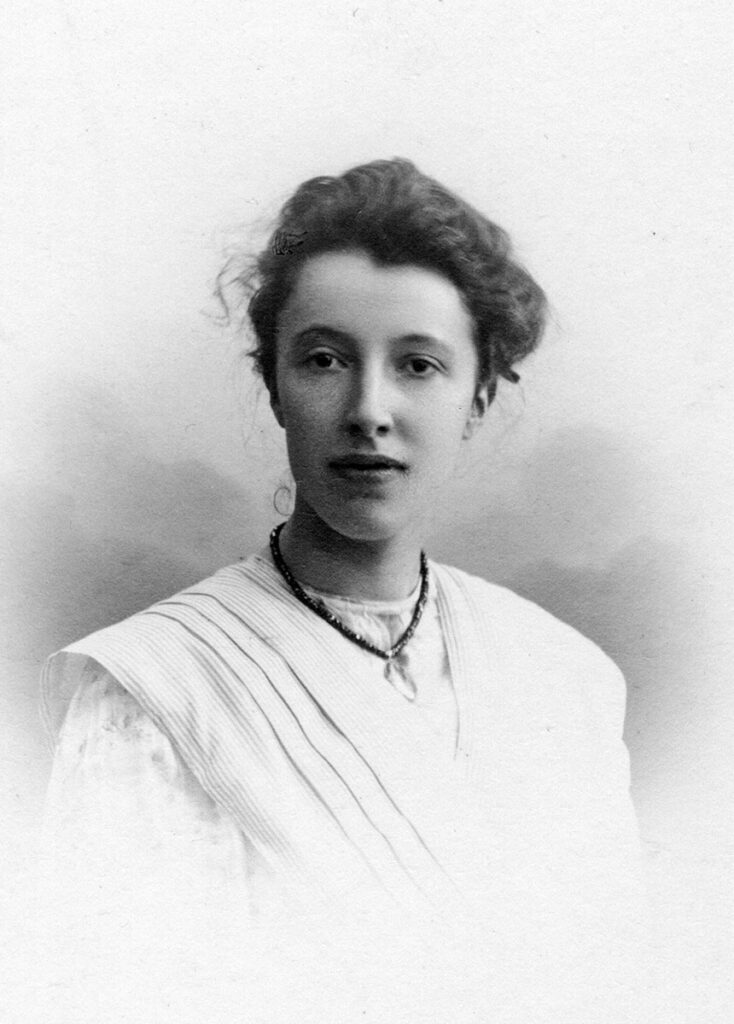
H. Johanna van Leeuwen

Photo courtesy of the Van Leeuwen family.

In 1919, Dutch physicist H. Johanna van Leeuwen (1887–1974) discovered that magnetism in solids cannot solely be explained by classical mechanics and statistical mechanics: It must be a quantum property. Niels Bohr had made the same insight in his 1911 doctoral thesis, but he never published the result in a scientific journal; it was published only in Danish and barely circulated outside Denmark. Van Leeuwen rediscovered what is now called the Bohr–Van Leeuwen theorem in her doctoral research at Leiden University. The theorem, which has applications in plasma physics and other fields, came to the attention of the broader community after Van Leeuwen published an article based on her doctoral thesis in the French Journal de Physique et le Radium (Journal of Physics and Radium) in 1921.

As happened with many women of that era, little trace was left of Van Leeuwen (pictured here in an undated photo) in the historical record. Chapter authors Van der Heijden and Miriam Blaauboer uncovered several sources that helped them assemble an illustrative synopsis of her career. Van Leeuwen was one of four women to study with Hendrik Lorentz, with whom she remained close until his death in 1928. Unlike many women of her generation, Van Leeuwen remained in the field for her entire career: She was appointed as an assistant at the Technical College of Delft in 1920, a position that required her to supervise laboratory courses for electrical engineering students. In the little spare time she had, Van Leeuwen continued her research into magnetism. In 1947, she was promoted to reader, which meant that she could finally teach her own courses.

Laura Chalk Rowles

Photo courtesy of Marilyn MacGregor.

Laura Chalk Rowles (1904–96) was one of the first women to receive a PhD in physics from McGill University in Montreal, in 1928. Her dissertation investigated the Stark effect—the shifting of the spectral lines of atoms exposed to an external electric field—in the hydrogen atom. In his series of 1926 articles on wave mechanics, Erwin Schrödinger had used quantum theory to predict how the Stark effect would affect the intensities of the Balmer series of spectral lines in hydrogen. As chapter author Daniela Monaldi outlines, Chalk (pictured ca. 1931) used an instrument known as a Lo Surdo tube to measure the intensities of the spectral lines; the work provided the first experimental confirmation of Schrödinger’s predictions. She published several articles on the subject in collaboration with her adviser, John Stuart Foster.

Later in his life, Foster regarded his subsequent work on the Stark effect in helium as more important than the hydrogen experiments he had carried out with Chalk. Observers and historians have tended to follow his lead, so her contributions are often overlooked. After spending the 1929–30 academic year at King’s College London, Chalk received a teaching position in McGill’s agriculture college. But after she married William Rowles, who was also at McGill, she scaled back to working only part time. Five years later, she was let go because of rules that were ostensibly designed to prevent nepotism but typically served to exclude women from the professoriat.

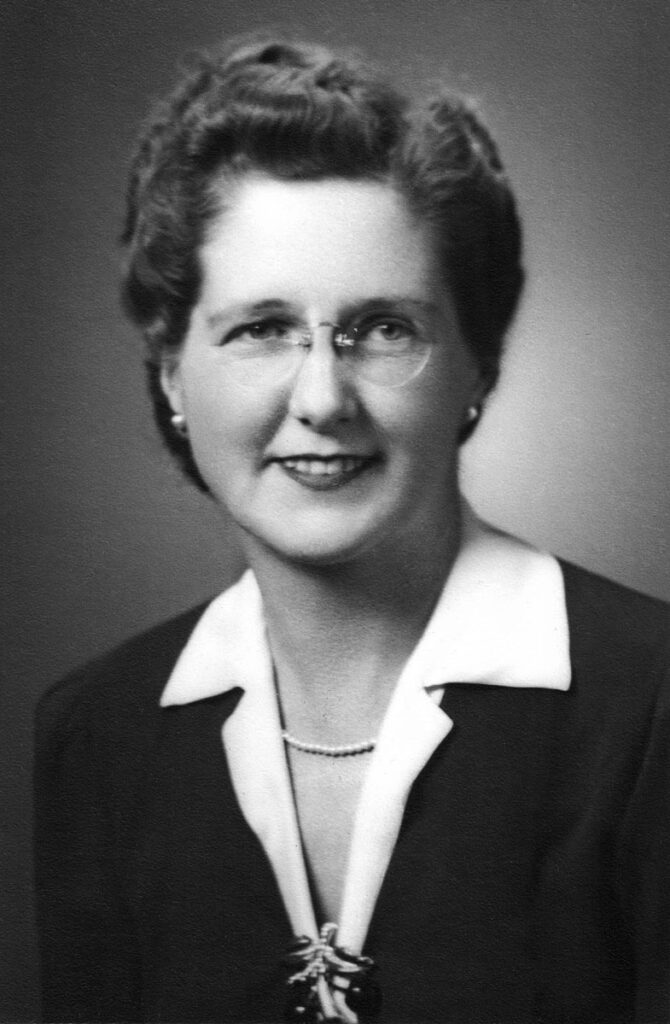
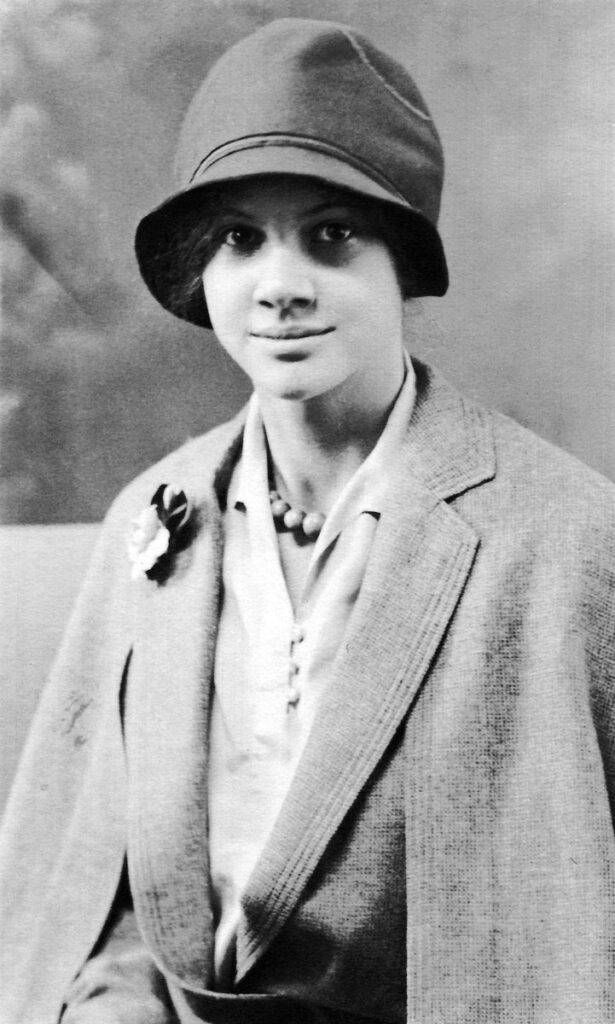
Elizabeth Monroe Boggs

Photo courtesy of Pamela Murphy.

Elizabeth Monroe Boggs (1913–96) received significant press attention for her advocacy work on behalf of people with disabilities. But her prior career in science has long gone overlooked, writes chapter author Charbonneau. Boggs (pictured in 1928) was the only undergraduate to study with famed mathematician Emmy Noether at Bryn Mawr College before Noether’s untimely death in 1935. After graduating, Boggs pursued a PhD at the University of Cambridge, where she began studying the application of quantum physics to molecular structure—a pursuit that is now known as quantum chemistry. For her thesis, she used an analog computing device called a differential analyzer to probe the wave functions of diatomic molecules.

After finishing her studies, she received a research assistantship at Cornell University, where she met and married chemist Fitzhugh Boggs. As was common in the day, his career took precedence over hers: They moved to Pittsburgh in 1942 when Fitzhugh received a job at Westinghouse. Elizabeth taught at the University of Pittsburgh for a year and then got a job at the Explosives Research Laboratory outside the city, where she ended up contributing to the Manhattan Project by helping to design the explosive lens for implosion bombs like the one ultimately used on Nagasaki. She eventually decided to withdraw from the field and focus on advocacy after the birth in 1945 of a son, David, who had severe developmental delays because of brain damage from an illness.

Katharine Way

Photo courtesy of the AIP Emilio Segrè Visual Archives, Wheeler Collection.

Katharine Way (1903–95) was the first graduate student of John Wheeler’s at the University of North Carolina at Chapel Hill in the late 1930s. As chapter author Stefano Furlan recounts, Way’s research during her PhD studies included using the liquid-drop model of the atom, which approximates the nucleus as a droplet of liquid, to examine how nuclei deform when rotating at high speeds. In a 1939 Physical Review article, she describes the magnetic moments of heavier nuclei. While carrying out the research, Way (pictured in an undated photo) noticed an anomaly that she brought to Wheeler’s attention: The model was unable to account for highly charged nuclei rotating at extremely high speeds. In later recollections, Wheeler regretted that the two didn’t further investigate that observation: He noted that, in retrospect, the model’s failure in that case was an early indication that nuclei could come apart, just as they do in fission.

During World War II, Way worked on nuclear reactor design at the Metallurgical Laboratory in Chicago; she moved to Oak Ridge Laboratory in 1945. Along with Eugene Wigner, she published a 1948 Physical Review article outlining what is now known as the Way–Wigner formula for nuclear decay, which calculates rates of beta decay in fission reactions. She spent much of her postwar career at the National Bureau of Standards (now NIST), where she initiated and led the Nuclear Data Project, a crucial source for information on atomic and nuclear properties that is now part of the National Nuclear Data Center at Brookhaven National Laboratory. Way was also active in efforts to get nuclear scientists to think about the societal ramifications of their work.

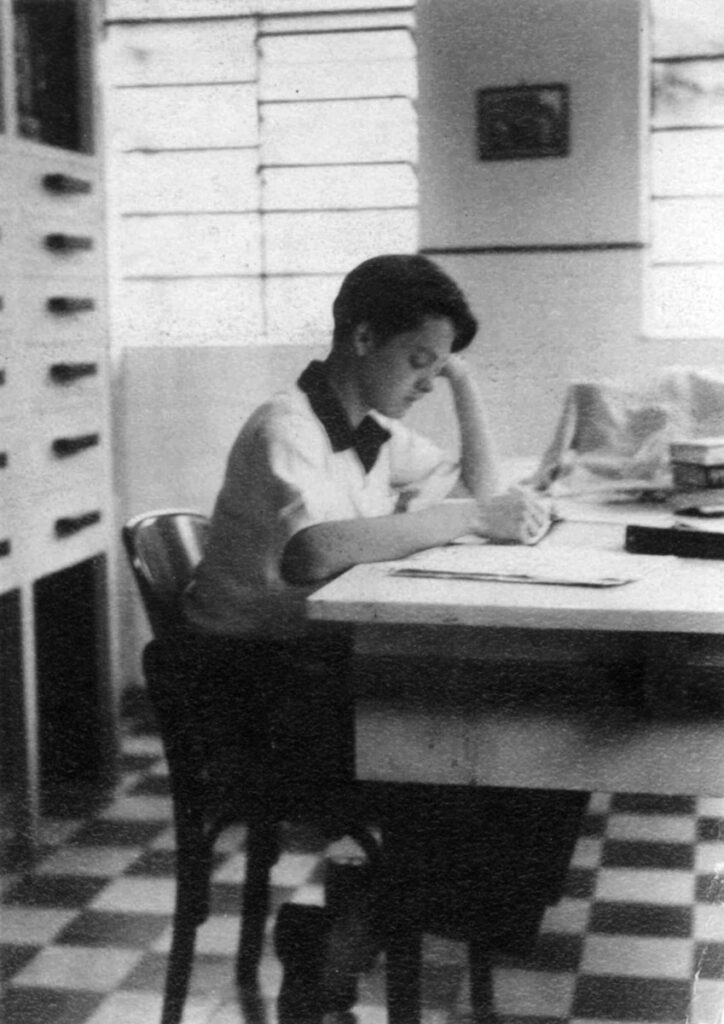
Sonja Ashauer

Photo courtesy of the Ashauer family.

Although her death from pneumonia at age 25 ended her career practically before it began, Sonja Ashauer (1923–48) was an accomplished physicist and promising talent, chapter authors Barbra Miguele and Ivã Gurgel argue. The daughter of German immigrants to Brazil, Ashauer (pictured ca. 1940) studied at the University of São Paulo with Italian physicist Gleb Wataghin, who likely introduced her to quantum theory. Shortly before the end of World War II, in 1945, she moved to the University of Cambridge, where she became the only woman among Paul Dirac’s few graduate students.

In her 1947 thesis, Ashauer worked on one of the most pressing problems of the day in quantum electrodynamics: what was termed the divergence of the electron’s self-energy. Because that self-energy—the energy resulting from the electron’s interactions with its own electromagnetic field—is inversely proportional to its radius, the value tends to infinity when the particle is modeled as a point charge. Ashauer attacked the problem by working to improve classical electrodynamics in the hope that it might inform the quantum theory. That divergence problem and others were ultimately solved through the renormalization techniques discovered around 1950.

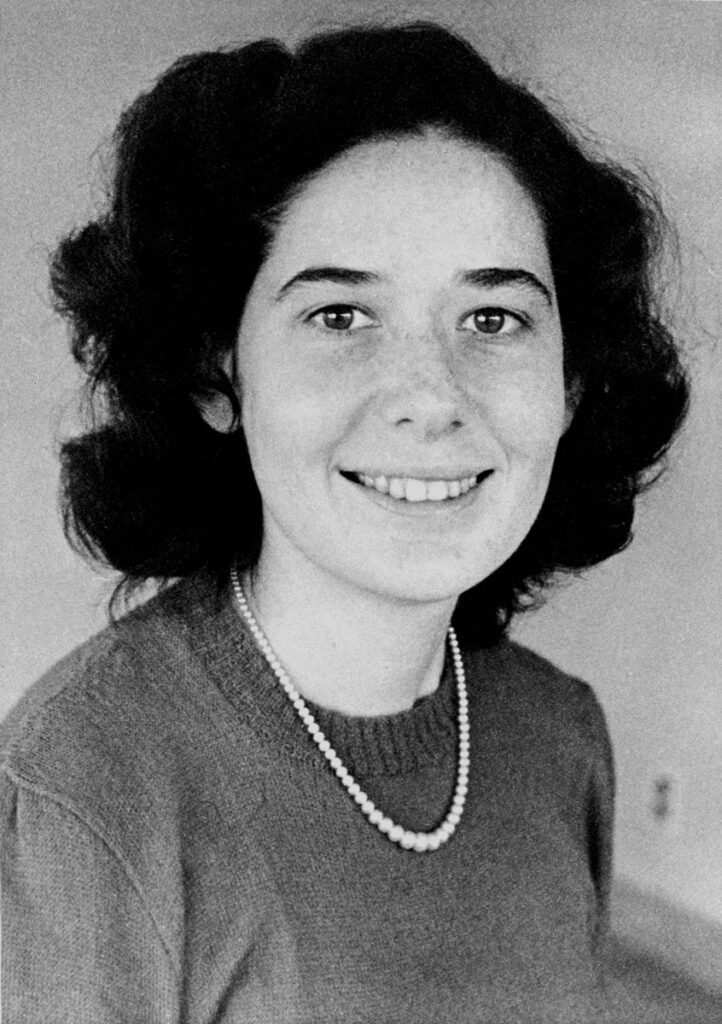
Freda Friedman Salzman

Photo courtesy of Amy Parker.

Freda Friedman Salzman (1927–81) is more often remembered for her work advocating for women in science than for her significant contributions to physics. As an undergraduate, Salzman (pictured in the late 1940s) studied physics with nuclear physicist Melba Phillips at Brooklyn College. In the mid 1950s, in collaboration with her husband, George Salzman, she came up with a numerical method to solve the integral equations of what was known as the Chew–Low model: a description of nuclear interactions developed by Geoffrey Chew—Freda’s dissertation adviser at the University of Illinois Urbana-Champaign—and Francis Low. To carry out those calculations, the Salzmans used the ILLIAC I, an early computer. Published in 1957 in Physical Review, what was soon termed the Chew-Low-Salzman method helped stimulate work by nuclear and particle physicists, including Stanley Mandelstam, Kenneth Wilson, and Andrzej Kotański in the late 1950s and early 1960s. Chapter author Jens Salomon argues that the method was one of Freda’s most important contributions to the field.

Freda and George lived an itinerant academic lifestyle for a period before finding what they believed to be permanent positions at the University of Massachusetts Boston in 1965. Four years later, Freda was fired after the university began to enforce what they claimed to be an anti-nepotism policy. Her termination became a cause célèbre, and after a long campaign, she got her job back in 1972 and received tenure in 1975. The fight to regain her job at the university appears to have motivated Salzman to devote increasing amounts of time to feminist advocacy in the 1970s.

From Physics Today

Uncertain-Sea Principle, a Brilliant Quantum Poem by Richard Blanco

What happens when the beauty of the quantum world collides with the power of literature? The Brilliant (Quantum) Poetry Competition dares poets from around the globe to explore just that. This unique international contest, created to celebrate the International Year of Quantum Science and Technology, invites everyone to express quantum science in verse.

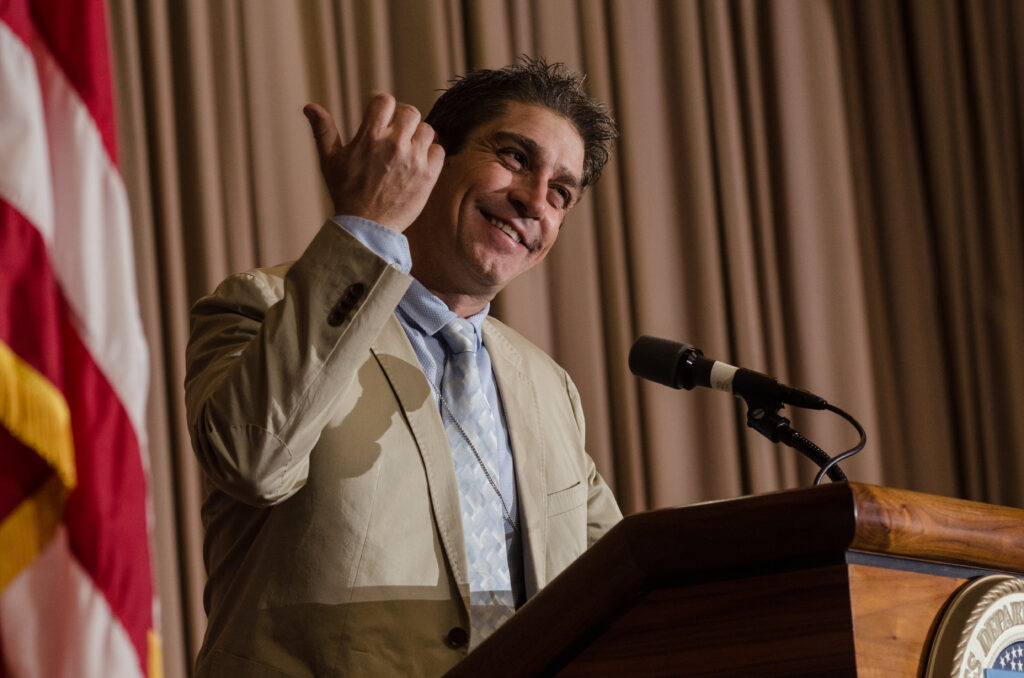
Poet Richard Blanco. USDA Photo by Lance Cheung.

Hosted virtually by The Brilliant Poetry Project, the call for submissions opened on March 21 this year and will close next week on June 30. Winners will be announced on November 10. In this framework, and to help inspire quantum enthusiasts, poet and engineer Richard Blanco shared his “stereoscope or contrapuntal poem,” Uncertain-Sea Principle, inspired by the quantum uncertainty principle introduced by Werner Heisenberg, one of the scientists who helped develop quantum mechanics 100 years ago. The author remarks that it can be read “in more than one way, such as left to right across the two columns or down first one column and then the other.”

Note: To read the poem from left to right across both columns, it must be opened on a desktop (laptop).

Uncertain-Sea Principle

after Werner Heisenberg

the more I try to measure x

the more I know where I am

I scribble my name across the sand

the more I know where I’m going

the ebb of each wave seduces me

the more I know how to get there

freighter lights burn on the horizon

like candelabras floating toward port

the more I know when I’ll arrive

the tide rises on cue to kiss the shore hello

the less I try to solve for y

the less I know where I am

rustling palms protest losing

their green to the darkness

the less I know where I’ve been

the ocean vanishes into the midnight sky

the less I know who I can be

there’s no horizon in the stark night

the less I know who I am

I erase my name with a wave of my palm

the more I try to determine my I

the less I can measure y

the less I know where I’m going

the burnt-orange moon rises, cools, disappears

the less I know how to get there

silhouettes of sailboats sleep till morning

the less I know when I’ll arrive

sea oats sway to the wind’s pitch

like inverted pendulums of timelessness.

the less I know where I am

seagulls abandon the sea every night

the more I can solve for x

the more I know where I’ve been

the sea gives and gives itself to the shore

yet returns again and again to itself

the more I know who I can be

the midnight sky vanishes into the ocean

the more I know who I am

even in the dark my eyes shape clouds

the more I know that I am, here

I clutch a fistful of sand, breathe, listen

the less I can determine my self

Listen to the poem below, read by the author in the video

“Uncertain-Sea Principle” is from the book Homeland of My Body: New and Selected Poems by Richard Blanco. Copyright © 2023 by Richard Blanco. Used with permission from Beacon Press and Richard Blanco.

Video edited by Serena Krejci-Papa

Feature picture edited by Alexandra De Castro

Building the Future of Quantum Computing in Mexico & Latin America

Interview with Claudia Zendejas-Morales,
A driving force behind quantum computing in Mexico and Latin America, developer of the Tequila programming platform, mentor at QWorld, and IBM Qiskit Advocate

Imagine a machine capable of solving problems that would take even the world’s most powerful supercomputers longer than the age of the universe to crack. As fantastical as it sounds, that’s one of the superpowers promised by emerging quantum technologies. And these technologies—like quantum computing—are starting to leap from labs to industry. In Mexico, serious strides are already being made to be part of this transformative future.

One of the pioneering scientists leading the way is physicist and computer engineer Claudia Zendejas-Morales. Her academic journey began in software engineering, but it was a quantum mechanics course that sparked her passion for quantum computing. Since then, she has built a solid academic and professional profile, participating in programs like USEQIP at the University of Waterloo, the Quantum Open-Source Foundation’s mentorship program (where she collaborated with The Matter Lab at the University of Toronto), and the IBM Quantum Summer Schools.

“As a physics student, I took quantum mechanics and found the subject fascinating. In that first class, they introduced us to quantum computing, and I dove in. At my school, there was little to nothing about quantum computing, so I actively sought out ways to learn about it online. That’s how I connected with different people and institutions involved in quantum computing. From there, I’ve been actively participating in the field,” Claudia explains enthusiastically.

“Access to the internet has been essential—it’s what allowed me to train and participate as a developer and mentor in projects like the Quantum Open Source Foundation. That’s where I worked on the Tequila project, which eventually led to a publication in IoP Science.”

Promoting Quantum Education in Latin America

Alongside her own training, Claudia has made a massive effort to promote education in quantum technologies across Mexico and Latin America. She became a Qiskit Advocate (Qiskit is IBM’s quantum programming platform), and has collaborated with initiatives like Quantum Flytrap, Qubit by Qubit, and QWorld. Always focused on Spanish-speaking students, she has developed educational content, translated Qiskit documentation into Spanish, and coordinated quantum computing courses at the National Autonomous University of Mexico (UNAM). She’ll soon join the University of Copenhagen’s Quantum Information Science program.

“A few years ago, there was nothing—now there’s something growing little by little. Thanks to people like Alberto Maldonado, we’ve kickstarted quantum computing in Mexico and created a community. He organized the first Qiskit Fall Festival in 2021, and we’ve held one every year since. Through him, I connected with a professor from another state working in quantum, and I reached out to folks at UNAM’s engineering faculty who were also interested. That’s how the community in Mexico has grown—we’re organizing more and more quantum events.”

QClass 23–24: A Game-Changing Experience

One of Claudia’s most rewarding experiences was organizing QClass 23–24, a free, advanced two-semester program in quantum computing for students from a wide range of backgrounds.

“What gave me the most satisfaction was coordinating a QWorld event called QClass 23–24. We ran postgraduate-level courses for two semesters. I was not only a mentor but also a professor—I designed the exams and course content using Qiskit. More than 1,500 students from over 100 countries and diverse professional backgrounds participated. It was incredibly rewarding—and all of it was free, because that’s the goal: to support others.”

A Quantum Network for Mexico

More recently, Claudia co-organized a national event alongside Dr. Alberto Maldonado and other collaborators, bringing together students, teachers, researchers, and industry professionals to collaborate, learn, and unlock new opportunities in quantum computing. Remarkably, the entire event was held in Spanish and prioritized inclusion.

A major barrier to learning quantum computing in Latin America is language—most resources are in English, and the concepts are already difficult. The event focused on creating learning spaces in Spanish, with accessible, clear explanations. As detailed in a paper published by IEEE, over 76% of participants—many without prior experience—felt confident diving into quantum computing thanks to this approach.

The attendee pool was highly diverse: undergraduates, master’s students, high schoolers, professors, professionals, and even public-sector workers. Over 40 universities were represented, some from outside Mexico. Women and non-binary people participated actively, highlighting the importance of diversity in scientific spaces.

One key goal of the event was to build a collaboration network between universities, research centers, and tech companies. That network is now a growing reality, with institutions like UNAM’s CECAv, the Autonomous University of Puebla (BUAP), Tecnológico de Monterrey, and companies like IBM Quantum, Xanadu, Quantinuum, and the Unitary Fund involved.

“Thanks to the network, our summer school at the engineering faculty now draws hundreds of attendees. We’re reaching more people and training more minds. The network and school are growing—it’s exciting to see. More students are getting interested, and some are even planning to write their thesis on quantum computing.”

Building a Quantum Community with Qiskit

Claudia’s journey with Qiskit perfectly illustrates how early access to educational tools can ignite passion and lead to meaningful contributions in a global tech community. What began as curiosity grew into mentorship, leadership, and major contributions to Spanish-language content.

“I primarily learned quantum computing through Qiskit, especially at the beginning. IBM did a great job promoting their platform and hosted events like the summer school, fall festival, and the Advocate program. I started as a participant, then became part of the staff. I became a Qiskit Advocate and began mentoring and translating materials into Spanish—tutorials, textbooks, programming notebooks. That led me to join the core localization team and get deeply involved.”

Woman. Latina. Scientist. Facing Challenges and Winning

Alongside her academic and technical achievements, Claudia has faced challenges rooted in gender and origin. Being a woman from Latin America has meant dealing with bias and discrimination. Her story highlights a persistent issue in STEM: the need to constantly prove yourself, being ignored in collaborative spaces, or judged for your name or nationality.

“This has been clear to me since the beginning: being a woman often means your knowledge isn’t considered sufficient or valid—especially by some men. I’ve seen it happen to other women, too. We have to work twice as hard to be heard or recognized as capable.”

“I’ve been rejected just for being a woman. At some hackathons, I tried joining teams but got no response. Then I’d see how the groups formed—and it was clear gender played a role.”

“Being Latin American adds to it. I’ve noticed people reacting to my surname or to the fact that I’m Mexican. Sometimes I even avoid saying where I’m from because people immediately form a limited idea about my abilities. Some don’t even know where Mexico is, but they still judge.”

Despite these hurdles, Claudia has found ways to turn exclusion into motivation. A great example is her second-place finish at a hackathon organized by Zaiku Group Ltd., where she and her team dotQ developed a hybrid quantum–classical model for genomics. This win wasn’t just technical—it was a statement against prejudice.

Final Thoughts: Feed Your Curiosity

After years of building pathways for quantum computing in Mexico and facing structural barriers, Claudia Zendejas-Morales offers this advice:

“I tell young girls to get into quantum computing. A lot of people hear the word ‘quantum’ and get scared without really knowing what it’s about. But the key is to dive in. Fortunately, there are now many entry points at different levels.”

“If you don’t know physics—you can learn. If you can’t code—you can learn. If you don’t speak English—that too can be learned. What matters is not ignoring your curiosity. Follow it. Explore. Seek answers.”

Mexico is planting the seeds for a solid, collaborative, globally connected quantum community—and anyone can be part of this technological era.

UCalgary Sparking Quantum-powered Solutions

(UCalgary is an IYQ academic partner.)

Quantum science has long held the promise of exponential speed and power, manipulating the properties of particles at the smallest scale to perform tasks in computing, sensing, and network communications.

At the University of Calgary, a quantum research and innovation ecosystem is focused on quantum-enabled solutions to real-world challenges. Support for quantum startups, industry partnerships, and next-generation talent is accelerating the development of commercial products that are now coming through the pipeline.

“We are finding solutions to problems using quantum technology,” says Shabir Barzanjeh, an associate professor in the Faculty of Science at UCalgary. He came there from Europe five years ago, drawn by the startup package and supportive environment the university offered, allowing him to make the leap from quantum theory to practical, market-ready applications.

Today, Dr. Barzanjeh is the scientific advisor of QuantaSense Inc., a company he co-founded with three UCalgary students, which is developing quantum amplifiers for use in devices such as ultra-sensitive microscopes that operate at low power.

The university has a 30-year history of quantum research, from foundational science to technology creation through such research-based startups, a key step in building Alberta’s quantum-enabling infrastructure.

“UCalgary is as close to ideal as you can get from a founder’s perspective,” says Jordan Smith, who graduated from the university with a bachelor’s degree in business and entrepreneurship, became a serial entrepreneur, and then returned there to pursue his lifelong interest in physics, with a goal of using frontier technologies to improve the world.

While completing bachelor’s and master’s degrees in physics, he co-founded Quantized Technologies Inc. (QTi) along with Daniel Oblak, an associate professor in the Department of Physics and Astronomy. Dr. Oblak is chief scientist and Mr. Smith is CEO of QTi, which has developed an advanced quantum encryption device to secure communications networks.

“We’ve got customers lined up to test, pilot and purchase our product,” says Mr. Smith, noting that QTi’s long-range objective is to build a quantum repeater, which is essential for enabling the backbone of the future quantum internet.

“That would be a first in the world,” says Mr. Smith, noting that UCalgary “is one of the most favorable universities for inventors and for researchers,” especially as QTi has the commercial rights to intellectual property generated on campus. “If you don’t have that in place, it can really undermine a lot of spin-out opportunities.”

Dr. Barzanjeh says support from UCalgary and the way it operates have been “super helpful” in the development of QuantaSense, from its low equity stake in the company to the business workshops it provides. “This gives us the chance to build our own future.”

The quantum ecosystem includes the Institute for Quantum Science and Technology, a multidisciplinary group of quantum researchers; Quantum Horizons Alberta, a province-wide initiative to expand and apply quantum science; Quantum City, focused on quantum solutions adoption through industry programs, startup support, quantum-enabling infrastructure, expert guidance and industry partnerships; and the Professional Master of Quantum Computing, which aims to upskill quantum graduate students and data scientists. UCalgary is also a supporting sponsor of the 2025 International Year of Quantum Science & Technology, marking 100 years of quantum mechanics.

Mr. Smith notes initiatives at UCalgary for quantum researchers looking to commercialize inventions include qHub, a “collision space” that allows new startups to interact. “Grad students just coming out of the lab have somewhere to go to get the ball rolling.”

Dr. Barzanjeh feels it’s important to expose students to quantum physics, even in high school and especially as undergrads, who will become the country’s next quantum experts.

“That’s where the quantum chain starts,” he says, which will then lead to commercialization in spin-out companies like QuantaSense and QTi. “If you have smart, directed people, you can make things happen.”

Published first here.

Featured Image: The quantum ecosystem at the University of Calgary is focused on finding quantum solutions to real-world challenges. Credits: Riley Brandt.

How Does One Become a Quantum Scientist?

How does one become a quantum scientist?


Well, the first point to make is that it would be unusual to find someone with a quantum scientist title or some academic degree in “quantum science.”  Since quantum science has such wide applicability, it’s used by lots of different fields of science, such as chemistry, physics, and many types of engineering.  People usually get academic degrees in these types of fields, but are learning some quantum science while doing so.  If a person gets a degree in chemistry and ends up using a lot of quantum mechanics in their work, they might be identified as a “quantum chemist.”

So, are there also “quantum physicists” and “quantum engineers”?

You won’t usually encounter people with these titles, even though quantum understanding is essential to both physics and engineering.  In the case of physics, most physicists use quantum science in their work, some sparsely and some intensively – this is true for subfields ranging from astronomy and astrophysics to condensed matter physics to particle physics.  Engineering disciplines where you’ll frequently encounter quantum science include electrical engineering, materials science, chemical engineering, and mechanical engineering.

And are there different subfields of chemistry that use quantum mechanics besides quantum chemistry?

Absolutely.  Almost all chemists are concerned with the making and breaking of chemical bonds between atoms, and, among many other things, quantum mechanics underlies the rules of how bonds are made and broken.  Some chemists will want to spend a lot of time understanding the quantum nature of bonds as part of their work, while others may not feel the need to.  Someone who does biochemistry is less likely to spend time thinking about the things they work on in terms of quantum mechanics, while someone who does physical chemistry is more likely to.

Besides Chemistry, Physics, and Engineering, are there other scientific fields where people learn quantum science?

Yes, people in other physical sciences, like earth science and materials science, can require a quantum understanding of some things.  As quantum mechanics can be viewed as a general theory of information, there’s increasing interest in it in computer science as well.  This interest is also related to the development of new technologies like quantum computers, which is also an area where you’re starting to see people who identify as quantum engineers.  There are also an increasing number of examples of people looking into whether quantum concepts are useful for biological systems.

I gather then that while there are few people who identify as quantum scientists, there are a lot of different types of scientists who use quantum science.

Yes!  This is probably not that surprising since quantum mechanics is such a wide-ranging theory and is understood to be the ground rules for the physical world.  You would expect that a theory that powerful would be useful for many different types of science.  One useful thing about learning more quantum science is that it is knowledge that you can take with you if you go from one field to another.


Written by Paul Cadden-Zimansky, Associate Professor of Physics at Bard College and a Global Coordinator of IYQ.

IYQ mascot, Quinnie, was created by Jorge Cham, aka PHD Comics, in collaboration with Physics Magazine
All rights reserved.

Illustrations: Solmar Varela

Featured image: Electronics factory worker, Cikarang, Indonesia © ILO/Asrian Mirza

Rethinking Energy in the Quantum Age

Interview with Dr. Alexia Auffèves, French physicist, pioneer of quantum energetics, and co-founder of the Quantum Energy Initiative (QEI).

Quantum physics has been the star of the tech world for almost a century now. However, a second quantum revolution is quietly emerging, shaking up the very foundations of how computers work at every level, from the principles behind the information itself and how the machines physically process it, to the algorithms. These new quantum technologies promise exceptionally faster computations and more secure communications. 

As governments and industries invest heavily in quantum systems, it’s time to think about how we build and use them responsibly. That means not just focusing on what they can do but also on how much energy they use to accomplish tasks. Environmental and societal challenges recognized nowadays impose new constraints that were not obvious when classical computers first emerged. Early signs from quantum processors show lower energy consumption compared to traditional machines, but we don’t fully understand why and whether this advantage will persist as they scale.

In a seminal paper published on Physics Review X Quantum, in 2022, physicist Dr. Alexia Auffèves, First Class Research Director at CNRS in France, head of the International Research Lab MajuLab and invited Professor at the Centre for Quantum Technologies of Singapore argues that “a strong link between fundamental research and engineering is necessary to establish quantitative connections between quantum-level computing performance and energy consumption at the macroscopic, full-stack level.” In the framework of the International Year of Quantum Science and Technology, we had a conversation with Dr. Alexia Auffèves about her work as a pioneer of quantum energetics and as a co-founder and leader of the Quantum Energy Initiative (QEI) —an interdisciplinary effort that brings together experts in quantum physics, thermodynamics and energetics, computer science, and engineering aiming to understand how quantum technologies use energy from the ground up.

I have been working in quantum thermodynamics for twelve years now, and at the beginning the impact of this research for quantum technologies was not easy to spot. The community of quantum thermodynamics was barely involved when the big takeoff in quantum technologies took place. I was part of the quantum thermodynamics community, but also had a vision of what was going on with quantum technologies because of my past as an experimentalist, and because I was running the Grenoble center for quantum technologies. So, I saw that there was clearly a gap to bridge between the two communities,” Alexia says. 

Drawing lessons both from the history of classical computing and the recent developments in artificial intelligence, Auffèves reminds us that energy efficiency does not happen by accident: If you don’t search for it, you won’t find it. In the case of quantum computing, it may require decades of refinement, from understanding fundamental principles connecting energy cost and performance, to designing chips that balance performance with power consumption. 

Creating an international research community to understand the energetic footprint of emerging quantum technologies

Motivated by the timeliness and relevancy of addressing the energy cost of quantum technologies, Alexia, her colleagues Robert Whitney and Janine Splettstoesser, and consultant and author Olivier Ezratty co-founded the Quantum Energy Initiative (QEI) in 2022.

That means establishing ways to measure energy efficiency in quantum devices, setting benchmarks, and identifying how to reduce energy consumption across different quantum platforms and computing paradigms. Quantum computing would be addressed first, but communication, and sensing, the two other so-called pillars of quantum technologies, would be investigated as well. The QEI team aims to define what “energy quantum advantage” really means in scientific terms and use that knowledge to guide smart design choices as quantum systems develop. 

“The QEI is one of the first attempts to develop innovation in a finite world. In the past, innovators used to invest lots of money, hoping that something would come out. Now, we have to take into account the fact that the physical resources, especially energy, are finite. In that sense, quantum computing is growing in very, very different conditions than its older sister, classical computing, when there was oil all over the place, and so you could develop technologies presuming that we have infinite resources.”

But launching such initiatives, where fundamental science and emerging technologies intersect, also means navigating the influence of industry sectors, which often seek to align themselves with the prevailing ethical narratives of the time. 

“When you launch an initiative like this, you are not really aware of the kind of forces it is going to trigger, especially nowadays, where there is a lot of quantum hype. If you mix this hype with the word “energy”, then it can quickly become unbearable. The QEI is not a greenwashing company. We are here precisely to prevent greenwashing. We are here to provide the community with objective scientific figures of merit so that sentences like: “Oh! My quantum computer will compute with less energy.” can be checked, and the energy efficiency of this very computer can even be compared to a fundamental bound and improved over time. 

Can we build a theory that captures the quantum and the classical altogether? 

To understand the true energy cost of quantum computing, we must look beyond hardware specifications and operational efficiency. At the heart of the challenge lies a much deeper, more conceptual problem: how to capture the quantum and classical worlds within a single physical model. This isn’t just a technical hurdle—it’s the oldest and still open problem of quantum physics, known as the measurement problem.

Any computation—whether classical or quantum—can be broken down into three stages: input, processing, and output. In quantum computing, both the input and the computational process involve inherently quantum phenomena such as superposition and entanglement. However, obtaining the result (the output) requires a measurement, a process that plays a central role in our understanding of quantum mechanics. Scientists remain puzzled by what exactly occurs during measurement, when quantum properties are seemingly lost as the quantum system interacts with the classical apparatus used to observe it. 

“If you think about a quantum computer, while the computation is being performed, we deal with Schrödinger’s cat states, i.e. superpositions of states of “macroscopic” systems – here, data registers made of large numbers of qubits. So, there you have Schrödinger’s cat states in a box (a cryostat, for instance) that you are trying to control from the external [classical] world. And my feeling is that the truly fundamental energy cost of quantum computing is actually the cost of the box surrounding the Schrödinger’s cat.

Answering that question is hardware-independent and would also be a way to solve one of the biggest open questions of quantum physics: can we build a theory capturing the quantum and the classical altogether? 

Nowadays, this question belongs to the field of quantum foundations, which is largely decoupled from quantum technologies where ‘Shut up and calculate’ [the answer usually given by engineers and academics to people wondering on the philosophical meaning of quantum theory] has been proven an efficient strategy; However, if you really want to calculate minimum energy costs and get a universal framework to benchmark all possible quantum platforms, solving that fundamental problem is highly relevant. This is a beautiful example of how the answer to foundational issues can be triggered by technological questions, just like the thermodynamic arrow of time came out from the optimization of heat engines,” Dr. Auffèves enthusiastically explains.

Quantum energetics at the forefront of the fundamentals of quantum physics itself

Peeling back the layers of abstraction to understand what’s really happening inside a quantum computer is foundational to asking deep questions about the nature of energy, noise, and computation at the quantum level. Alexia reflects on how her investigation offers a window into that philosophical and scientific inquiry, one that challenges us to rethink what “energy cost” means in the quantum world.

This is research driven by curiosity, not utility, by the desire to grasp what quantum energetics truly means at its core.

My research is about understanding the fundamental mechanisms ruling flows of energy, entropy and information at the quantum level, and how these behaviors scale up to the macroscopic level. This research line dubbed quantum energetics is young, fundamental and it has an intrinsic value, out of any technological considerations. It is very important to underline that the QEI does not only promote a technologically-driven research. We also foster this fundamental core of quantum energetics. It is curiosity-driven and has triggered a number of exciting new questions lately, like measurement-powered engines where looking at a quantum system is enough to put it in motion!

Dr. Alexia Auffèves kindly explains what quantum energetics is.

“It is inspired by classical thermodynamics, whose first motivation is to turn ‘messy energy’ (heat) from hot baths into a useful, controllable one (work). That is called a heat engine, and thermodynamics tells us what is its maximal efficiency, which is a fundamental bound. A second motivation is to reverse natural heat flows, which has a work cost: this is called a fridge, and it also has a fundamental bound.   Now, what plays the role of the heat in quantum physics is quantum noise (like decoherence), which comes from the coupling to baths which do not necessarily have a well-defined temperature. This is why I talk about quantum energetics and not quantum thermodynamics (where temperatures play a central role). One of the purposes of the field is to derive quantum fundamental bounds: find the minimum energy cost for any kind of quantum process, for any kind of quantum noise. We want to relate irreversibility and energy waste in the quantum realm, where there is no temperature in the picture. This line of investigation is all about understanding the fundamentals of quantum physics with energetic and entropic probes.”

While much of quantum research today is driven by the race to innovate and commercialize, there remains a quieter, deeper pursuit—one that asks foundational questions about the nature of energy, noise, and irreversibility at the quantum level.

In a world increasingly shaped by energy concerns and climate imperatives, amazing women in science, such as Dr. Alexia Auffèves and the QEI, offer a roadmap for responsible innovation while pioneering fundamental research in quantum mechanics. It’s time to power the quantum future, with precision, purpose, and sustainability.

The quantum future doesn’t have to repeat the mistakes of the digital past. It can be better—if we start now.

Credit for the pictures: CQT.