


If you’ve never seen a dilution refrigerator, or a “dil fridge” as we call it in the lab, it’s a surprisingly beautiful machine. A tall column of nested, gold-plated stages and intricate wiring hangs suspended several feet in the air, forming a structure that could be a piece of art in itself. For the next year, a model of one will be in the middle of O’Hare International Airport.
On a recent trip through O’Hare, I stopped by the exhibit located in United Airlines’ Terminal 1. Before heading to my own gate, I stood for a bit and watched people walk around the glass case, read the captions, watch the video, and pull out their phones to scan the QR code to learn more.
People heading to or from flights were drawn to the spectacle before they realized, “Oh, it’s science!”
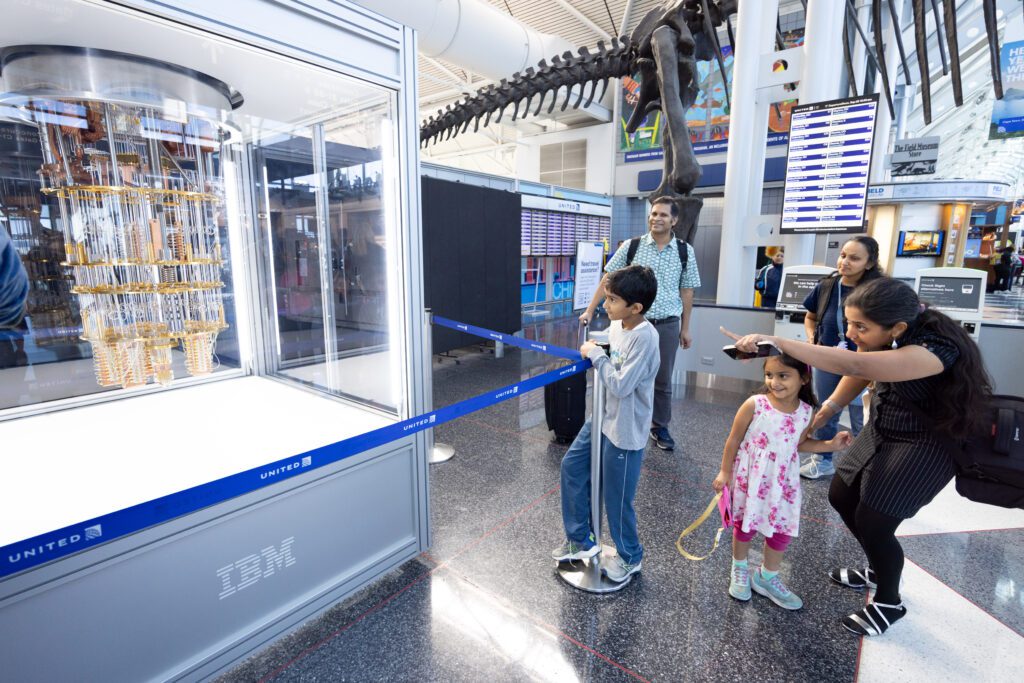
As a quantum-track Molecular Engineering major at the University of Chicago’s Pritzker School of Molecular Engineering, it was deeply meaningful to see travelers pause to engage with the field that I study and love. Standing among them, I was struck by the quiet fact that no one knew I had helped build the exhibit they were exploring.
The exhibit and accompanying informational website are called “Imagining the Future: An Encounter with Quantum Technologies.” I helped design both as part of UChicago’s Scientists, Technologists, and Artists Generating Exploration (STAGE) Center. Supported by a generous American Physical Society Innovation Fund grant with space donated by United Airlines, the exhibit celebrates the UN’s International Year of Quantum Science and Technology by putting quantum in public spaces.
I care about finding ways to make quantum science more visible. Today, it’s hidden behind lab walls and layers of complex math, even as quantum technologies become increasingly relevant to everyday life. Biological sensors may one day detect diseases at the smallest levels, and quantum networks could create uncrackable, secure communications. And with resources like UChicago PME, the Chicago Quantum Exchange, Argonne and Fermi national labs, and a growing startup community, it is all centered right here in Chicago.
I came to the University of Chicago to be part of this quantum revolution and for the STAGE Center.
The STAGE Center, led by UChicago PME Prof. Nancy Kawalek, is a groundbreaking collaboration between engineers, physicists, artists, filmmakers and game creators working to tell stories about and inspired by science. For years, I have been passionate about both quantum physics and documentary filmmaking, and I’ve always been drawn to using narrative to make complex science approachable. The STAGE Center creates a rare environment for that intersection.
When the United Nations announced 2025 would be the International Year of Quantum Science and Technology, I continued to think about how to make quantum visible to people. I wanted the public to not just become aware of quantum science, but to feel its relevance and the role it will play in their lives. I thought back to the first time I saw a dilution refrigerator, how striking and intricate it was, and how it invited a sense of curiosity long before I understood what it did.
I envisioned an exhibit that would place a dilution refrigerator in a public space as a centerpiece. I brought the idea to Prof. Kawalek and STAGE Director of Science Sunanda Prabhu-Gaunkar. It has been remarkable to watch that initial spark of “Let’s put quantum in public” grow into this very real exhibit, now greeting the millions of travelers who pass through the terminal each year.
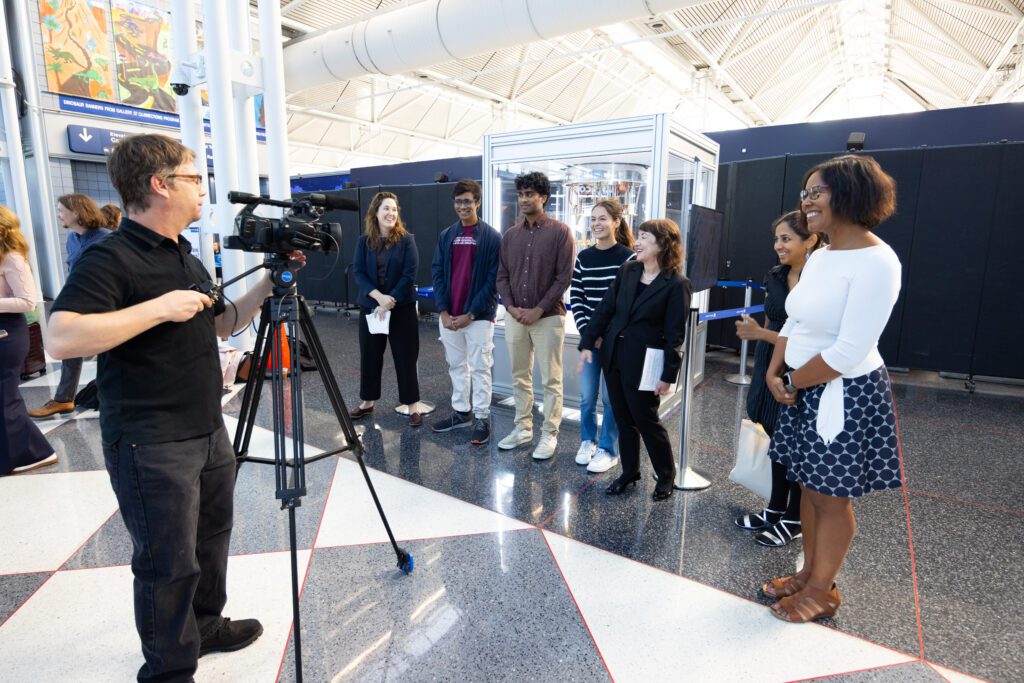
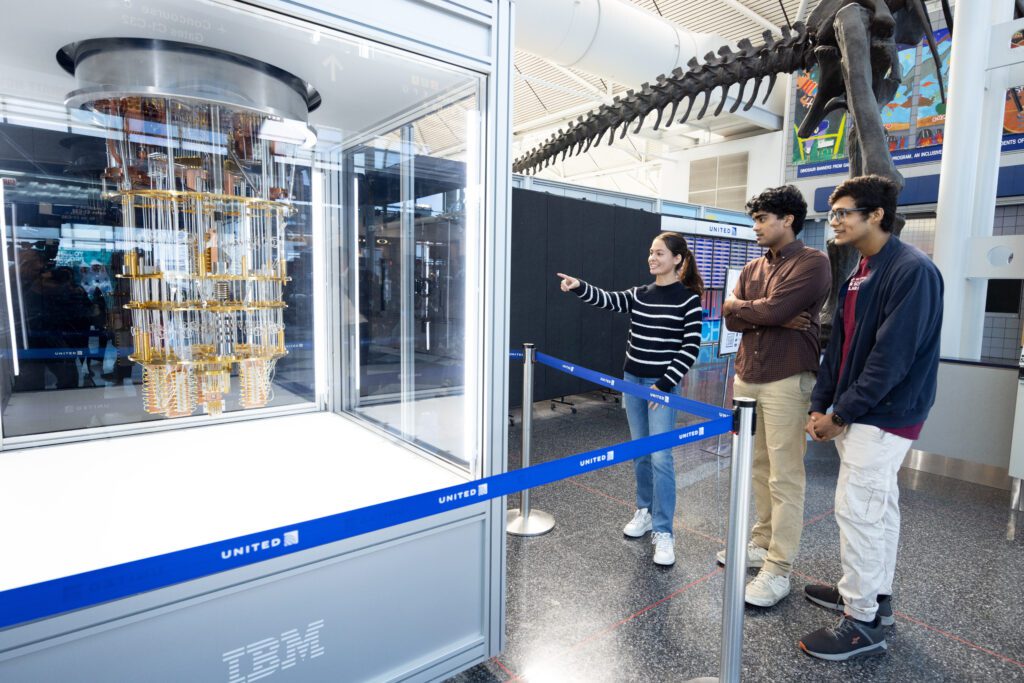
It was important to us that the exhibit would be genuinely educational, not just showcasing an incredible piece of hardware, but also the science behind it. Over several months, a team of five University of Chicago students—Jeffrey Li, Avery Linder, Reet Santosh Mhaske, Rohan Venkat, and myself—worked to develop the exhibit’s educational materials, including a website designed to help travelers understand what they’re looking at and why it matters.
We wanted the science to be both accurate and accessible, a balance that is difficult to hit. Oversimplifying risks losing the integrity or accuracy of the science, but too many details can be overwhelming and turn people away. So we thought carefully about our audience, how much time they might spend at the exhibit, and what type of information would be engaging in that brief encounter.
Luckily, the STAGE Center has always done a very good job of making science accessible and exciting in all its projects. Under Nancy and Sunanda’s guidance, the exhibit grew into what you can see today.
Working together, APS, United, IBM and the STAGE Center team put science where people would least expect to encounter it.
In traditional museums or classrooms, people choose to seek out science. In an airport, it finds them where they are. As I continued to my gate, I kept thinking about the travelers who had paused to engage with quantum science in the middle of their journey. I’m sure they had no idea they would learn anything about quantum today, yet the exhibit made space for curiosity anyway. That, to me, is the power of bringing science into public life.
Credit for the cover picture: Anne Ryan