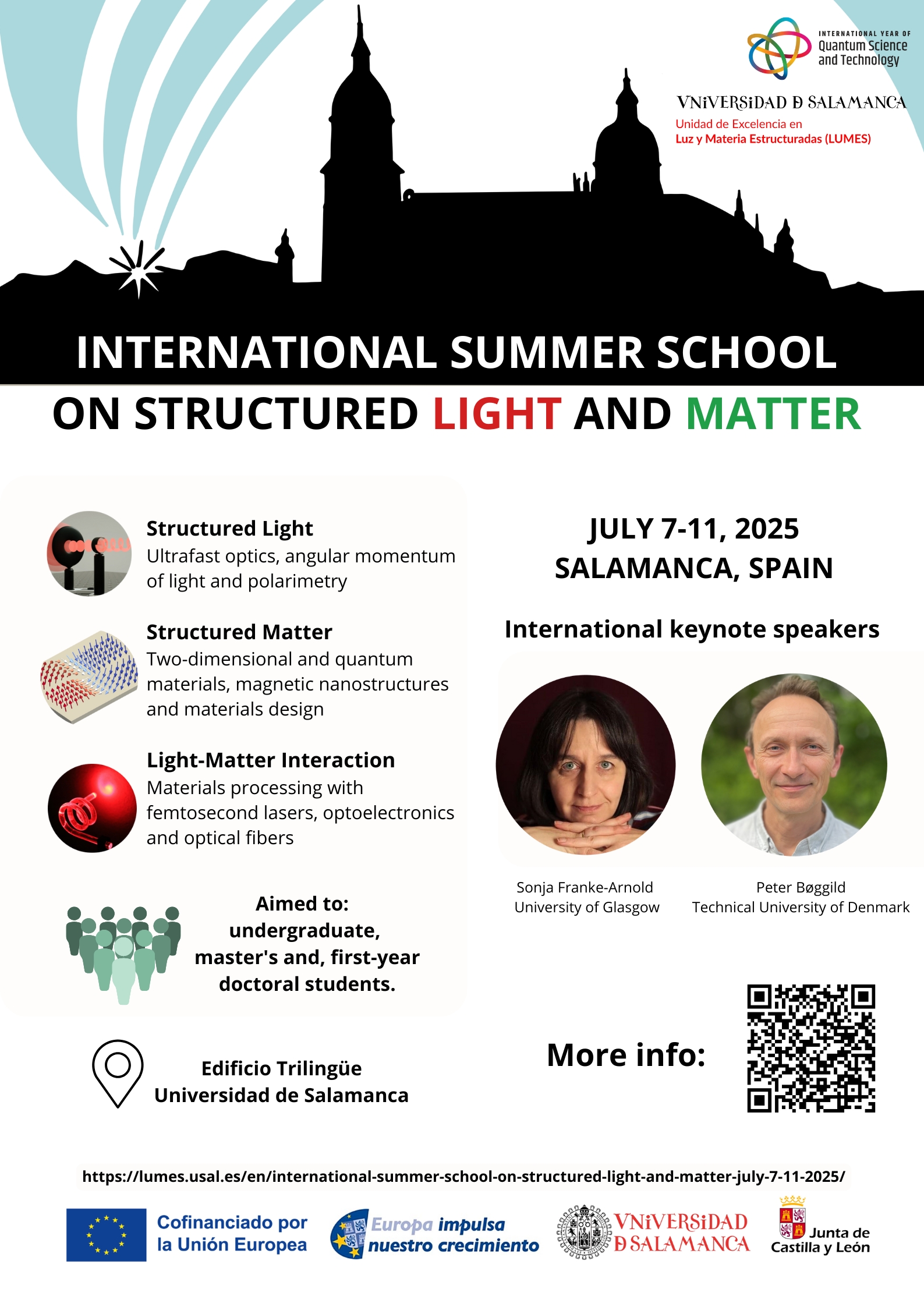
International Summer School on Structured Light and Matter

Welcome to the first edition of the International Summer School on Structured Light and Matter, organized by the Unit of Excellence LUMES at the University of Salamanca. The school will take place from July 7 to 11 in Salamanca, Spain.

The Summer School offers a week of intensive, interdisciplinary training in three key areas of current research: structured light, structured matter, and light-matter interaction. The school features 11 courses spread over 36 teaching hours, carefully structured to offer participants an advanced and practical introduction to these topics. The program combines theoretical sessions, practical modules, keynote lectures delivered by international experts, and a special visit to the Center for Pulsed Lasers (CLPU), featuring 21 researchers from the Universidad de Salamanca.

As part of the event, we are pleased to host two plenary sessions delivered by leading international researchers (Open Entry).

Share Your Vision of Light and Quantum Science


Light is one of the most basic and essential parts of the universe. It’s also where the journey into quantum science, the branch of science that studies how the tiniest particles in the universe behave, begins. From the glow of heated objects to the puzzling behavior of tiny particles of light, light has helped us discover how the quantum world works.

Share your visual works on light and quantum science. Selected submissions will be showcased on UNESCO’s website.


Key dates

  • Call opens: 16 May 2025 (International Day of Light)
  • Submission deadline: 16 July 2025
  • Public voting: August 2025
  • Publication of winners: October 2025

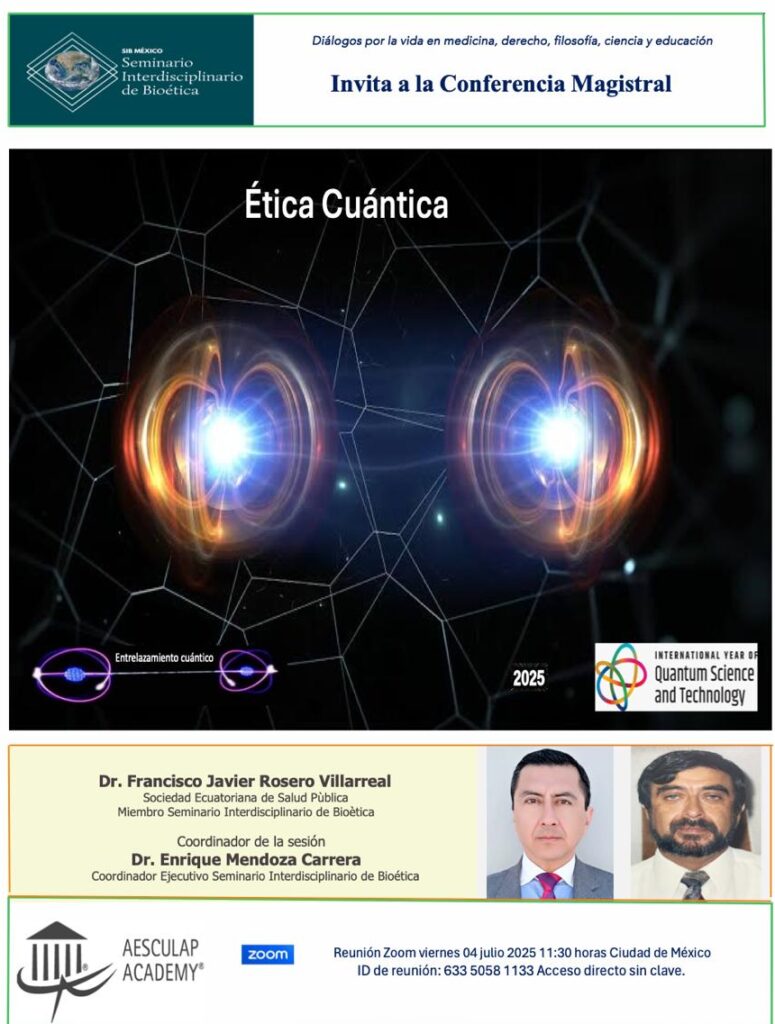
Ética Cuántica

Conference for partners and the general public on Quantum Ethics. Introduction to ethical, legal, social, and political issues on quantum applications (ELPSI framework).

Monday Seminar – 100 Years of Quantum

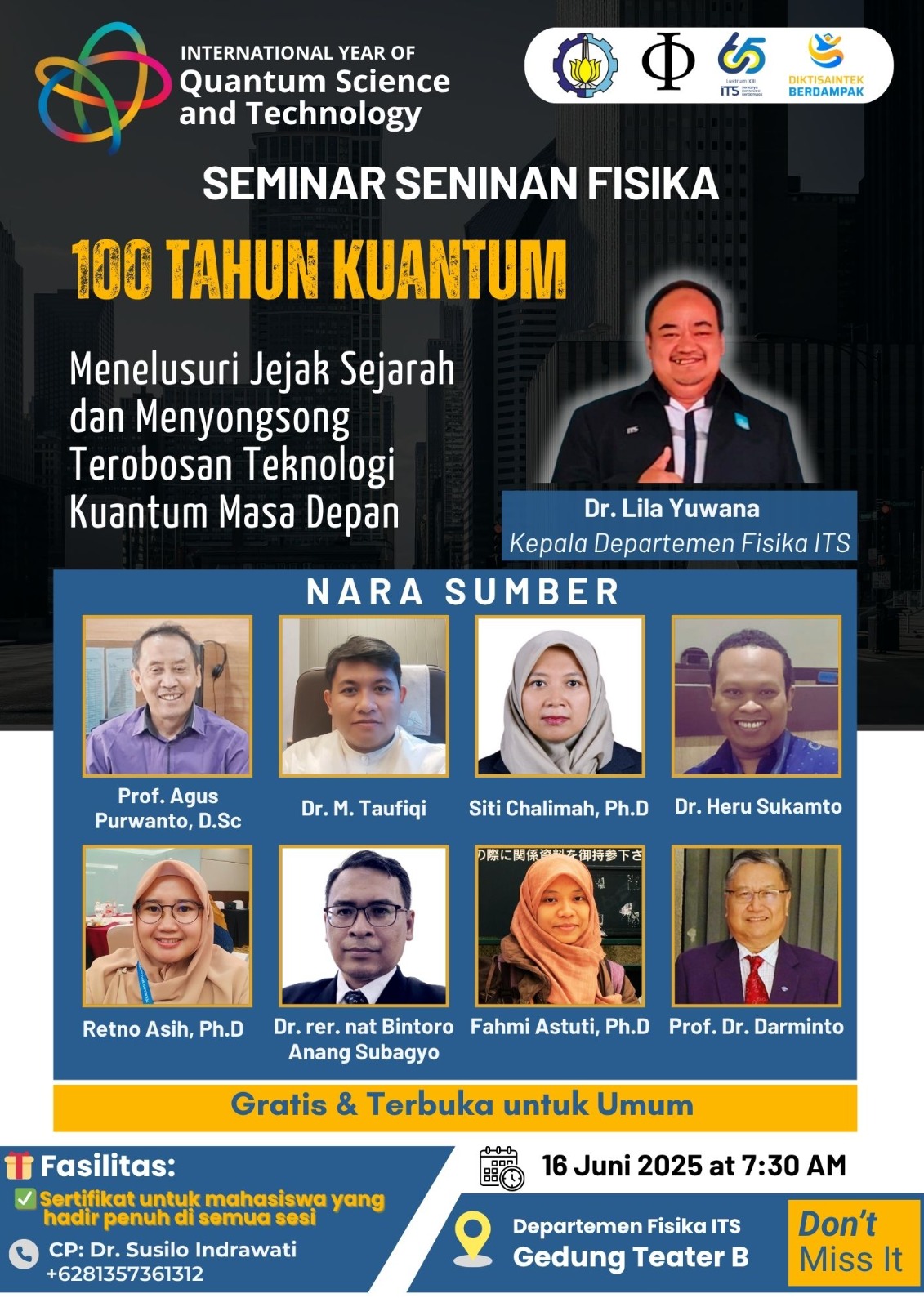
Celebrating the UNESCO-declared International Year of Quantum Science and Technology in 2025, the Department of Physics at Institut Teknologi Sepuluh Nopember (ITS) proudly presents the 23rd annual Monday Physics Seminar, the longest-running weekly seminar series in Indonesia, featuring the special theme “100 Years of Quantum: Tracing the Historical Footsteps and Embracing Future Quantum Technology Breakthroughs.” This event, held on June 16, 2025, at the ITS Physics Department, brings together leading Indonesian experts in quantum science to explore the evolution, achievements, and future directions of quantum research, with a focus on entanglement, quantum teleportation, quantum heat engines, quantum optics, and solid-state quantum systems, and many more.

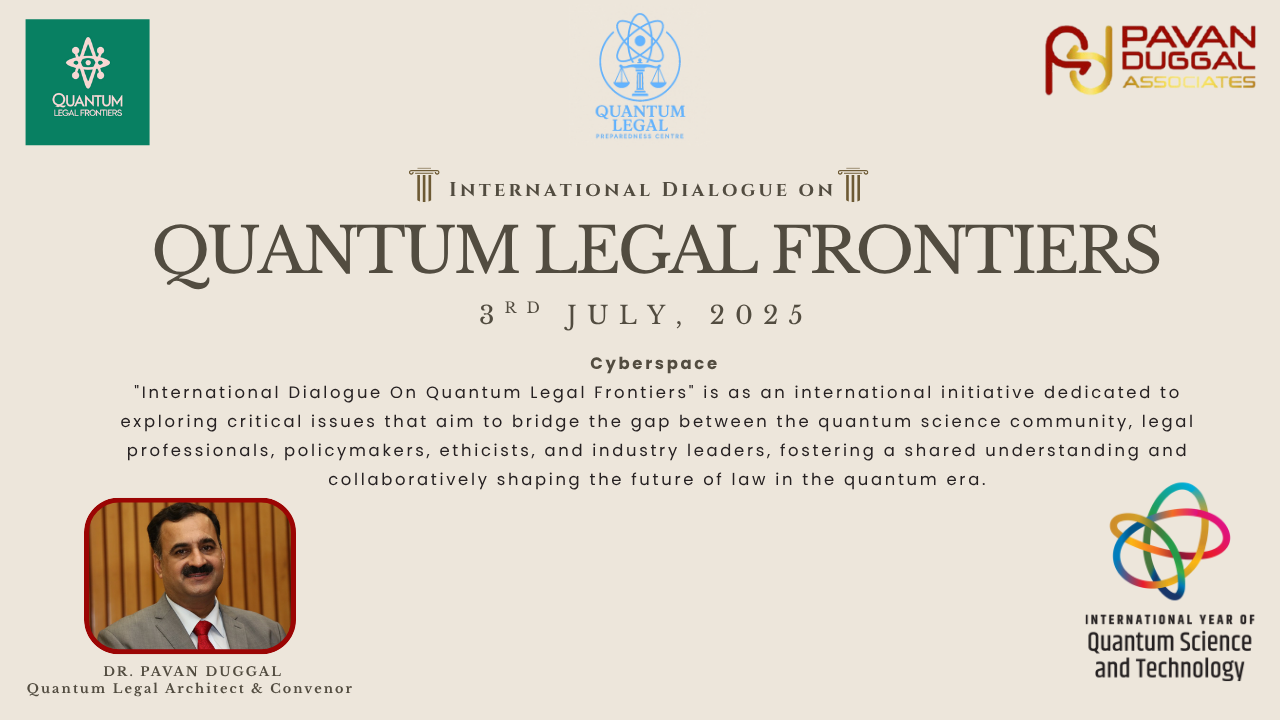
International Dialogue on Quantum Legal Frontiers 2025

The Quantum Leap and the Legal Imperative


The world stands on the cusp of a second quantum revolution. Advances in quantum science and technology, particularly in quantum computing, promise unprecedented computational power capable of tackling problems currently intractable for even the most powerful supercomputers. From accelerating drug discovery and material science to revolutionizing financial modeling and artificial intelligence, the potential applications are vast and transformative.


Recognizing the profound significance of this field, the United Nations has proclaimed 2025 as the International Year of Quantum Science and Technology. This global acknowledgment underscores the importance of raising public awareness, promoting international cooperation, and exploring the impact of quantum advancements across all sectors of society.


As quantum technology progresses from theoretical labs to practical applications, it inevitably intersects with existing legal, regulatory, and ethical frameworks. The unique principles of quantum mechanics challenge traditional notions of data security, intellectual property, privacy, governance, and even fundamental legal concepts. The development and deployment of quantum computing necessitate a proactive and informed approach to law and policy to harness its benefits while mitigating potential risks.

The Need for Legal Frontiers

While the scientific and technological aspects of quantum computing are rapidly evolving, the legal and policy discourse is still in its nascent stages. Existing laws, designed for a classical digital world, are often ill-equipped to address the complexities introduced by quantum capabilities. Issues such as the existential threat of quantum computers to current encryption methods, the legal status of quantum data, the ethical implications of quantum AI, and the need for international regulatory harmonization demand urgent attention.
“Quantum Legal Frontiers” is conceived as a timely and essential international platform dedicated to exploring these critical issues. It aims to bridge the gap between the quantum science community, legal professionals, policymakers, ethicists, and industry leaders to foster a shared understanding and collaboratively shape the future of law in the quantum era.


Event Objectives

The “Quantum Legal Frontiers” event aims to achieve the following objectives:


• Raise Global Awareness: Educate legal professionals, policymakers, industry stakeholders, and the public about the fundamental concepts of quantum computing and its immediate and long-term implications for law and society.
• Facilitate Interdisciplinary Dialogue: Create a unique hybrid space for experts from quantum science, law, policy, ethics, and industry to engage in constructive discussions on pressing issues.
• Identify and Analyze Legal Challenges: Deep dive into the specific legal, regulatory, and ethical complexities introduced by quantum computing across various domains.
• Explore Policy Responses: Discuss potential legal and policy frameworks, standards, and strategies necessary to govern quantum technologies effectively and responsibly.
• Promote International Collaboration: Highlight the importance of cross-border cooperation in developing harmonized legal approaches to a technology with global impact.
• Build Capacity: Equip attendees with the knowledge and perspectives needed to navigate the evolving landscape of quantum computing and law in their respective fields.
• Contribute to the UN International Year of Quantum Science and Technology: Serve as a significant global event marking the year by focusing on the crucial societal dimension of quantum advancements – its legal implications.


Exploring the Frontiers: Key Themes


The event will feature sessions covering, but not limited to, the following key themes:
• Quantum Cybersecurity and the Law: Post-Quantum Cryptography (PQC) migration legal mandates, liability for quantum-related data breaches, legal implications of “harvest now, decrypt later” threats, legislative needs for quantum-resistant infrastructure.
• Data Privacy & Protection in the Quantum Age: Re-evaluating data protection laws (like GDPR, CCPA) in light of quantum capabilities, legal challenges to consent and anonymity, protecting sensitive data against quantum attacks.
• Intellectual Property Rights in Quantum Technologies: Patenting quantum algorithms and hardware, trade secret protection for quantum software and techniques, challenges of inventorship and ownership in collaborative quantum research.
• Quantum Computing Regulation & Governance: The need for new national and international regulatory frameworks, export controls and national security implications, international standards for quantum technologies, anticipatory governance approaches.
• Ethical and Societal Implications: Legal and ethical considerations of quantum-enhanced AI (bias, accountability, transparency), potential for misuse (e.g., surveillance), ensuring equitable access and preventing a “quantum divide.”
• Quantum Computing and Cybercrime: Legal definitions of quantum-enabled cyber offenses, challenges for law enforcement and digital forensics, international cooperation in prosecuting quantum cybercrimes.
• Contractual and Liability Issues: Defining terms, reliability, and responsibility in contracts involving quantum computing services or hardware; establishing liability for errors or unintended consequences of quantum computations.
• Geopolitics of Quantum Computing: Legal and policy aspects of the global race for quantum supremacy, international norms, and arms control considerations.
• Sector-Specific Legal Deep Dives: Examining the unique legal impacts in finance, healthcare, pharmaceuticals, energy, and other key industries.


Join us in exploring and shaping the Quantum Legal Frontiers of tomorrow. More in the link

QSUN, SAQuTI & NITheCS Seminar

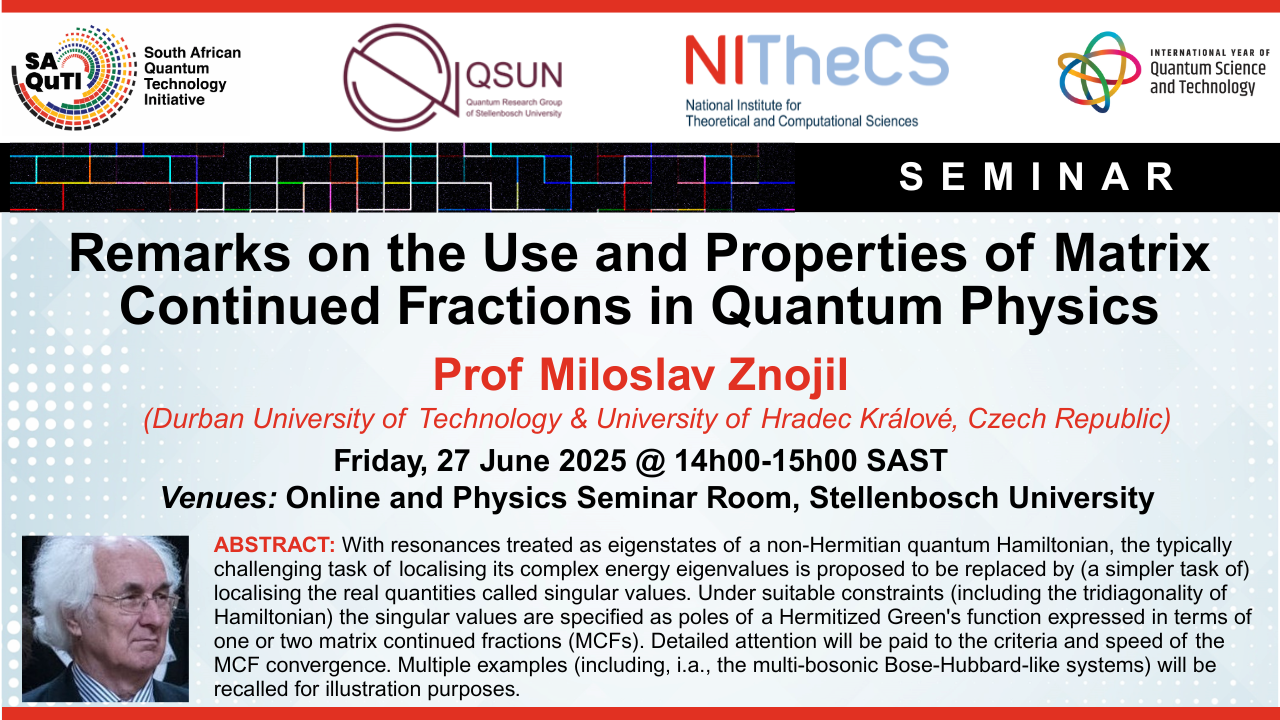
With resonances treated as eigenstates of a non-Hermitian quantum Hamiltonian, the typically challenging task of localising its complex energy eigenvalues is proposed to be replaced by (a simpler task of) localising the real quantities called singular values. Under suitable constraints (including the tridiagonality of Hamiltonian) the singular values are specified as poles of a Hermitized Green’s function expressed in terms of one or two matrix continued fractions (MCFs). Detailed attention will be paid to the criteria and speed of the MCF convergence. Multiple examples (including, i.a., the multi-bosonic Bose-Hubbard-like systems) will be recalled for illustration purposes.

Biography

Prof Miloslav Znojil is a Czech theoretical and mathematical physicist specialising in quantum mechanics, with a focus on simplified and tractable models, pseudo-Hermitian operators, and advanced algebraic and analytical methods. He earned his BSc in Nuclear Physics from the Czech Technical University (1968), followed by MSc and PhD degrees in Theoretical and Mathematical Physics from Charles University, Prague, where he was later awarded the prestigious Dr.Sc. scientific degree in 1994.
Prof Znojil has held research positions across Europe and Russia, including at the Institute of Nuclear Physics (CSAS, Rez), the J. Stefan Institute (Ljubljana), and FIAN Moscow. He currently serves as a Leading Research Worker at the Nuclear Physics Institute of the Czech Academy of Sciences, a Research Professor at Durban University of Technology, and an independent researcher at the University of Hradec Králové.


He is Deputy Director of the Doppler Institute (Rez branch) and sits on the editorial boards of Physics and Acta Polytechnica. He has authored over 325 publications with more than 5,800 citations (h-index: 38), and is recognised internationally for his contributions to quasi-Hermitian quantum models, perturbation theory, and supersymmetry.

AIMS Quantathon

The AIMS Ghana QTEdu Global Event is a week-long celebration of innovation, collaboration, and education. The goal of the AIMS Quantathon is to create opportunities for young Africans to participate in quantum education and contribute to the development of Quantum Computing (QC) applications for the SDGs. This is based on the “Hackathon in a Box” toolkit, which is curated by the Open Quantum Institute (OQI) Education Consortium.

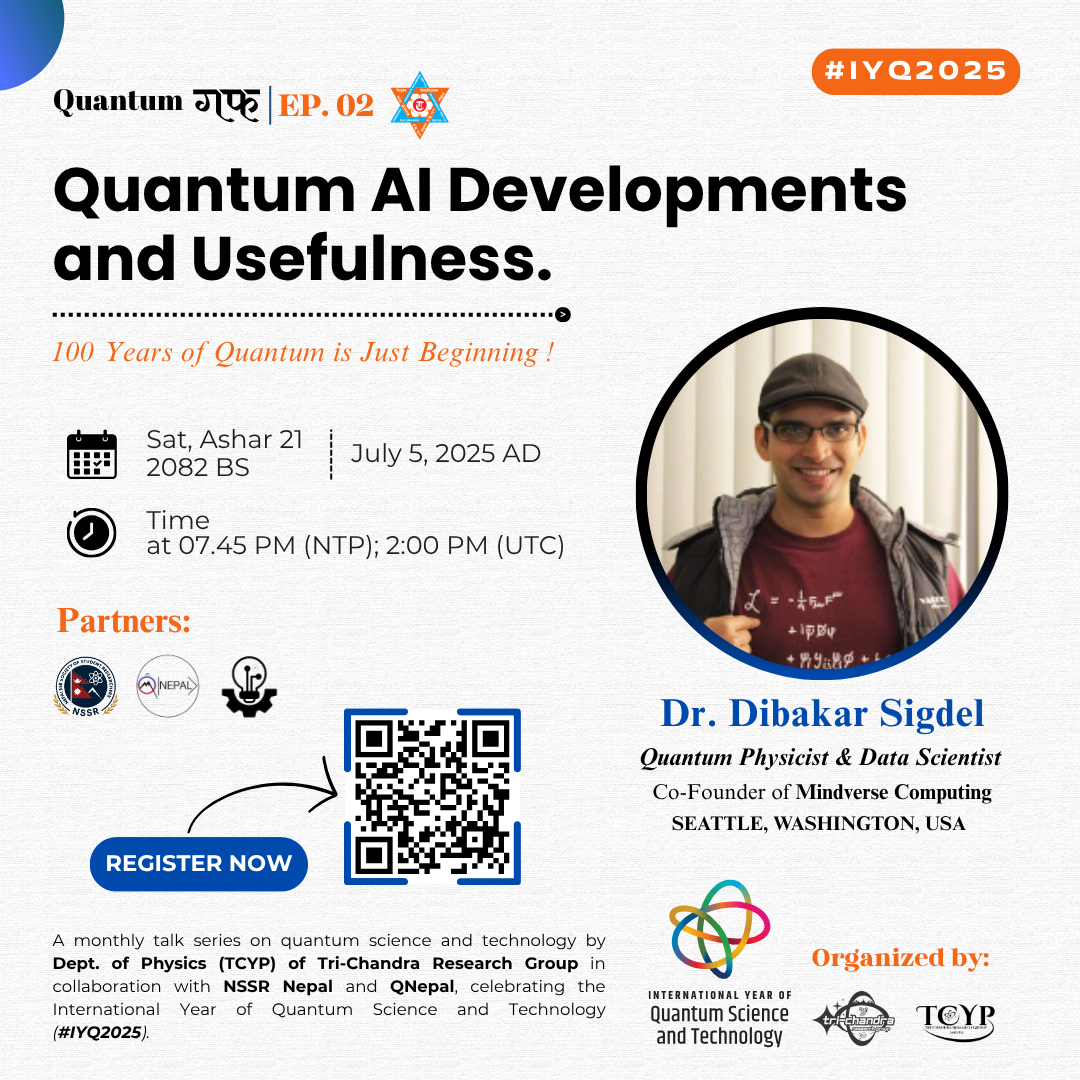
Quantum गफ | EP.02 Quantum AI Developments and Usefulness

Join us for Episode 02 of Quantum गफ, a monthly talk series exploring the frontiers of quantum science and technology. The series is organized by the Dept. of Physics (TCYP) of Tri-Chandra Research Group (TCRG) in collaboration with QNepal and NSSR Nepal, as part of the global celebration of the International Year of Quantum Science and Technology (#IYQ2025).

 Topic: “Quantum AI Developments and Usefulness”

Guest Speaker: Dr. Dibakar Sigdel, Quantum Physicist & Data Scientist, Co-Founder, Mindverse Computing
Seattle, Washington, USA

Session Overview

In this session titled “Quantum AI Developments and Usefulness,” Dr. Dibakar Sigdel will explore how recent advancements in quantum computing are driving innovation in artificial intelligence. From quantum machine learning techniques to real-world applications in data science, the talk will examine how quantum AI is poised to revolutionize the future of intelligent systems.


Contact Us

📧

 Facebook

 Instagram

 LinkedIn

 The Quantum Roundtable

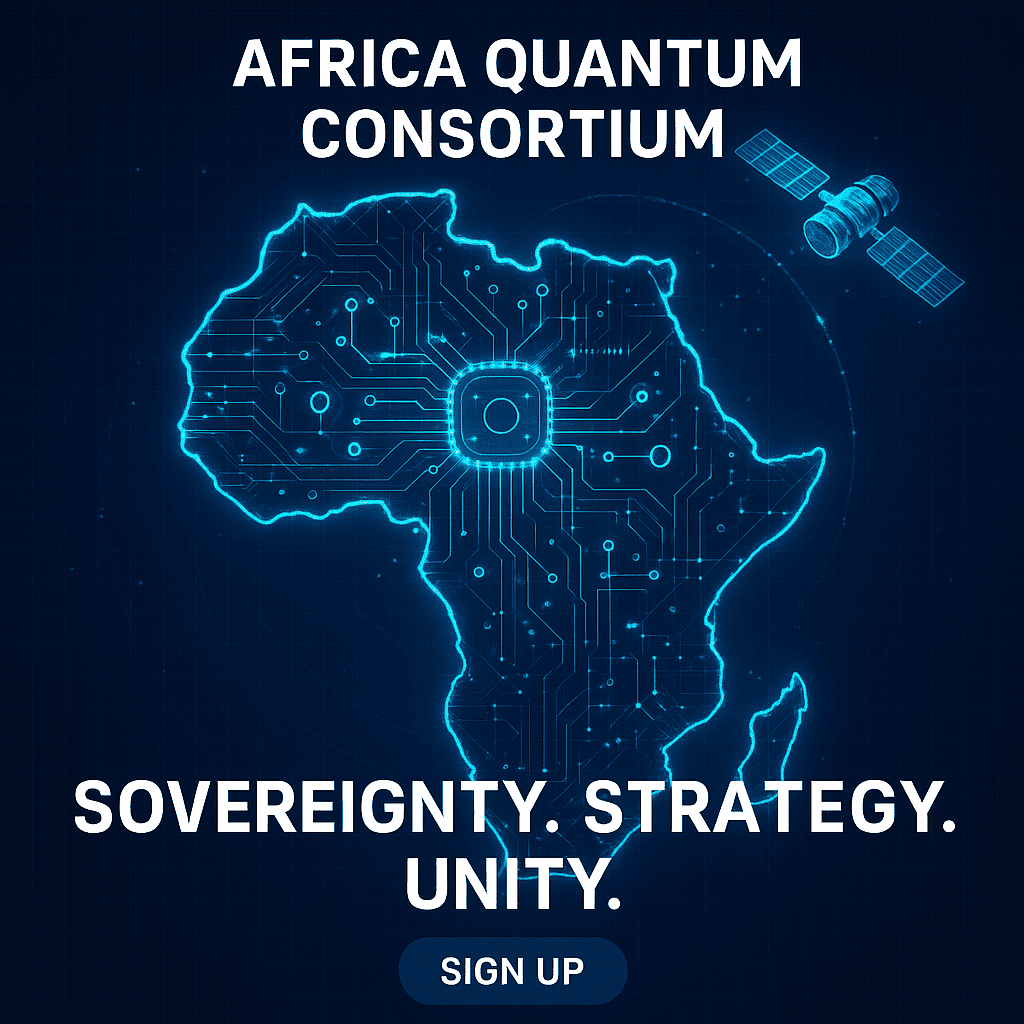
Coming This September: The AQC 3Q Quantum Roundtable Showcase Africa’s Quantum and Deep Tech Momentum. This roundtable spotlights breakthrough startups, frontier research, and our bold vision for a deep tech innovation hub rooted in Africa. Global and diaspora partners will chime in as we shape the continent’s next leap. This is where ideas meet action. Pre-register now. Be part of the build.

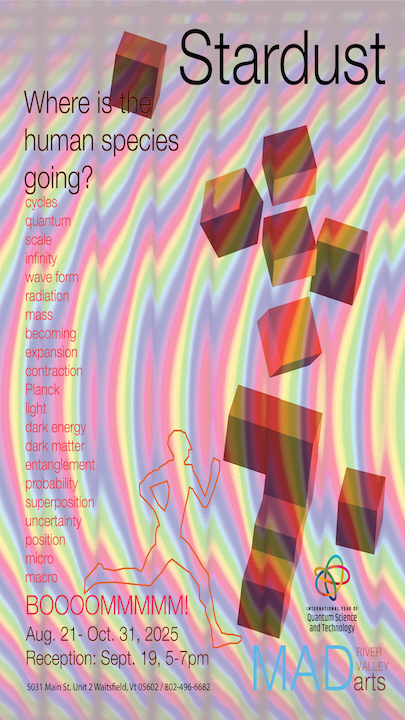
Stardust

The Mad 802 Collective (Mad River Valley Arts) is proud to share ‘Stardust’, an exhibition about the Quantum World. The Quantum World is one of uncertainty. One can’t really talk about where a quantum object is; we can only talk about where we might find it. Yet, our seemingly solid reality is built upon this tiny world of possibilities; stuff has form, the universe has form, and we are solid. This show looks at the behavior of photons, particles, and mysterious patterns of quantum phenomena. It inspires us to think about the magic of the quantum fundamental basis of reality and asks us to be curious about where the human species is going. Artists open up to their interpretation of the immaterial while engaging with the scales of the unimaginably tiny to the infinitely large.