This event on quantum science and technology will take place at the Faculty of Sciences, University of Medea, Algeria, on June 24, 2025. The aim of the workshop is to bring together leading scientists in the domain of quantum science and technology to discuss the latest achievements in this field. The event will provide PhD students and interested researchers with the opportunity to learn about the latest progress in the field of quantum science and quantum-based technologies. The workshop includes keynote talks and will feature a panel discussion with invited scientists renowned in the global quantum science and technology community. The event can be attended virtually (online), where participants also have the opportunity to present their work related to the workshop’s topic.
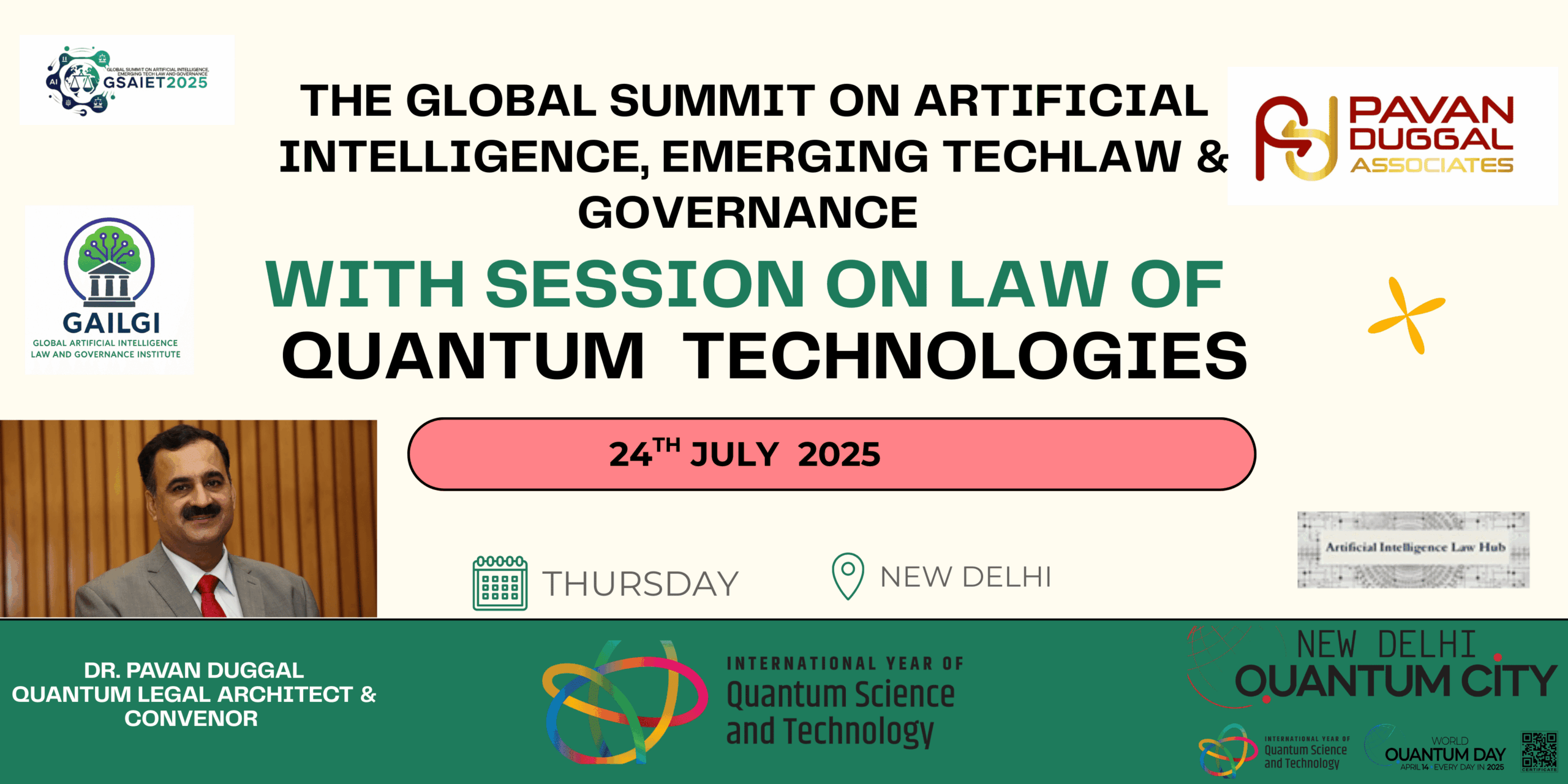
The Global Summit on Artificial Intelligence, Emerging Tech Law & Governance 2025, with Session on Law for Quantum Technology
Summit Overview
Scheduled for 24 July 2025 in New Delhi, India, the Global Summit on Artificial Intelligence, Emerging Tech Law & Governance 2025 (GSAIET 2025) will convene the foremost jurists, policymakers, regulators, technologists, industry leaders, and civil-society advocates to confront the legal, ethical, and governance challenges posed by artificial intelligence and other disruptive technologies, including quantum technology.
Jointly organised by the Global AI Law & Governance Institute (GALGI), the Artificial Intelligence Law Hub, and Pavan Duggal Associates, Advocates, with academic collaboration from Cyberlaw University, the Summit is designed as a high-level working forum that transforms dialogue into tangible, actionable outputs:
• Adoption of an international consensus document articulating core legal and ethical principles for emerging technologies.
• Publication of a peer-reviewed, ISBN-registered proceedings volume capturing scholarly contributions and session insights.
• Launch of a sustained institutional partnership platform to drive cross-border cooperation, research, and capacity-building in AI law and policy.
Objectives
1. Forge a cohesive, human-centric, and ethically robust international AI-governance architecture.
2. Operationalise risk-based regulatory models inspired by instruments such as the EU AI Act.
3. Harmonise national AI laws with universal human-rights standards and multilateral frameworks (UN, UNESCO, OECD).
4. Establish clear liability principles for AI-related harms and mechanisms for mitigating algorithmic bias.
5. Address quantum-computing governance, cryptographic resilience, and national-security implications.
6. Define legal recognition and oversight for decentralised autonomous organisations (DAOs) and blockchain ecosystems.
7. Strengthen algorithmic transparency and explainability as constitutional or statutory imperatives.
8. Develop sector-specific ethical jurisprudence for autonomous systems in healthcare, transportation, and defence.
Profile of the Summit Chair
Dr Pavan Duggal – Chair & Convenor, GSAIET 2025
Dr Pavan Duggal is internationally recognised as a trail-blazer at the intersection of technology and jurisprudence. An Advocate of the Supreme Court of India, he has authored 200 books and advised governments, multilateral agencies and Fortune 500 companies on cyberlaw, AI regulation, data governance and emerging-tech policy.
Strategic Vision
• Architect of the Summit’s Intellectual Framework – personally conceived the six thematic pillars that align legal discourse with real-time technological advances.
• Champion of Interoperable Governance – advocates harmonised AI-law standards to ensure cross-border consistency while preserving national sovereignty.
• Driver of Outcome-Oriented Engagement – mandates that every panel produce concrete recommendations feeding directly into the Summit Outcome Document.
Leadership Milestones
• Founder & President – Global AI Law & Governance Institute (GALGI): galvanises global research networks to anticipate AI-related legal challenges.
• Chief Mentor – Blockchain Law Epicentre: pioneers jurisprudence for decentralised ecosystems, smart contracts and digital-asset compliance.
• Chairman – International Commission on Cyber Security Law: steers development of global cybersecurity legal standards.
• Chancellor – Cyberlaw University: has trained 29,000+ professionals from 170 countries in cyberlaw and AI-governance programmes.
Convening Power
Leveraging a career-spanning network, Dr. Duggal has secured the participation of cabinet-level regulators, UN advisors, leading AI scientists, and digital rights advocates from all inhabited continents. His outreach ensures that diversity of jurisdiction, discipline, and viewpoint is embedded in every Summit conversation.
Legacy Focus
Dr Duggal envisions GSAIET 2025 not as a one-off conference but as the launchpad for a sustained global movement that embeds legal foresight into the fabric of technological innovation, ensuring that progress remains anchored in human dignity, constitutional values, and sustainable development.
Thematic Pillars
Pillar Scope (Key Issues)
1. AI & Fundamental Rights Bias audits, algorithmic explainability, data-protection alignment, human-in-the-loop oversight
2. AI, Accountability & Liability Tort and regulatory models, systemic risk management, insurer frameworks
3. Cybersecurity & Autonomous Defence AI-enabled cyber-conflict, autonomous weapons, drone-warfare norms
4. Law for Quantum Technology & Decentralised Tech Smart-contract enforceability, zero-knowledge proofs, post-quantum crypto standards
5. Digital Trade, Competition & IP Cross-border data flows, antitrust in AI-driven markets, IP for AI-generated works
6. RegTech & LegalTech Innovation: AI-assisted compliance, smart-contract adjudication, digital dispute resolution
Distinguished Speakers
• Dr Rajiv Mani – Secretary, Legislative Department, Ministry of Law & Justice, Government of India
• Dr. Pavan Duggal- International acclaimed AI Law expert, President ,Global Artificial Intelligence Law and Governance Institute (GAILGI) and Summit Chair, GSAIET
• Traci Ruiz – High-Stakes Leadership Expert & Crisis Strategist
• Alfredo Ronchi – General Secretary, EC-MEDICI Framework; Chair, JRC S2D2
• Saakshar Duggal – Forbes Communication Council; 19× TEDx Speaker on AI Law
• Prof. Christoph Stückelberger – Founder, Globethics Foundation
Organising Entities
1. Global AI Law & Governance Institute (GALGI) – Centre of excellence for AI-law research and policy.
2. Artificial Intelligence Law Hub – Interdisciplinary platform tracking global AI-regulatory developments.
3. Pavan Duggal Associates, Advocates – Niche law firm specialising in cyberlaw, AI-governance and emerging-tech regulation.
VII. Anticipated Outcomes & Legacy
• Summit Outcome Document – to be tabled before the UN, G20 and OECD for standard-setting deliberations.
• ISBN-Registered Proceedings Volume – enduring resource for policymakers, academia and industry.
• Stakeholder Directory & MoUs – institutionalise research collaborations and capacity-building initiatives.
• Specialised Working Groups – permanent task-forces on AI-liability, quantum-tech law and digital-rights governance under GALGI’s auspices.
Registration
Secure participation via the official form
For speaking, sponsorship, or media enquiries, please contact: Dr Pavan Duggal, Summit Chair, GSAIET 2025
Email: pavan@pavanduggal.com | pavanduggal6@gmail.com
LinkedIn: linkedin.com/in/pavanduggal | Twitter: @pavanduggal
GSAIET 2025: Building the legal scaffolding for a technology-driven future—by humanity, for humanity.

La Cuántica en Nuestro Mundo
El Departamento de Ciencias Naturales de la Universidad Pedagógica Nacional “Francisco Morazán” tiene el agrado de invitarles a “La Cuántica en Nuestro Mundo”, un evento dedicado a explorar los misterios y aplicaciones de la ciencia cuántica.
A lo largo del día, sumérgete en una serie de charlas magistrales de 45 minutos que abordarán temas como la dualidad onda-partícula, la evolución de nuestra comprensión del átomo, el impacto de los puntos cuánticos, el prometedor futuro de la computación cuántica y la relevancia de la seguridad radiológica en este campo.
Además, podrás apreciar una exposición de pósteres que ilustra la evolución histórica de la ciencia cuántica, ofreciendo una perspectiva visual y educativa sobre sus hitos y descubrimientos clave. Para una experiencia más interactiva, tendremos visitas guiadas al laboratorio de física, donde podrás presenciar directamente un fenómeno cuántico: los espectros de emisión de gases.
Decentralised Energy Forum’s “Energy and the Quantum Advantage”
DEF 2025 is Canada’s leading industry event focused on decentralised energy solutions. In alignment with the International Year of Quantum Science and Technology (IYQ), this year’s forum will explore how quantum computing, sensing and communication can accelerate the transition to sustainable, resilient, and data-driven energy systems.
DEF 2025 is premised on the principles of openness, collaboration, and scientific integrity. We are inviting participants across sectors, including developers, researchers, policymakers, and the public, to engage with quantum’s potential in emissions monitoring, grid optimization, and AI-enhanced demand response. Ultimately, by connecting people, ideas, and technologies, DEF 2025 models the IYQ spirit: making quantum science accessible, inclusive, and impactful.
Quantum Information Science and Technology Conference
QISTCon.ph 2025 is the premier Quantum Information, Science, and Technology Conference in the Philippines, bringing together experts, researchers, industry professionals, and the community to develop a responsible quantum ecosystem in the country and the region.
This conference is made possible through close collaboration between the Quantum Computing Society of the Philippines (QCSP), the Department of Science and Technology—Philippine Council for Industry, Energy, and Emerging Technology Research and Development (DOST-PCIEERD), the Open Quantum Institute (OQI), the Geneva Science and Diplomacy Anticipator (GESDA) Foundation, and the International Year of Quantum Science and Technology (IYQ2025).
Quantum Computing Hackathon at Swiss Quantum Week
Teams will develop quantum solutions for the UN Sustainable Development Goals. This hands-on competition offers students practical experience, helps corporates explore first applications, and shows policymakers that quantum is already delivering real results—making it a key driver for Switzerland’s innovation agenda and future investment.
SEA Quantathon

The SEA Quantathon 2025 aims to innovate quantum computing applications for social good, allowing us to redirect the benefits of quantum technologies towards humanity. The issues chosen are in healthcare & medicine, renewable energy, and climate change, all of which are relevant to Southeast Asian countries.
The First MOLESs Workshop
The first MOLESs Workshop (MOLecular Excited State spectroscopy Workshop) will take place in Belgrade from November 6-7 2025, following the CEQPAS (Centennial of Quantum Theory: Progress in Atomic and Molecular Structure) meeting. Both events are part of the International Year of Quantum regional activities. The workshop is an annual meeting of the MOLESs consortium, launching a long-term effort to collate and disseminate data on the excited-state spectroscopy of molecules across gaseous and solid phases. Sessions will include: 1. Review of available data from contributors; 2. Accessing published and unpublished data sets; 3. Invitations to increase participants; 4. Templates and guides for data presentation; 5. Databases; 6. Dissemination of MOLESs to the broader community. 7. CEQPAS follow-up.
Participation is free but by invitation only. Attendees are responsible for their own travel and accommodation arrangements. Further information will be available on the MOLESs webpage.
CEQPAS – Centennial of Quantum Theory: Progress in Atomic and Molecular Structure

CEQPAS – Centennial of Quantum Theory: Progress in Atomic and Molecular Structure” will be held in Belgrade, Serbia from 3–5 November 2025. Organized by the University of Belgrade – Institute of Chemistry, Technology and Metallurgy, University of Belgrade – Institute of Physics, and the MOLESs consortium, this three-day symposium will be part of the International Year of Quantum regional activities. It will welcome up to 40 participants, with priority for researchers from Central and Eastern Europe and a special focus on early-career scientists. It will feature oral presentations by all delegates.
The program will be structured into five interlinked sessions: 1. Atomic and molecular spectroscopy and its applications to atmospheric sciences and astronomy. 2. Collisions and their applications in plasma physics. 3. Studies in chemical physics and physical chemistry. 4. The use of artificial intelligence and machine learning for atomic and molecular data analysis and generation. 5. The application of quantum science to our wider understanding of phenomena, including radiation sciences.
There is no registration fee; participants are responsible for their travel and accommodation. Further details will be available on the CEQPAS website.
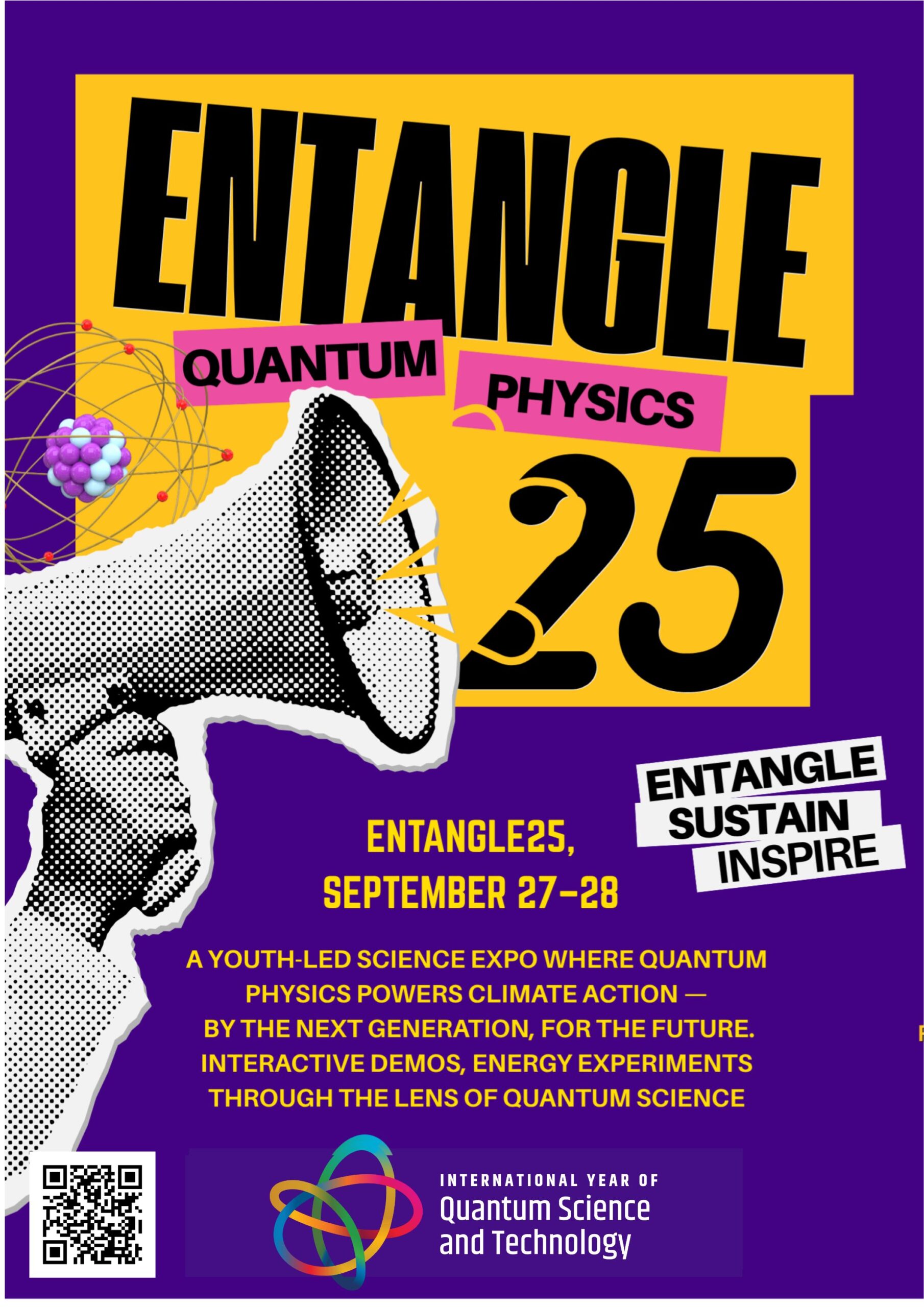
Entangle25
Entangle25 is a youth-led science expo where quantum physics meets climate action. Organized by high school students in Athens, Greece, this dynamic event features interactive exhibits, sustainability experiments, and live demonstrations that showcase how quantum science can power a more resilient future. As part of the International Year of Quantum Science and Technology 2025, Entangle25 will be the first event of its kind in Greece, designed by the next generation for the next generation.
The event is free and open to all. Our mission: to entangle science with society, sustainability, and hope.