Quantum World Congress

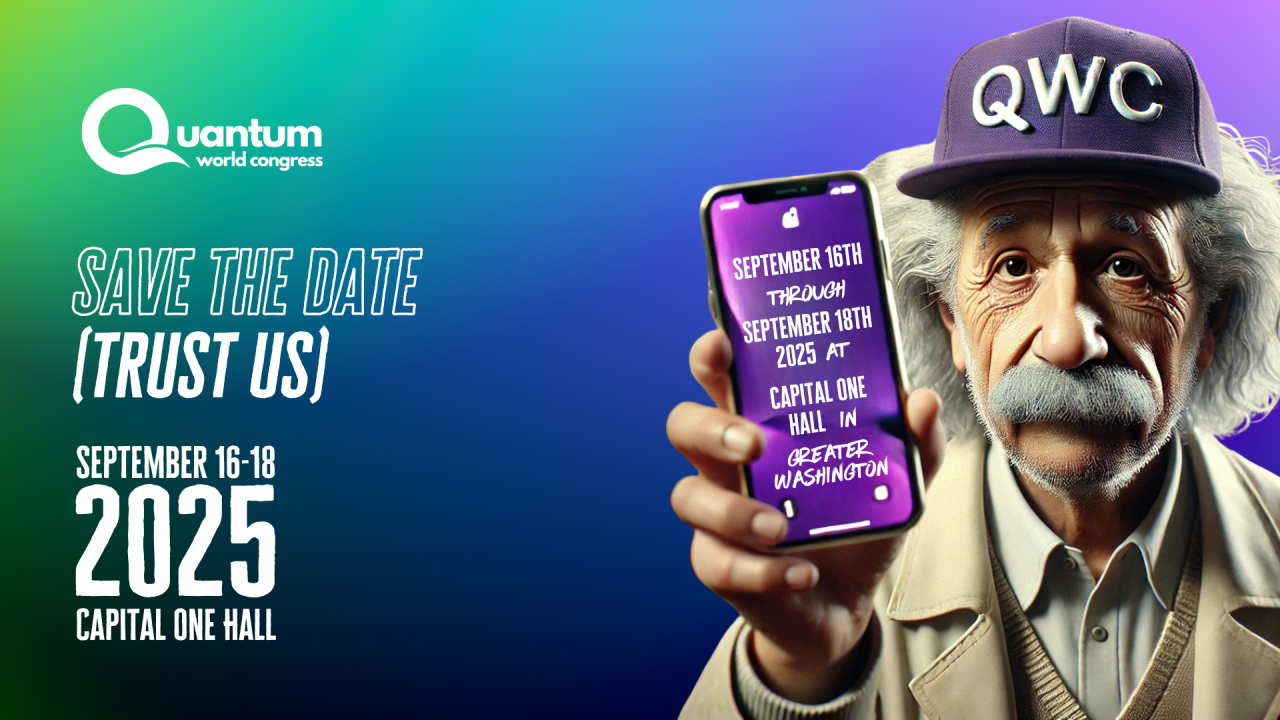
Get ready for Quantum World Congress 2025, happening from September 16th to 18th at Capital One Hall in Greater Washington. Join us as the worldโ€™s quantum ecosystem comes together to bring a quantum-ready future into focus. From groundbreaking keynotes to cutting-edge discussions and unparalleled networking, this is where the quantum revolution happens. Mark your calendarsโ€”you wonโ€™t want to miss it!

Background

Since 2022, the worldโ€™s Quantum ecosystem has gathered to bring a quantum-ready future into focus. Quantum World Congress is the worldโ€™s premier gathering for quantum technology leaders, innovators, and visionaries. The 2024 event took place from September 9th to 11th in Greater Washington, uniting global experts from industry, government, and academia to explore the latest breakthroughs in quantum research, applications, and commercialization. With keynote speakers, interactive sessions, and cutting-edge exhibits, Quantum World Congress fosters collaboration and accelerates the development of the global quantum ecosystem. This annual event highlights the pivotal role of quantum technology in shaping the future, building on Greater Washingtonโ€™s leadership as a hub for innovation.

The International Year of Quantum: Igniting Possibility, Accelerating the Future

(Quantum Insider is an IYQ sponsor.)

Insider Brief:

  • The International Year of Quantum is a call to action, not just a celebration. It is intended to bring quantum science into public awareness, ensuring accessibility and engagement beyond academia.
  • Collaboration and inclusivity are essential for quantumโ€™s future. The ceremony reinforced the need for interdisciplinary partnerships, iterative progress, and expanding participation across industries and communities.
  • Education and workforce development must be prioritized now. Quantum literacy in K-12 and reskilling professionals across fields are critical to building a robust and diverse ecosystem.
  • Ethical responsibility and societal impact must guide quantumโ€™s growth. The field must balance innovation with security, sustainability, and equitable global access, ensuring quantum benefits humanity as a whole.
  • Image Credit: UNESCO/Marie ETCHEGOYEN

Quantum has always been a force of contradictionโ€”both foundational and elusive, shaping the modern world while remaining an enigma to most. It exists in the devices we use, the systems we rely on, yet it is spoken of in paradoxes, understood by few.

The opening ceremony of the International Year of Quantum was an acknowledgment of this dualityโ€”not just a reflection on a century of discovery, but a call to shape what comes next. It was a gathering of scientists, policymakers, and industry leaders, aligned not only in their ambition but in their responsibility to make quantumโ€™s future more tangible, more accessible, and more inclusive.

UNESCO, the American Physical Society, and organizations like The Quantum Insider are championing this year-long initiative to bring quantum into public consciousnessโ€”not as a distant theoretical field, but as a potential tool to impact society at every level. The mission is not just to celebrate progress but to ensure that the next era of quantum is one that belongs to all.

A Convergence of Purpose

The ceremony was not just a stage for reflectionโ€”it was a stage for alignment. On stage, we confirmed as a community that we are on the right page, with common themes of accessibility, education, responsible development, and tools to work towards the Sustainable Development Goals. Off stage, conversations deepened, partnerships formed, and the work of the future was not just imagined but actively set in motion.

Building something new requires an ability to see beyond what exists and take the next best step forward. The International Year of Quantum is not just about celebrating achievements; it is about pushing past barriersโ€”technical, conceptual, institutionalโ€”to ensure that quantumโ€™s promise is realized for all.

Celia Merzbacher, Executive Director of QED-C, captured this vision: โ€œThe International Year of Quantum, I believe, is an opportunityโ€”because itโ€™s broad, itโ€™s inclusive, and itโ€™s raising awareness. While QED-C is very much focused on advancing the commercial industry, that industry depends on the entire innovation ecosystemโ€”from research to product development. I always say: quantum is global. Innovation is global. Talent is globally distributed, and the markets are global. The International Year of Quantum is about bringing together as many stakeholders as possible.โ€

And true inclusion is an active processโ€”one that goes beyond awareness and requires sustained engagement across disciplines, industries, and communities. As the conversation deepened, a common thread emerged: progress in quantum will come not just from visionaries but from those who refine, challenge, and evolve ideas in real time. Allison Schwartz, Vice President of Global Government Relations & Public Affairs at D-Wave, reinforced this reality: โ€œBeing at the center of this industryโ€”building applications today and providing real-time cloud access across 42 countriesโ€”gives us a unique opportunity to tap into new generations of innovators. Weโ€™re especially focused on those who arenโ€™t just thinking theoretically but are asking, โ€˜What can I do today?โ€™โ€

Quantum is not a solitary endeavor. It thrives on collaboration, on the merging of disciplines, on ideas that challenge conventional wisdom. Krysta Svore, Technical Fellow and Vice President of Advanced Quantum Development for Microsoft, emphasized this dynamic: โ€œIn computing, you always compareโ€”you run it, measure against a baseline, and if itโ€™s better, you use it. But in quantum computing, we havenโ€™t been able to do that. The power today is that we are producing reliable quantum machines that can be integrated and layered onto existing workflows.โ€

The future of quantum cannot be built in isolation. It is not a closed-loop system, self-contained and exclusive to a handful of experts. It must be expansive, integrative, and, above all, inclusive.

The Question of Understanding

Education stood as one of the ceremonyโ€™s most urgent themes. Digital literacy is foundational in todayโ€™s world, yet classical computer science remains absent from many K-12 curriculums. Mathematics and physicsโ€”essential to quantum computingโ€”are often overlooked. If we do not prioritize these subjects early, we risk creating a future where only a select few have the knowledge and opportunity to engage with this technology in meaningful ways.

But waiting for the next generation to come of age is not an option. The urgency of quantumโ€™s development requires a workforce that draws from all disciplines and industries. We need physicists, yesโ€”but also electrical engineers, software developers, policymakers, and advocates. The success of quantum technology will not rest on scientists alone; it will require the efforts of an entire ecosystem.

Rajeeb Hazra, CEO of Quantinuum, put it bluntly: โ€œA big part of the access challenge is workforce. For quantum to realize its full potential, it must evolve from a small set of people who have to labor inordinately hard against the systems of the world to do it right.โ€

Mitra Azizirad, President & COO of Strategic Missions & Technologies at Microsoft, expanded on this idea: โ€œThe first step for usโ€”and what Iโ€™m most focused onโ€”is identifying those initial hybrid applications. How do we work with our partners and customers to determine what they will be? Because when you think about the marriage of AI and quantum, thereโ€™s an incredible opportunity ahead.โ€

Jonathan Felbinger, Deputy Director of the QED-C, drew a parallel to AI: โ€œI think this is a great opportunity to capture the public imaginationโ€”much like AI has. Every day, thereโ€™s something in the news about AI, and Iโ€™m sure kids today are thinking, โ€˜I want to work in AI. I want to learn AI.โ€™ In a way, theyโ€™ve become AI-native, interacting with it, shaping it, and building awareness around it. I want that same level of public engagement for quantumโ€”both in terms of understanding use cases and building the future workforce.โ€

Ethics, Sustainability, and the Responsibility of Knowledge

Science does not exist in a vacuum, nor should it. The pursuit of knowledge is deeply human, driven by curiosity, by wonder, by the desire to push beyond the known. But awe alone is not enough. If we possess a technology, even in its early stages, that has the potential to address the worldโ€™s most profound challenges, then the responsibility to pursue it extends beyond personal ambitionโ€”it becomes an obligation to humanity.

Professor Yasser Omar, President of the Portuguese Quantum Institute, reminded attendees in his opening remarks on the second day of the event that โ€œBasic science is a societal benefit.โ€ But its impact depends on how we choose to apply it. The responsibility of scientific discovery does not lie solely with researchers in the labโ€”it extends to educators, policymakers, businesses, and individuals who seek to integrate and apply these discoveries for the benefit of society.

Hazra emphasized this dual responsibility: โ€œOur job is to accelerate useful quantum computing for goodโ€”and each word in that is meaningful. Our role is to ensure we are accelerating both the rate of technology creation and its adoption. It does no good to develop technology and leave it in the lab. And it does no good to stop innovating just because democratizing that technology beyond the lab is getting harder.โ€

As with any powerful technology, ethical considerations and security risks must also be addressed. Merzbacher urged a balanced approach: โ€œIn the context of the International Year of Quantum, I think we should focus on the beneficial applicationsโ€”whether itโ€™s point-of-care diagnostics, improving weather forecasting to help farmers, or other positive impacts. As we develop these beneficial uses, national security controls will need to be targeted. Protections will still be necessary, but they should be narrowly focused to ensure that quantumโ€™s positive applications can be widely shared and used.โ€

The Work That Lies Ahead

One of the most striking takeaways was the acknowledgment that progress is not always comfortable and quantum cannot afford to be an exclusive field. The future belongs to those willing to integrate it across industries, disciplines, and communities. The ceremony was a beginning, not an endpoint.

As Hazra observed, โ€œThe last three or four yearsโ€”and even the last decade, before Quantinuum was formedโ€”have been years of discovery. Weโ€™ve learned what works, and weโ€™ve learned what doesnโ€™t. Now, 2025 is the year of acceleration. Iโ€™m not saying weโ€™ve solved all the problems, but we have a pathโ€”we have a map. And now, weโ€™re moving faster along that map. The International Year of Quantum marks the year of accelerating useful quantum computing for good.โ€

The urgency is not just in the technology itself but in the decisions we make around it. The International Year of Quantum is not just a celebration; it is a challenge. A call to ensure that the foundations we build now will last. Science, after all, is not just about what we can doโ€”it is about what we should do.

Azizirad, with passion and intention, captured the essence of this moment: โ€œBut right nowโ€”this momentโ€”is the most exciting. Because weโ€™re on the cusp of something where everything feels possible. Weโ€™re in the โ€˜art of the possibleโ€™ phase, where weโ€™re truly ideating and layering quantum into what comes next.โ€


This piece was published on the Quantum Insider

Unraveling the process of Building for Quantium, with Marina Otero Verzier, Manuel Correa, and Aran Garcรญa-Lekue

In this new session of the public program Organismo Year One, Marina Otero, architect and researcher, and Manuel Correa, filmmaker, and researcher, will present the research and creative process behind the film that accompanies the video installation Building for Quantum. This work will be featured in the upcoming 19th edition of the Venice Architecture Biennaleโ€” โ€œIntelligens. Natural. Artificial. Collectiveโ€ โ€”and will premiere during the event’s inauguration in May this year.

The film Building for Quantum follows the construction of the building that will host one of the few quantum computers in the world, the first in Spain. As quantum computing redefines the boundaries of knowledge, this film, still in process, examines the imaginaries and aspirations surrounding the arrival of this technology at the Quantum Basque Center in Donostia-San Sebastiรกn. The film navigates the intersection of the physical and the philosophical within quantum architectureโ€”juxtaposing the tangible, ordinary materials of brick and mortar with the meticulous precision required to sustain near-perfect vacuum chambers at temperatures colder than deep space.

The event will feature Aran Garcรญa-Lekue, physicist and PhD in materials science and technology, who specializes in the development and application of computational tools for the simulation of quantum electronic properties at the nanoscale. With her, we will explore the principles of these theories, which have been counterintuitive for humans so far, and the horizons that may emerge from their instrumentalization. The three will engage in a conversation to unravel the potentials of this science and the paradigm shift it represents compared to classical mechanics, according to which we have traditionally organized our ways of living.

Desentraรฑando el proceso de Construir para Quantium, con Marina Otero Verzier, Manuel Correa y Aran Garcรญa-Lekue

En esta nueva sesiรณn del programa pรบblico Organismo Aรฑo Uno, Marina Otero, arquitecta e investigadora, y Manuel Correa, cineasta e investigador, presentarรกn la investigaciรณn y el proceso creativo que hay detrรกs de la pelรญcula que acompaรฑa a la videoinstalaciรณn Construir para Quantum. Esta obra se presentarรก en la prรณxima 19ยช ediciรณn de la Bienal de Arquitectura de Venecia “Intelligens. Naturales. Artificial. Colectivo”- y se estrenarรก durante la inauguraciรณn del evento en mayo de este aรฑo.

La pelรญcula Building for Quantum sigue la construcciรณn del edificio que albergarรก uno de los pocos ordenadores cuรกnticos del mundo, el primero de Espaรฑa. Mientras la computaciรณn cuรกntica redefine las fronteras del conocimiento, esta pelรญcula, aรบn en proceso, examina los imaginarios y aspiraciones que rodean la llegada de esta tecnologรญa al Quantum Basque Center de Donostia-San Sebastiรกn. La pelรญcula navega por la intersecciรณn de lo fรญsico y lo filosรณfico dentro de la arquitectura cuรกntica, yuxtaponiendo los materiales tangibles y ordinarios del ladrillo y el mortero con la meticulosa precisiรณn necesaria para sostener cรกmaras de vacรญo casi perfectas a temperaturas mรกs frรญas que el espacio profundo.

El acto contarรก con la presencia de Aran Garcรญa-Lekue, fรญsica y doctora en ciencia y tecnologรญa de materiales, especializada en el desarrollo y aplicaciรณn de herramientas computacionales para la simulaciรณn de propiedades electrรณnicas cuรกnticas a nanoescala. Con ella exploraremos los principios de estas teorรญas, hasta ahora contraintuitivas para el ser humano, y los horizontes que pueden surgir de su instrumentalizaciรณn. Los tres entablarรกn una conversaciรณn para desentraรฑar los potenciales de esta ciencia y el cambio de paradigma que representa en comparaciรณn con la mecรกnica clรกsica, segรบn la cual hemos organizado tradicionalmente nuestras formas de vida.

Dรฉmรชler le processus de construction de Quantium, avec Marina Otero Verzier, Manuel Correa, et Aran Garcรญa-Lekue

Lors de cette nouvelle session du programme public Organismo Year One, Marina Otero, architecte et chercheuse, et Manuel Correa, cinรฉaste et chercheur, prรฉsenteront la recherche et le processus crรฉatif ร  l’origine du film qui accompagne l’installation vidรฉo Building for Quantum. Cette ล“uvre sera prรฉsentรฉe lors de la 19e รฉdition de la Biennale d’architecture de Venise, intitulรฉe “Intelligens. Natural. Artificiel. Collective” – et sera prรฉsentรฉe en avant-premiรจre lors de l’inauguration de l’รฉvรฉnement en mai de cette annรฉe.

Le film Building for Quantum suit la construction du bรขtiment qui accueillera l’un des rares ordinateurs quantiques au monde, le premier en Espagne. Alors que l’informatique quantique redรฉfinit les frontiรจres de la connaissance, ce film, encore en cours de rรฉalisation, examine les imaginaires et les aspirations qui entourent l’arrivรฉe de cette technologie au Quantum Basque Center ร  Donostia-San Sebastiรกn. Le film explore l’intersection du physique et du philosophique dans l’architecture quantique, juxtaposant les matรฉriaux tangibles et ordinaires de la brique et du mortier ร  la prรฉcision mรฉticuleuse requise pour maintenir des chambres ร  vide presque parfaites ร  des tempรฉratures plus froides que celles de l’espace lointain.

L’รฉvรฉnement accueillera Aran Garcรญa-Lekue, physicienne et docteur en science et technologie des matรฉriaux, spรฉcialisรฉe dans le dรฉveloppement et l’application d’outils informatiques pour la simulation des propriรฉtรฉs รฉlectroniques quantiques ร  l’รฉchelle nanomรฉtrique. Avec elle, nous explorerons les principes de ces thรฉories, qui ont รฉtรฉ contre-intuitives pour les humains jusqu’ร  prรฉsent, et les horizons qui peuvent รฉmerger de leur instrumentalisation. Tous trois engageront une conversation afin de dรฉcouvrir les potentiels de cette science et le changement de paradigme qu’elle reprรฉsente par rapport ร  la mรฉcanique classique, selon laquelle nous avons traditionnellement organisรฉ nos modes de vie.

Quantum: Dos Impactos nos Setores aos Desafios de Regulaรงรฃo

As part of the International Year of Quantum Science and Technology (IYQ), declared by the United Nations for 2025, the PQI – Portuguese Quantum Institute and Vieira de Almeida are organising a session dedicated to Quantum Technologies (QT).

This initiative aims to increase public awareness of the importance of quantum science and its applications, as well as encourage public discussion on the impact of these technologies on economic sectors, aligning it with regulatory issues.

*This event is held in Portuguese.

Quantum: De los Impactos en los Sectores a los Desafรญos de la Regulaciรณn

Como parte del Aรฑo Internacional de la Ciencia y la Tecnologรญa Cuรกnticas (IYQ), declarado por las Naciones Unidas para 2025, el PQI – Instituto Cuรกntico Portuguรฉs y Vieira de Almeida organizan una sesiรณn dedicada a las Tecnologรญas Cuรกnticas (QT).

Esta iniciativa pretende aumentar la concienciaciรณn pรบblica sobre la importancia de la ciencia cuรกntica y sus aplicaciones, asรญ como fomentar el debate pรบblico sobre el impacto de estas tecnologรญas en los sectores econรณmicos, alineรกndolo con las cuestiones normativas.

*Este acto se celebra en portuguรฉs.

Quantum : De l’impact sur les marchรฉs au manque de rรฉglementation

Dans le cadre de l’Annรฉe internationale des sciences et technologies quantiques (AISQ), dรฉclarรฉe par les Nations unies pour 2025, le PQI – Institut quantique portugais et Vieira de Almeida organisent une session consacrรฉe aux technologies quantiques (QT).

Cette initiative vise ร  sensibiliser le public ร  l’importance de la science quantique et de ses applications, ainsi qu’ร  encourager le dรฉbat public sur l’impact de ces technologies sur les secteurs รฉconomiques, en l’alignant sur les questions rรฉglementaires.

*Cet รฉvรฉnement est organisรฉ en portugais.

Quantum Meets ’25

Quantum Meets is a series of refreshingly different quantum events happening in Amsterdam from May 13 to 16, 2025.

In celebration of the UNESCO International Year of Quantum, this is the premier destination for quantum end-users to discover new technologies, for quantum businesses to connect with industry and investors, and for policymakers to stay on top of industry advancements.

Breaking away from the traditional conference format, Quantum Meets features collaboratively designed, open-access events. Highlighting this year’s lineup again is the second edition of the Q-Expo, a unique two-day event by the European Quantum Industry Consortium (QuIC) featuring a business expo day, a plenary day, and the most awaited quantum community gathering Nodes.

Quantum rencontre ’25

Quantum Meets est une sรฉrie d’รฉvรฉnements quantiques rafraรฎchissants et diffรฉrents qui se dรฉrouleront ร  Amsterdam du 13 au 16 mai 2025.

ร€ l’occasion de l’Annรฉe internationale du quantum proclamรฉe par l’UNESCO, il s’agit de la premiรจre destination pour les utilisateurs finaux du quantum qui souhaitent dรฉcouvrir de nouvelles technologies, pour les entreprises du domaine du quantum qui souhaitent entrer en contact avec l’industrie et les investisseurs, et pour les dรฉcideurs politiques qui souhaitent se tenir au courant des progrรจs de l’industrie.

S’รฉcartant du format traditionnel des confรฉrences, Quantum Meets propose des รฉvรฉnements en libre accรจs conรงus en collaboration. La deuxiรจme รฉdition de Q-Expo, un รฉvรฉnement unique de deux jours organisรฉ par le Consortium europรฉen de l’industrie quantique (QuIC), qui comprend une journรฉe d’exposition commerciale, une journรฉe plรฉniรจre et le rassemblement le plus attendu de la communautรฉ quantique, Nodes, est ร  nouveau un รฉvรฉnement phare de cette annรฉe.