

Bridging the Quantum Divide Beyond the International Year of Quantum

The United Nations declared 2025 as the International Year of Quantum Science and Technology (IYQ), celebrating 100 years since the discovery of quantum mechanics and raising global awareness of the rapidly developing technology and its applications. 

As quantum technologies continue to evolve rapidly, their transformative potential also raises concerns about the uneven distribution of expertise and resources worldwide. With these advancements geographically concentrated, it’s easy to imagine a future where the technology is in the hands of and benefits a select number of nations. This situation risks widening the already existing divide between the Global North and South, as such concentration of control amplifies the uneven distribution of skills, infrastructure, and opportunities on a global scale. 

The Open Quantum Institute (OQI), hosted at CERN for its pilot phase, is working to mitigate this divide through practical, forward-looking efforts that will be sustained beyond the IYQ. Avoiding the widening of these gaps involves more than just developing new quantum algorithms or identifying new technological breakthroughs; it requires building and sustaining inclusive ecosystems in all regions, where stakeholders, including researchers, policymakers, and citizens, can actively help shape as well as benefit from the technology. 

Capacity building in action

Throughout the year, OQI has contributed to the IYQ through organising and supporting more than 30 events across five continents, with a pipeline of educational events planned for 2026 to sustain momentum beyond the IYQ.

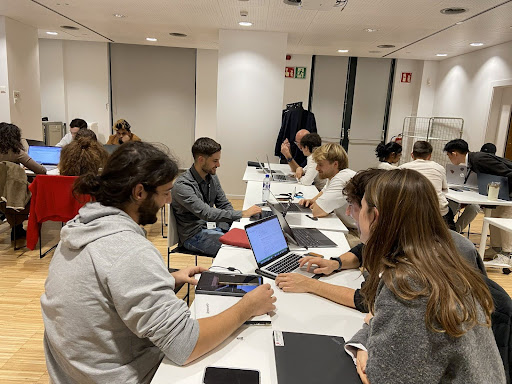
One of OQI’s main efforts is driving global capacity building. In 2025, over 380 participants in hackathons across quantum-underserved regions had the opportunity to develop their quantum computing skills. During these hackathons, participants worked collaboratively to develop algorithms that address locally relevant challenges and advance the UN Sustainable Development Goals (SDGs). OQI’s educational activities throughout the IYQ also included the Quantum Diplomacy Game, a role-play simulation designed to raise awareness and anticipation of the geopolitical implications of quantum computing as an emerging technology, and regional events around the world—all with the collective aim of fostering the sharing of knowledge and open-access resources globally. 

SDG-aligned use cases 

Another core pillar of OQI is focusing on developing quantum computing applications that address the SDGs and contribute towards mitigating the existing divide. OQI supports the development of SDG use cases and fosters collaborations between experts around the world to guide their progress from ideation to proof-of-concept and implementation on today’s quantum devices. Taking a multidisciplinary approach has proven essential, bringing together research, diplomacy, philanthropy, academia, industry, and civil society to amplify impact on a global level. 

Beyond the IYQ

Alongside raising public awareness, the IYQ also identified a range of challenges to be overcome, including limited access to the technology in underserved regions and identifying governance gaps that highlight the need to develop inclusive frameworks. As the global quantum community reflects on the successes and lessons learned, an emphasis on sustained international collaboration will be essential to continue nurturing a diverse global ecosystem and to further mitigate the divide, showing a clear path towards ensuring the technology is advanced inclusively and for the benefit of all humanity.

Photo credit: Marc Bader.

Securing the Quantum Future Demands Action Today

(IYQ partners)

With quantum technologies shifting from theoretical potential to real-world deployment, we believe the urgency to secure our digital future has never been greater.

Our modern world runs on digital infrastructure, financial systems, healthcare networks, energy grids, and national security, all secured by cryptographic designs for classical computing. These systems have served us well for decades, but they are not equipped to withstand the disruptive power of quantum computing.

Quantum computing is redefining what’s possible in computation. Unlike classical machines, which process information in binary bits, quantum machines rely on qubits that can exist in multiple states simultaneously. This extraordinary capability enables them to solve certain problems exponentially faster than traditional counterparts, advancing areas such as drug discovery, climate modeling, and logistics optimization. Yet, the same power that makes quantum computing so promising also poses a direct threat to the cryptographic algorithms that safeguard digital communications and data.

The greatest near-term threat lies in public-key cryptography. Algorithms such as RSA and ECC, which rely on the difficulty of factoring large numbers and the discrete logarithm problem over elliptic curves, respectively, are particularly susceptible to quantum attacks. Using Shor’s algorithm, quantum computers will eventually be capable of breaking these encryption schemes in a fraction of the time required by classical machines.

This is not a distant threat. The concept of harvest now, decrypt later is already being employed, where malicious actors collect encrypted data today with the intention of decrypting it once quantum capabilities become available. Sensitive information, from personal health records to classified communications, is being stockpiled, awaiting the moment when quantum decryption becomes possible. The implications are profound: breaches that occur years from now could expose data that was once assumed to remain secure for decades.

Transitioning to quantum-resilient systems is therefore not optional—it is essential. Post-quantum cryptography (PQC) offers one of the most promising paths forward, featuring algorithms designed to resist quantum attacks while remaining compatible with existing infrastructure.

In the UAE, we are taking proactive steps to prepare for this new frontier. The UAE CyberSecurity Council and the Technology Innovation Institute (TII)have joined forces on CyberQ, an event dedicated to advancing research, standards, and readiness for quantum-safe cybersecurity. CyberQ is designed to help organizations across both the public and private sectors identify their quantum vulnerabilities, evaluate post-quantum cryptographic solutions, and accelerate the transition to secure communication systems that withstand future quantum threats. Through CyberQ, we are combining policy leadership and advanced scientific capability to strengthen the UAE’s role as a global contributor to quantum security. Together, CSC and TII are collaborating with international experts, industry partners, and standards bodies to safeguard our digital infrastructure and protect the critical assets that underpin our nation’s security in the quantum era.

However, adoption across industries remains uneven. Too often, quantum threats are seen as speculative when, in reality, the groundwork for future breaches is being laid today.

The challenge is not merely technical. It is strategic.

Cryptographic systems are deeply embedded in our digital fabric, and transitioning to new standards will require coordination across sectors and sustained and decisive leadership.

Policy frameworks must evolve in tandem with technological advancements. Governments must update regulatory frameworks to guide the adoption of PQC, incentivize migration, and support public-private partnerships that accelerate readiness.

International cooperation is also essential. Quantum threats do not respect borders, and fragmented responses will leave critical gaps in global security.

Just as crucial is fostering crypto-agility, the readiness to evolve cryptographic systems as threats emerge. Now is the time for organizations to evaluate their vulnerabilities, map their cryptographic assets, and prepare for a hybrid era where classical and quantum-safe algorithms work side by side.

The quantum future is not a distant horizon; it is approaching rapidly. The decisions we make today will determine whether our digital infrastructure remains resilient or becomes a casualty of technological progress.

Through initiatives like CyberQ, we are committed to leading this transformation, combining policy, research excellence, and international collaboration to secure the quantum future, starting now.

As leaders in cybersecurity and advanced research, we share a single goal: to ensure that the world approaches the quantum future with foresight, responsibility, and cooperation.

Protecting digital trust in the quantum age will demand global resolve and shared responsibility, as what we build together today will determine the security and integrity of the digital world for generations to come.

Attend a Quantum Hackathon with Me

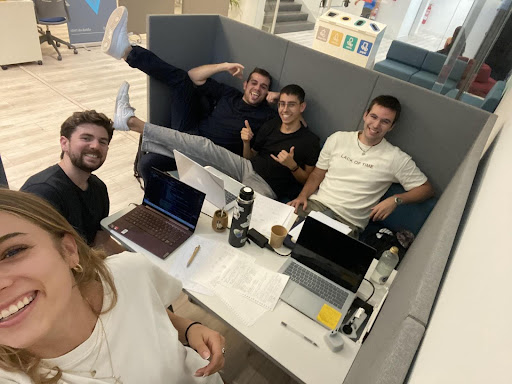
Hello! My name is Serena and I’m currently a master’s student in theoretical and computational chemistry as a part of the Erasmus Mundus Joint Master’s program in Europe. A few weekends ago, some classmates and I decided to venture out of our comfort zone and participate in IBM’s Qiskit Fall Fest 2025 Hackathon. The purpose was to use Qiskit, a quantum software development kit from IBM, to solve a problem using quantum computation instead of classical computers over the course of four days. 

Day 1 – Introduction & Talks

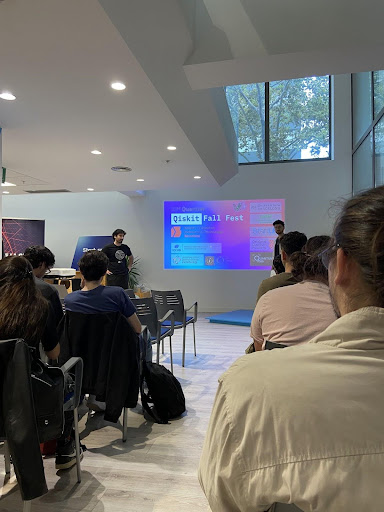
First task—meeting everybody. The first day, we gathered in the physics faculty at the University of Barcelona to introduce ourselves to each other and to the new quantum concepts we would be using. Artur Garcia gave the first talk from the Barcelona Supercomputing Center; he discussed tensor networks for circuit simulation and a little bit about the difference between classical supercomputing and quantum computing. He was followed by Niccolo Baldelli, also from the Barcelona Supercomputing Center, who gave a great presentation on simulating quantum circuits.

Day 2 – Set Up

The next day, we were on our own; we had to install the Qiskit package on our computers and complete an exercise to familiarize ourselves with the software. They sent the instructions over Discord, which included a link to IBM’s YouTube channel that walked you through the entire setup procedure and one practice problem. By the end of the night, I was ready and nervous; I was about to spend 48 hours doing something I had never done before. 

Day 3 – Hacking!

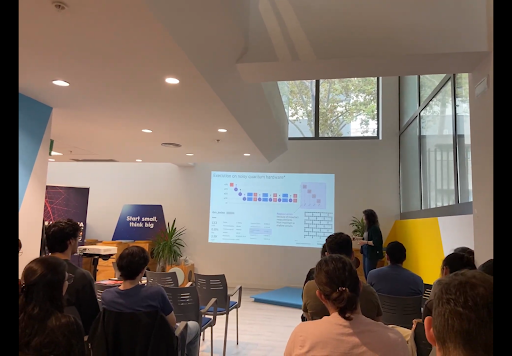
Joana Fraxanet from IBM came in the morning to kick us off with a presentation on quantum algorithms and their applications (shoutout quantum chemistry!). She gave us more information about the connection between high performance computing and quantum computing, and advised us on the quantum algorithms we would use. Then it was time for the challenges!


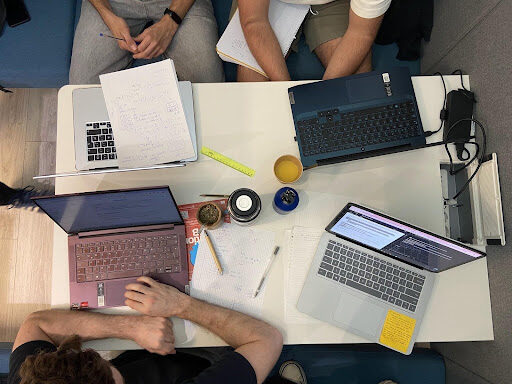
My group chose the intermediate challenge of the three options called “The Queen’s Problem”. Although none of us had ever used Qiskit before, we thought trying a challenge that interested us was the way to go: the best motivator is genuine curiosity! At about 11:00, we set out for a full day of coding (eight hours!), stopping only at 2:00 pm for a quick lunch break.  
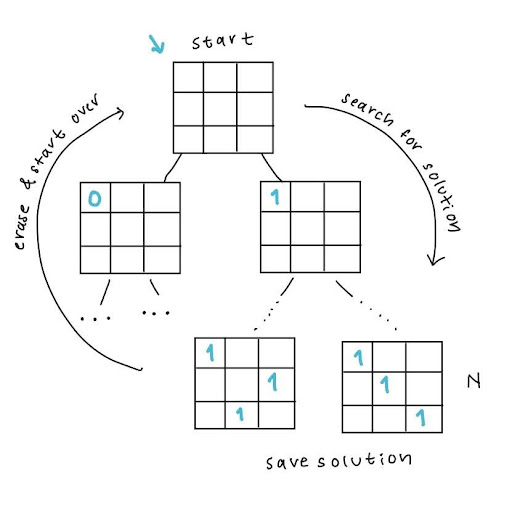
The challenge we had selected was this: find the maximum number of queens you can place on a chessboard so that no two queens can attack each other. For the first part of the challenge, we had to use a classical algorithm, or a brute-force method, to find the answer to this question. We started with a blank chessboard, filled in the first eligible space with a piece, and then had the code find all the possible solutions from there. After it saved all the solutions from that starting point, it saved them, wiped the board, and started again. 

The next part of the challenge used a quantum algorithm to transform the problem into a physics one: we were going to use a “lowest energy state” to find a board with no pieces attacking each other. The lowest energy state in physics just means the point in the system with the lowest energy. If our system is a ball teetering at the top of a valley, the highest energy state is going to be the ball at the top, while the lowest energy state is going to be the ball at the bottom. If you give that teetering ball a push, where is it going to go? That’s our lowest energy state. 

The quantum algorithm would basically do the same thing with the arrangement of the board; if it placed pieces that could attack each other, that would be a high-energy state, and if they couldn’t, it would be a low-energy state. The goal was to have the algorithm place pieces to find, like our ball rolling down the hill, in the lowest possible energy state. 

The hardest part about this challenge for me was translating my logic into code. I could answer the question on paper, and on paper it seemed so simple, but then I had to execute it using Qiskit–something I had never done before. It was a lot of trial and error (and a lot of asking for help), but by the end of the day, we were getting the hang of it. 

Day 4 – Presentations & Results

The next day, I was back to hacking after coffee and breakfast. We took our seats and dove back into where we left off. The day before, we had completed the challenge for the rook and bishop pieces. Today was about putting it all together to solve the queen’s question. 

By lunch, we were almost finished, but had to shift our attention to designing our presentation. In terms of the competition, how we presented our solutions was almost as important as what those solutions were. 

Finally, at five, all eight teams were ready to present. We watched as groups presented their solutions for the various challenges, and presented as they listened to ours. Our group successfully completed the part of the challenge that used classical computers to solve the queens’ problem, but only got about two-thirds of the way through the quantum one. We wrote the quantum algorithm we needed to solve it, it just wasn’t giving us the right answers! Still, not bad for a group of chemists among physicists. 

In the end, the prize went to a very deserving team that worked on the hardest challenge, the Phase Recognition Challenge, which had to do with identifying the phase of a quantum state, or how a quantum state evolves over time. 

My biggest takeaway from the event was: ‘I should have done this sooner’. In college, I always prioritized the acquisition of knowledge over its use. Even though I’m technically learning programming as a part of my curriculum right now, I learned so much in just 48 hours by being forced to use and apply it. Doing it with my friends and working on a real problem I found interesting helped too. 

So, if you are interested in learning quantum mechanics, my advice is to get involved: go to an event or try out some online resources. Even better to do it with a friend. 

If you’re interested in learning more about quantum computing or checking out Qiskit for yourself, here are some of the resources we used over the weekend:

Serena Krejci-Papa is a first-year master’s student at the University of Barcelona, studying theoretical and computational chemistry with the Erasmus Mundus program. She writes about complex science topics in a way that makes people laugh. You can find more about her at Sciencewithserena.com.

Putting People at the Center of Quantum

For all the complexity in quantum, the real story begins with people 

(SC Quantum is an IYQ sponsor.)

At SC Quantum, our first conversations typically aren’t about physics or code. They’re about trust, connection, and building something that works for everyone.

From Possibility to Participation

Quantum holds enormous promise, and with that comes the responsibility to make sure its benefits can be shared widely. Progress depends not just on the science, but also on how we invite people with different backgrounds, experiences, and perspectives into the space.

SCQ aims to design opportunities that are meaningful and collaborative, so that educators, engineers, creatives, and community leaders can see a role for themselves in shaping what’s next. Expanding participation strengthens our outcomes and helps ensure that quantum grows in ways that are both innovative and grounded.

Listening Comes First

When we engage an academic institution, a nonprofit, or an industry partner, we begin by listening. Often the best question we can ask is simple: What do you need?

That question helps shape our strategy and determine whether quantum has a useful role to play. It also makes clear that we’re not here to talk to people. We’re here to work with them.

Peopleware Matters

There’s hardware and software, but there’s also peopleware. Human infrastructure makes new technology usable and meaningful. It’s easy to overlook, but without it even the most powerful tools can fall short of their full potential.

Peopleware is about relationships, trust, and the spaces where learning and collaboration happen. Quantum is as much about culture, communication, and connection as it is about qubits.

For Leaders Ready to Invest in People 

If you’re leading a business, school, or workforce program and looking to engage with quantum, here are three places to start:

  1. Identify a People-Centered Priority: Think about a challenge related to talent, training, or engagement. That could be helping students explore emerging careers, supporting employee development, or deepening STEM learning.
  2. Build New Connections: Partner with SC Quantum to link with educators, researchers, or employers who share your goals. Good collaborations often start with shared questions.
  3. Make Space for Exploration: Quantum isn’t just for experts. Creating space for curiosity in classrooms, boardrooms, and community spaces opens the door for new voices and fresh ideas.

Looking Ahead

Quantum is still taking shape. That means the values we embed today will influence how it grows tomorrow. Putting people first helps us stay focused on relevance, usefulness, and long-term impact.

My hope is that as South Carolina builds its place in the quantum landscape, we keep a sense of responsibility and openness: Not just what we can build, but who we are building it for.

Want to learn more or connect with the team? Contact SC Quantum.

Ciclo de Charlas: Un Centenario con Aire Milenario

Los 100 años de la mecánica cuántica

En el marco de la proclamación de 2025 como el Año Internacional de la Ciencia y la Tecnología Cuánticas por la UNESCO, la Facultad de Ciencias de la Universidad de Los Andes (ULA) organiza una jornada conmemorativa titulada “Un centenario con aire milenario: los 100 años de la Mecánica Cuántica”, que se celebrará los días 19 y 20 de noviembre de 2025.

Esta actividad da continuidad al éxito del coloquio “Cien años de espeluznante encantamiento, cien años de mecánica cuántica”, realizado en junio en la ULA, el cual contó con una nutrida asistencia y una destacada participación del público académico. Motivados por la positiva recepción de aquel encuentro, este nuevo evento busca ampliar el alcance y el impacto de la conmemoración, promoviendo la enseñanza, la divulgación y la investigación en el ámbito de la física cuántica tanto en la ULA como en otros centros de investigación y universidades del país.

Quantum Women’s Netwik

We are delighted to invite you to our inaugural event of the Quantum Women’s Network in New York City!

​Quantum Women’s Network is a community dedicated to supporting women and girls who work — or aspire to work — in the field of quantum technologies. We celebrate and value diverse contributions to this growing field, spanning education, business development, advocacy, partnerships, strategy, hardware innovation, and algorithm design.

​Our mission is to build a supportive network that empowers women and girls to thrive in quantum technologies, each from their own perspective. To achieve this, we organize various initiatives, including networking events where we come together to connect, share experiences, and strengthen our community.

​This inaugural gathering marks the beginning of our journey, and we plan to host these events monthly in NYC moving forward.

​📩 If you would like to learn more about our plans or get involved, feel free to reach out at quantumwomennetwork@gmail.com.

​We look forward to seeing you there and building this network together!

CyberQ

CyberQ 2025 is the UAE’s flagship summit for cybersecurity and quantum technologies, hosted by the UAE Cybersecurity Council and the Technology Innovation Institute (TII). Under the theme “Future-Proofing Digital Defenses,” the event will explore how quantum computing, artificial intelligence, and emerging technologies are transforming the global cybersecurity landscape.
For the second year running, the CyberQ Summit 2025: Future-Proofing Digital Defenses is providing a global forum for government, industry leaders and those at the cutting-edge of emerging quantum technologies to explore the dangers they pose to current cryptographic systems, the opportunities that post quantum cryptography is creating and the best ways to integrate new cryptographic solutions to ensure a smooth transition, without disrupting operations.

XII-GeoExpoFísica 2025

At the 12th edition of GeoExpoFísica, and its third hybrid (virtual-in-person) edition, we are opening a space for students from different regions of Colombia and several international institutions, along with engineering and geology students from the Universidad del Norte, to present their projects.

These projects, designed and developed by them, seek to solve everyday problems by applying concepts from various branches of physics: mechanics, electromagnetism, heat and waves, modern physics, biophysics, and geophysics.
Along with the exhibitions, we will have guest lectures on quantum science and technology to bring participants closer to these topics and celebrate the 100th anniversary of quantum mechanics.

National Science Seminar

National Science Seminar 2025, a flagship event of the National Council of Science Museums (NCSM), will be held on 30th October 2025 at the Visvesvaraya Industrial & Technological Museum (VITM), Bengaluru, India. This year’s theme is “The Quantum Age Begins: Potentials and Challenges.” The seminar aims to inspire young minds and prepare them to contribute towards positioning India as a leader in the rapidly emerging field of quantum technologies.

UNESCO International Year of Quantum Symposium

On September 19, Columbia University will welcome experts from industry and academia who will share their insights into recent quantum research and the development of emerging quantum technologies.