
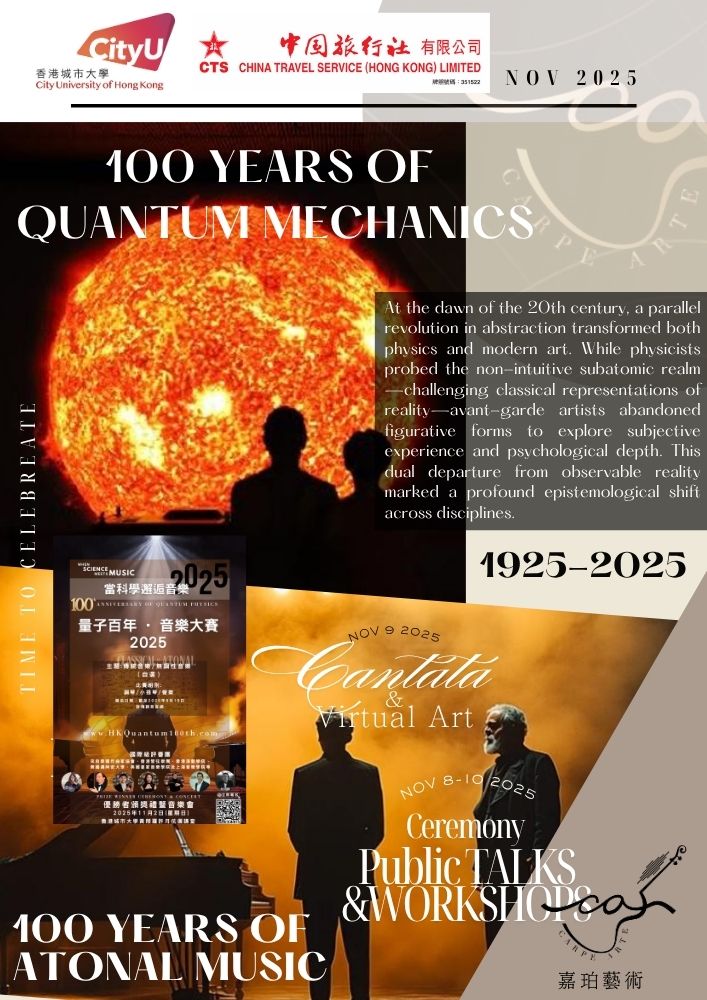
100th Anniversary of Quantum Physics

2025 also marks the 100 years of atonal music. Dr. Wu Xiaodong, Founder of Executive Medical Physics Associates, a dedicated publisher and a sought-after lecturer in medical physics and cancer research worldwide, also a lifelong advocate for classical music, has discovered the connection between quantum physics and atonal music. To celebrate the 100th anniversary of the two inventions, he worked closely with a young American composer and created a brand new choral symphony, Quantum Odyssey. It consists of 7 acts, and we will perform Act II: The Unveiling of Quantum Laws as the world premiere performance.

This Choral Symphony will be performed by the prestigious tenor and soprano, together with Hong Kong’s famous conductor and its orchestra and choir. Visual presentation created by students of the School of Creative Media of City University will be incorporated throughout the symphony. We aim to promote public participation in celebration of this 100-year event, to encourage science popularization and the understanding of science through music and the arts.
Share Your Vision of Light and Quantum Science


Light is one of the most basic and essential parts of the universe. It’s also where the journey into quantum science, the branch of science that studies how the tiniest particles in the universe behave, begins. From the glow of heated objects to the puzzling behavior of tiny particles of light, light has helped us discover how the quantum world works.

Share your visual works on light and quantum science. Selected submissions will be showcased on UNESCO’s website.


Key dates

  • Call opens: 16 May 2025 (International Day of Light)
  • Submission deadline: 16 July 2025
  • Public voting: August 2025
  • Publication of winners: October 2025

Quantum Play: Copenhagen at Yale

Set in 1941, Copenhagen explores the enigmatic meeting between German physicist Werner Heisenberg and his Danish counterpart, Niels Bohr, amidst the backdrop of World War II. As former collaborators now on opposing sides, they grapple with the mysteries of quantum physics and the complexities of human relationships.

Sponsored by the Yale Quantum Institute (YQI) in recognition of the 2025 International Year of Quantum Science and Technology this production marks the centennial of Heisenberg’s Matrix Mechanics. Through the YQI Artist-in-Residence program, producer Florian Carle collaborates with director Vince Tycer and talented artists from Yale and UConn to bring this profound story to life.

Florian Carle, YQI Managing Director, shares, « When I created the YQI Artist-in-Residence program, bringing quantum physics to a theater production was always in the back of my mind. The QuantumCT initiative brought Vince Tycer and me together to explore how to teach quantum science to diverse learners. I could only think about one thing: Copenhagen. »

Don’t miss this unique blend of art and science that offers a glimpse into the minds of two iconic figures in quantum theory.

Inspiring the Next Generation: Teaching Optics and Photonics to Young Minds in the Age of New Technologies

The interactive session is designed as an exchange between colleagues and physics educators to explore and discuss new possibilities, approaches, and tools in the teaching of physics, with a particular focus on optics and photonics.

Under the motto: “Quantum Physics Unleashed – Navigate the fascinating Double-Slit Experiment. Step into a digital universe where quantum weirdness becomes an interactive journey, transforming abstract physics into a breathtaking visual experience,” the double-slit experiment will be presented in a virtual reality (VR) environment. For this purpose, the experiment has been visualized using Unity and implemented on a Pico 4 headset. Participants will have the opportunity to experience the experiment in an immersive manner.

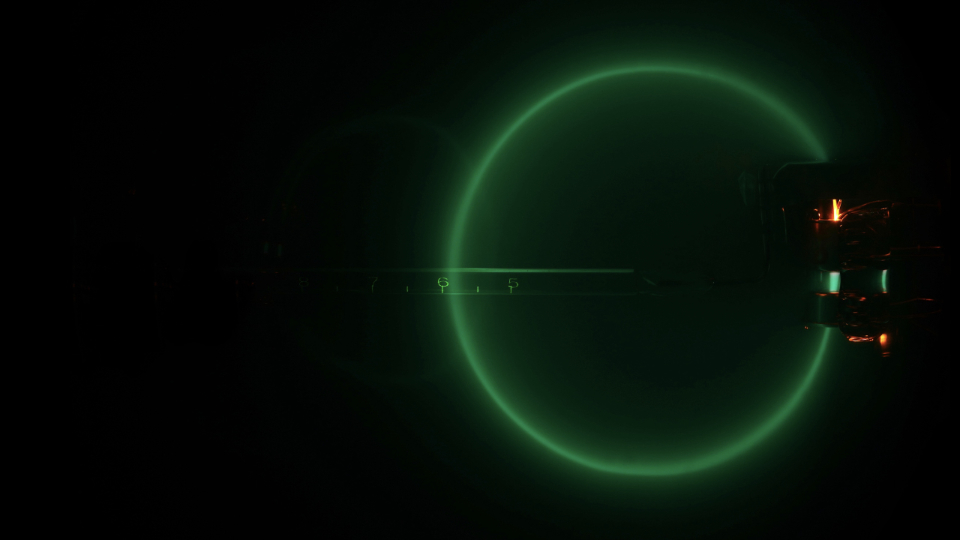
The use of simulations is demonstrated through the example of determining the specific charge (e/m). For this purpose, we have developed an app that realistically simulates the experiment. Using the app, it is possible to determine the specific charge of the electron for various parameters.

Birds of Science

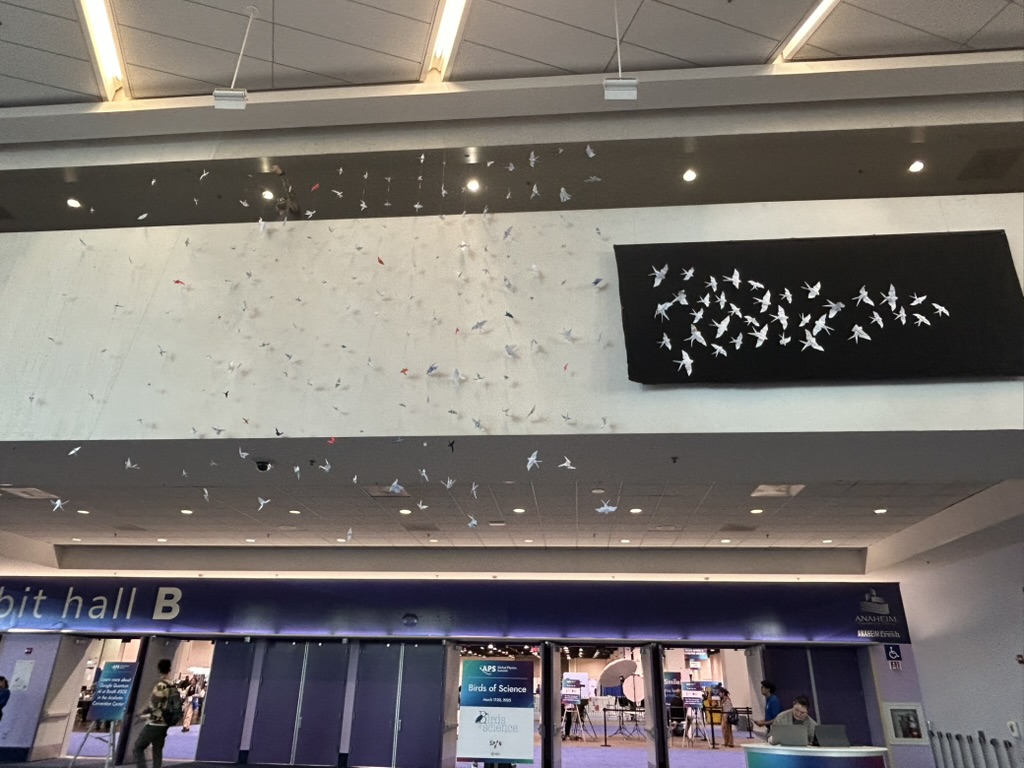
Birds of Science is a collaborative art and science project in which participants craft origami birds from the pages of their scientific writings or their notebooks. These origami birds come together as they are created to form a breathtaking large-scale installation, symbolizing the knowledge, science, and the collective journey of ideas taking flight.

Birds of Science is created and directed by NCCR SPIN.

NCCR SPIN

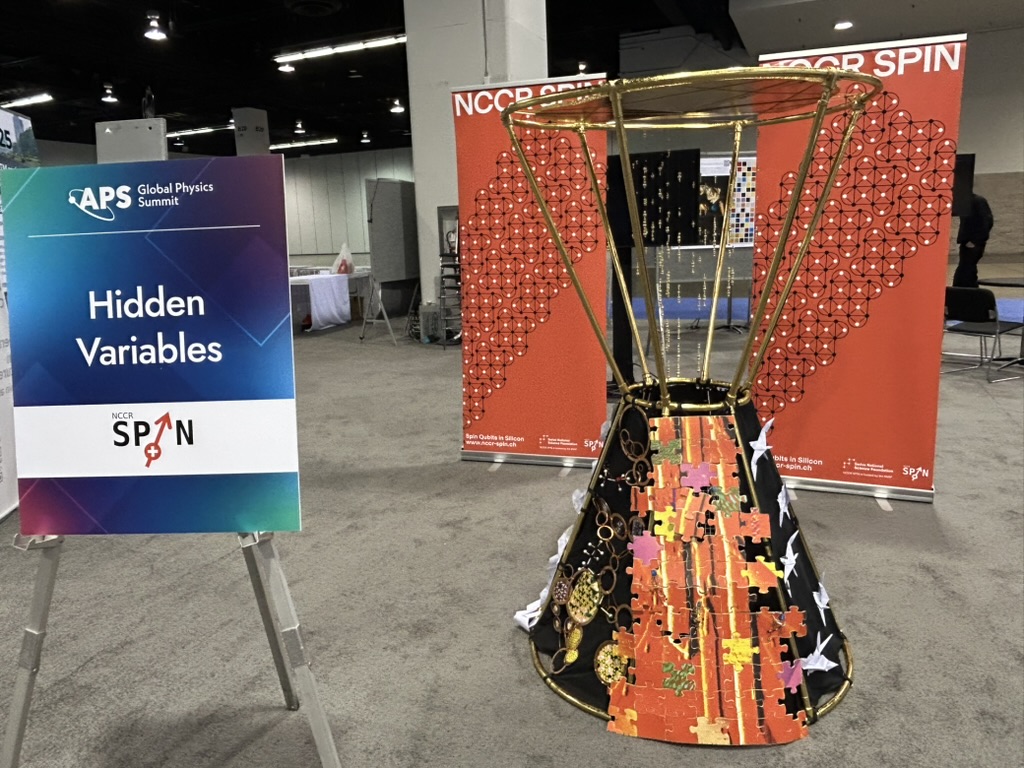
Hidden Variables is a 3D art and science installation co-produced with young researchers at the NCCR SPIN in Switzerland. It was realized using discarded scientific data from theory or experimental equipment and measurements to highlight the important role of failure in the scientific journey.

Hidden Variables

What lies behind a single scientific breakthrough? A journey of trials and errors, ups and downs, successes and failures, and above all, an investment of time. At the intersection between art and science, a team of six dedicated quantum computing scientists comes to show you the hidden beauty within lost data and failed measurements – essential components in the pursuit of even the most subtle scientific insights.

Superposition Composition: Grüße Unscharf

A durational sonic installation by ZKM | Hertzlab

The artwork—an installation featuring a self-playing piano that performs a composition by composer Jia Liu twice daily—makes audible the quantum mechanical principle of superposition. In quantum computing, superposition refers to the ability of quantum bits (qubits) to exist in multiple states simultaneously. Unlike classical bits, which always have a value of either 0 or 1, qubits can assume multiple states at once until their value is determined by measurement.

The composition includes variable elements that take on specific values based on certain probabilities. These values are recalculated for each performance using a quantum computer. Each playback thus represents a measurement, fixing the state of the composition. Only through repeated performances does the final composition emerge as a percentage-based probability pattern—this version will have its world premiere at ZKM | Karlsruhe in December 2025.
The composition will be performed twice daily (11 a.m. and 5 p.m.) on the music balcony of ZKM Karlsruhe from April to December 2025. A complementary data visualization will accompany the installation.

Public Measurements: Daily at 11 a.m. & 5 p.m. until December 2025

Quantum Explorations

Tūhura Otago Museum and Te Whai Ao debut a platform for community engagement with quantum science and technology at ASB Polyfest, the largest Polynesian cultural festival in the world. Look for the big, blue shipping container: Lab in a Box!

Anderson Localisation for the Dunedin Arts Festival

Science, mystery…

Space, time, and history…

Who are they?

Who are you?

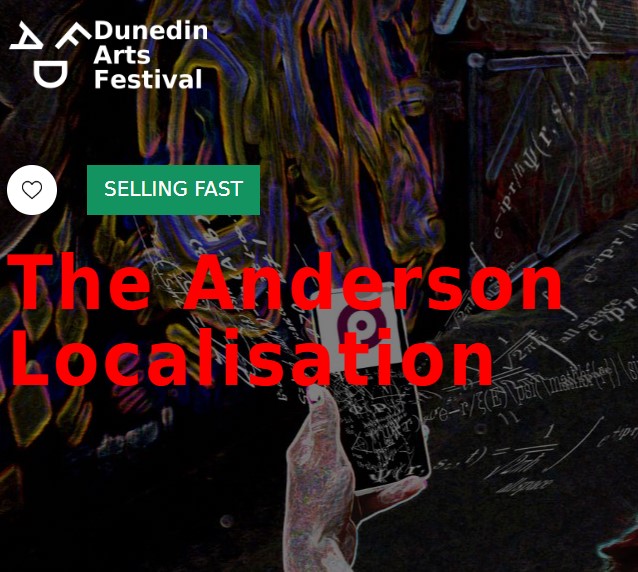
The Anderson Localisation is an immersive theater piece that takes you on a journey into the quantum world where the past, present, and future co-exist. 

Using Pickpath, a cutting-edge interactive app on your phone, you’ll be taken on a unique, audio-driven, individual journey into the quantum world and through one of Ōtepoti’s hidden lane ways. The Anderson Localisation reveals a hidden realm and tells a story of how the tiny atomic world can shape our understanding of life. Created by Martyn Roberts, David O’Donnell, Hilary Halba, Sofia Kalogeropoulou, David Hutchinson, Doug Ditford and Amanda Faye Martin. 

Participants should wear warm clothing and footwear, and bring an umbrella (just in case – this is Dunedin) as some of the experience takes place outside.

Pickpath can be loaded onto your phone via your app store.

Limited places to 10 per performance, so book sooner rather than later.

A Century of Quantum Mechanics: How 100 Years of Quantum Mechanics Changed our Perspective on Reality

Aotearoa New Zealand’s first event to commemorate the International Year of Quantum Science and Technology will be a lecture and panel hosted by the MacDiarmid Institute and supported by Te Whai Ao – Dodd-Walls Centre.

Join us to hear the famous American theoretical physicist Gordon Baym talk about his part in the history of the world’s most successful and mysterious description of reality. Professor Baym is an expert in everything from condensed matter to the physics of elementary particles, and the formation of neutron stars in supernova explosions.

Next, Professor Smitha Vishveshwara will describe how advances in quantum physics have required imaginative leaps, and in turn have inspired creative works.

Finally, our expert panel will debate the development and future of quantum mechanics. Jessa Barder will lead a discussion between Professor Laura Greene, Dr Ratu Mataira, Dr Jacob Ngaha, and others.