
This session delves into quantum simulators on MeluXina’s GPUs, offering participants the opportunity to work on real-world simulations and understand how these tools advance quantum research.



This session delves into quantum simulators on MeluXina’s GPUs, offering participants the opportunity to work on real-world simulations and understand how these tools advance quantum research.
This session covers the fundamentals of Quantum Computing and practical applications. It’s ideal for those looking to understand the current state and future potential of quantum technologies.
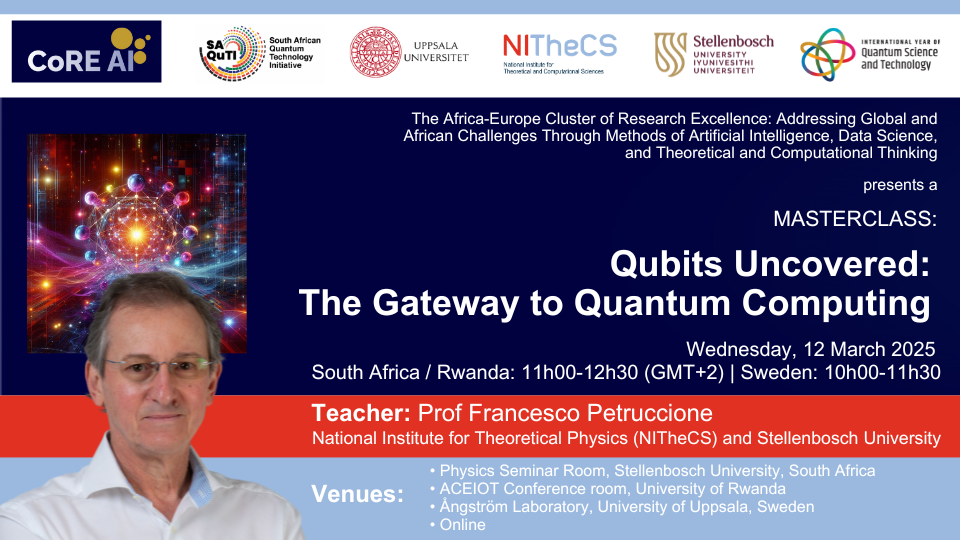
This Masterclass offers an accessible exploration into the world of quantum computing, focusing on the qubit—the fundamental unit of quantum information. In this class, we demystify core quantum concepts such as superposition, interference, and measurement through hands-on demonstrations that can be performed with just one qubit. Designed for a diverse audience including computer scientists, mathematicians, and curious minds alike, the course illustrates how a single qubit can generate true randomness, secure data using quantum cryptography, and even implement simple algorithms. Join us to discover how understanding one qubit opens the door to the revolutionary possibilities of quantum technology.
Francesco Petruccione is a physicist and professor with a career spanning quantum science, computational thinking, and artificial intelligence. After earning his PhD and habilitation from the University of Freiburg, he joined the University of KwaZulu-Natal in South Africa, where he held the South African Research Chair in Quantum Information Processing and served as Pro-Vice-Chancellor for Big Data and Informatics. Now Director of the National Institute for Theoretical and Computational Sciences and a Professor of Quantum Computing at Stellenbosch University, he co-leads the Africa Europe Cluster of Research Excellence in AI and Data Science for global challenges. Prof Petruccione has authored over 250 scientific papers and landmark texts, including ‘The Theory of Open Quantum Systems and Machine Learning with Quantum Computers’. His contributions have earned him accolades such as the Stella d’Italia honour and fellowship in leading academies, reflecting his impact on science and education worldwide.
Course 216 – Frontiers in Medical Physics
Topics:
Magnetic Resonance Imaging
X-Ray imaging
External beam Radiotherapy (RT): status and new perspectives
Innovative instrumentation for external beam radiotherapy
The bleeding edge in AI, imaging, and therapeutic technologies
1 – 6 July 2025
Directors
Cristina Lenardi – Università degli Studi di Milano & INFN Milano (Italy)
Katia Parodi – Ludwig-Maximilian University Munich (Germany)
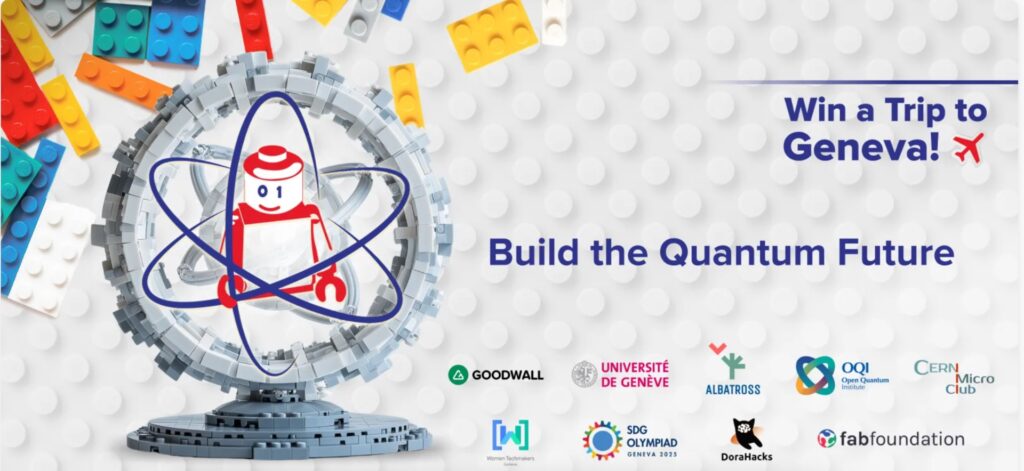
This is a global online competition. Participants submit a 3-minute TikTok-style video pitch on the Swiss youth social network Goodwall. The winner gets a trip to Geneva to participate in the University of Geneva’s SDG Summer School
In the video pitch, participants should imagine how Augmented Reality could transform LEGO bricks into virtual tools for exploring quantum mechanics and explaining quantum concepts like entanglement and superposition that underlie the quantum computing revolution.
Participants should use their imagination and talent to illustrate their ideas visually, too. You don’t need to use an AR headset or do a lot of coding to compete. Just convey your concept clearly and convincingly.
The competition opens on March 3, and closes on March 31.

Edimburgo, jueves 13 de marzo de 2025. El Concurso Poesía Brillante vuelve por segundo año consecutivo, celebrando las abundantes conexiones entre la ciencia y la poesía. Tras el éxito del concurso inaugural, que atrajo 375 inscripciones de 36 países, la edición de 2025 pretende ser aún más ambiciosa, fomentando la exploración creativa de temas cuánticos.
La iniciativa está dirigida por el profesor Sam Illingworth, académico de poesía científica de la Universidad Napier de Edimburgo, y Kylie Ahern, editora de The Brilliant, una plataforma de comunicación científica líder en el mundo, y directora ejecutiva de STEM Matters.
Este año, el concurso se alinea con orgullo con el Año Internacional de la Ciencia y la Tecnología Cuánticas (IYQ 2025), que marca un siglo desde los fundamentos de la mecánica cuántica. Se invita a los poetas a participar en las maravillas de la ciencia cuántica, junto con cualquier otro tema científico que les inspire.
«La mejor poesía, como la mejor ciencia, trata sobre la curiosidad, la observación y la comprensión del mundo de nuevas maneras», dijo el profesor Sam Illingworth. «Poesía (Cuántica) Brillante es un espacio para que los escritores exploren la ciencia con asombro y precisión, creando obras que resuenen en todas las disciplinas».
«Nos sorprendió la profundidad emocional y el ingenio creativo de las obras presentadas el año pasado», dijo Kylie Ahern. «Los vínculos entre las artes y las ciencias son innegables: ambas exigen innovación, imaginación y un profundo compromiso con lo desconocido. Estamos deseando ver cómo los poetas dan vida a la ciencia cuántica y a otros campos a través de la poesía».
El concurso de este año cuenta con un respetado panel de jueces, entre los que se encuentra Diego Golombek, biólogo de renombre internacional, divulgador científico y autor galardonado. Golombek, que lleva mucho tiempo defendiendo la intersección entre la ciencia y la cultura, aporta una perspectiva única a la hora de evaluar trabajos que unen el pensamiento científico con la expresión poética.
La participación en el Concurso Poesía (Cuántica) Brillante es gratuita y está abierta a escritores de todo el mundo.
Europa
Professor Sam Illingworth, Edinburgh Napier University
📞 +44 (0) 7886 238 517
📧 S.Illingworth@napier.ac.uk
EE. UU. /Asia/Australia
Kylie Ahern, STEM Matters
📞 +61 (0) 416 196 942
📧 kylie@stemmatters.com.au
Únase a nosotros para celebrar la fusión de la ciencia y la poesía, donde las palabras se encuentran con el asombro.
This Masterclass offers an accessible exploration into the world of quantum computing, focusing on the qubit—the fundamental unit of quantum information. In this class, we demystify core quantum concepts such as superposition, interference, and measurement through hands-on demonstrations that can be performed with just one qubit. Designed for a diverse audience including computer scientists, mathematicians, and curious minds alike, the course illustrates how a single qubit can generate true randomness, secure data using quantum cryptography, and even implement simple algorithms. Join us to discover how understanding one qubit opens the door to the revolutionary possibilities of quantum technology.

El Instituto Tecnológico Superior de Calkiní (ITESCAM) propone organizar un ciclo de conferencias de dos días, del 3 al 4 de abril de 2025. El título del evento es «Revolución Cuántica: Ciencia, Tecnología y Futuro”. Este evento está diseñado para ser mayoritariamente divulgativo, con el objetivo de hacer accesibles los conceptos de la ciencia y la tecnología cuántica a toda la comunidad, independientemente de su formación en física.
Las actividades incluirán charlas que abordarán temas como la computación cuántica, las aplicaciones médicas de la tecnología cuántica y su impacto en la vida cotidiana, aplicaciones en energías renovables y nanomateriales. Los contenidos se presentarán de manera sencilla y comprensible, utilizando ejemplos prácticos y evitando tecnicismos, para asegurar que todos los asistentes puedan comprender y apreciar la relevancia de estos avances.

Outreach activity of one day, in which high-school students attend a University or Institute to learn about particle physics and analyze real data, ending with an international video conference moderated by scientists at the Pierre Auger Observatory. Integrated with the IPPOG’s International Masterclasses in Particle Physics.
Outreach activity in particle physics, in which high-school students go to a University or Institute to learn about particle physics, analyze real data from the ALTAS Experiment installed in the LHC at CERN, and participate in an international video conference moderated by scientists at CERN. It is integrated in the IPPOG’s International Masterclasses in Particle Physics programme.